The best Shopify SMS marketing apps in 2026 are Postscript for US brands that want a dedicated SMS tool, Klaviyo if your email already runs there, and Attentive for larger brands that want a managed program. Outside the US, look hard at WhatsApp: in markets where customers live on it, WhatFlow usually does the job SMS was meant to do, with images, buttons and replies.
I'm Safwan, co-founder of WhatFlow, a WhatsApp app. So yes, I have a horse in this race. But I'll say up front where SMS is still the right answer, because there's one big case where WhatsApp simply can't compete right now: marketing to US phone numbers.
How we picked
On November 18, 2026 I opened every app's Shopify App Store listing and took ratings, review counts, plans, per-message rates and channels from it. Yotpo's SMS listing says the app isn't currently available on the Shopify App Store, so it's not included. Prices and ratings are as of November 2026 and they change, so check before you buy. WhatFlow is ours; I've included it as the WhatsApp alternative, not as an SMS tool. I haven't benchmarked these apps against each other, so the limitations come from what each listing says.
This is the section I'd read first if you sell outside the US.
When WhatsApp beats SMS
Your customers use WhatsApp every day. In India, Pakistan, the Gulf, Brazil, Indonesia and much of Europe and Latin America, WhatsApp is where people talk to shops. A promotion there sits next to messages from family, not in a folder of one-time codes.
You need more than 160 characters. WhatsApp templates carry product images, video, quick-reply buttons and links. Say you're launching a new kurta colour: one message can show the photo, the price and a "Show me sizes" button.
You want the reply. When a customer answers a WhatsApp campaign, the chat lands in your team inbox and you can sell in the conversation. Most SMS tools here list two-way messaging too, but in my experience, customers in WhatsApp-first markets are far more used to chatting with shops on WhatsApp than over text.
Order messages are part of the plan. Utility templates (order confirmations, shipping updates) are cheap on WhatsApp. As of November 2026, Meta's utility rate is $0.0014 per message in India and $0.0068 in Brazil.
Here's what a WhatsApp campaign template might look like for that kurta launch:
Hi Ayesha, the Eid edit is here 🌙 Our best-selling cotton kurta now comes in sage green, sizes XS to XXL. Tap below to see it, or reply with your size and we'll check stock for you.
The SMS version of the same offer has to squeeze into a line of text and a link:
Eid edit is live: our cotton kurta now in sage green, XS-XXL. Shop: [link] Reply STOP to opt out
Both can work. The difference is what happens next. The WhatsApp customer can reply "Do you have M?" and get an answer from a person in the same thread, while most SMS programs are built around the tap on the link.
One trade-off to plan for: every WhatsApp campaign uses a Meta-approved template, and Meta reviews each one before you can send it. Build templates a few days before a launch, not the morning of.
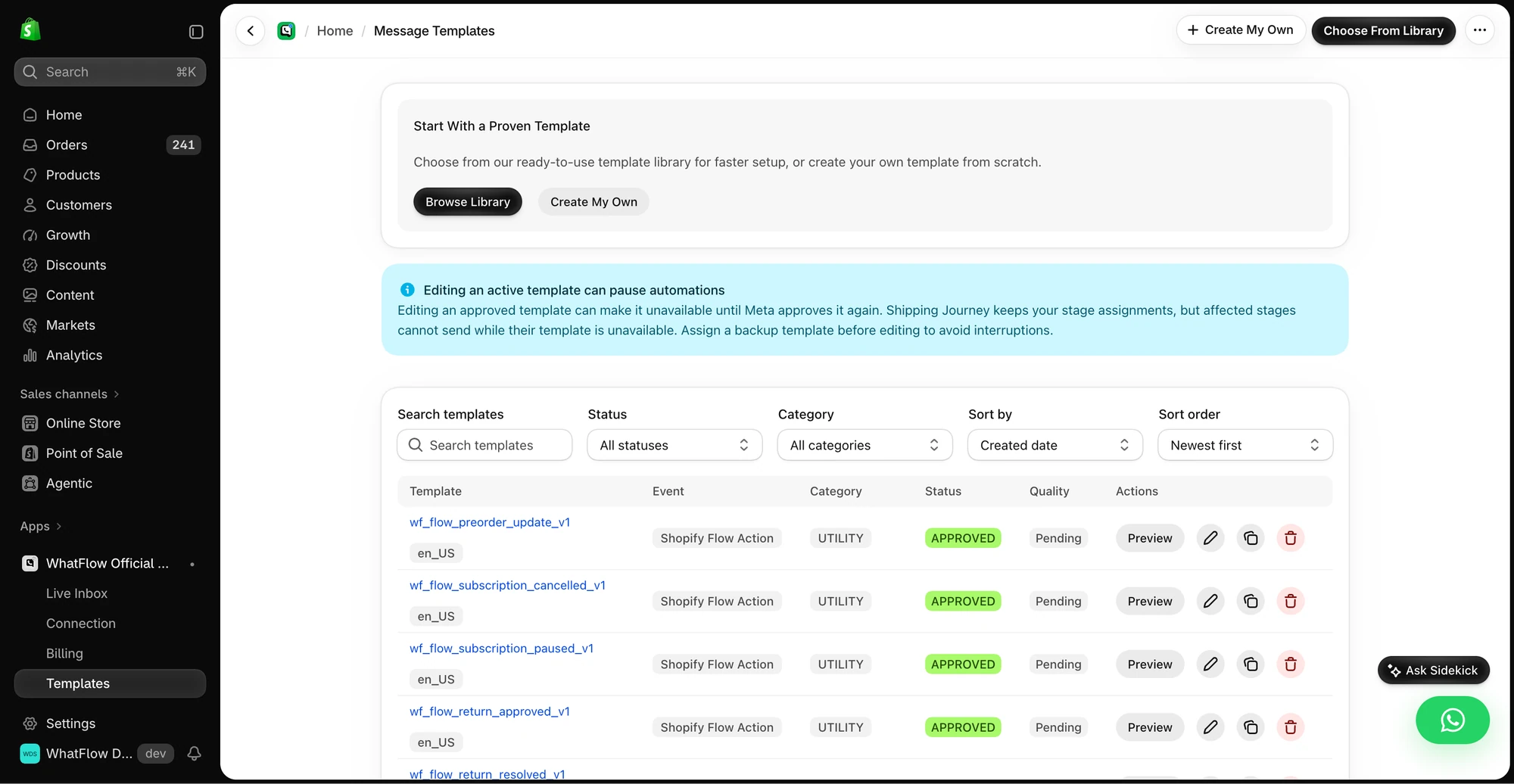
The WhatFlow template manager with category, approval status and preview controls, in a demo store.
When SMS is still right
Marketing to US numbers. Meta's documentation says WhatsApp "does not currently deliver marketing template messages" to users with United States phone numbers (Meta, per-user marketing template limits). That covers promotions. If most of your list is American, you need SMS for campaigns, full stop.
Your audience doesn't use WhatsApp. If your customers barely open WhatsApp, a cheaper-per-message channel they don't read is no bargain.
Per-message cost in some markets. WhatsApp marketing isn't always cheap. As of November 2026, Meta's marketing rate is $0.0118 in India and $0.0411 in Indonesia, but $0.0625 in Brazil, $0.0635 in the UK and $0.1365 in Germany. Postscript's listing quotes $0.007 to $0.009 per SMS plus carrier fees. The SMS listings I checked don't publish international rates, so get a quote for your countries before you compare.
My honest default: run SMS for US promotions, WhatsApp for promotions everywhere WhatsApp is the norm, and let customers pick. Our guide on coordinating email, SMS and WhatsApp messages shows how to stop one customer getting the same offer three times. For a deeper channel comparison, see WhatsApp vs SMS for Shopify.
How to choose a Shopify SMS marketing app
Map your list by country. Pull a customer export and count phone numbers by country code. That one number tells you whether SMS, WhatsApp or both should lead.
Read the billing model. Postscript sets a monthly minimum and charges per message. Klaviyo and Omnisend bundle SMS into plans priced partly by contacts. Attentive bills outside Shopify. Recart starts at $299/month.
Check consent tools. You need opt-in before sending promotions on either channel, and WhatsApp requires you to honour opt-outs (WhatsApp Business Messaging Policy). Look for compliant signup forms and keyword opt-outs.
Decide if you want email in the same tool. Klaviyo, Omnisend, Mailchimp and Shopify Messaging do both. Postscript is SMS-first with email rolling out in phases.
1. WhatFlow WhatsApp Business API
Who it's for: Shopify stores outside the US, or with large non-US audiences, that want WhatsApp campaigns and conversations instead of (or alongside) SMS.
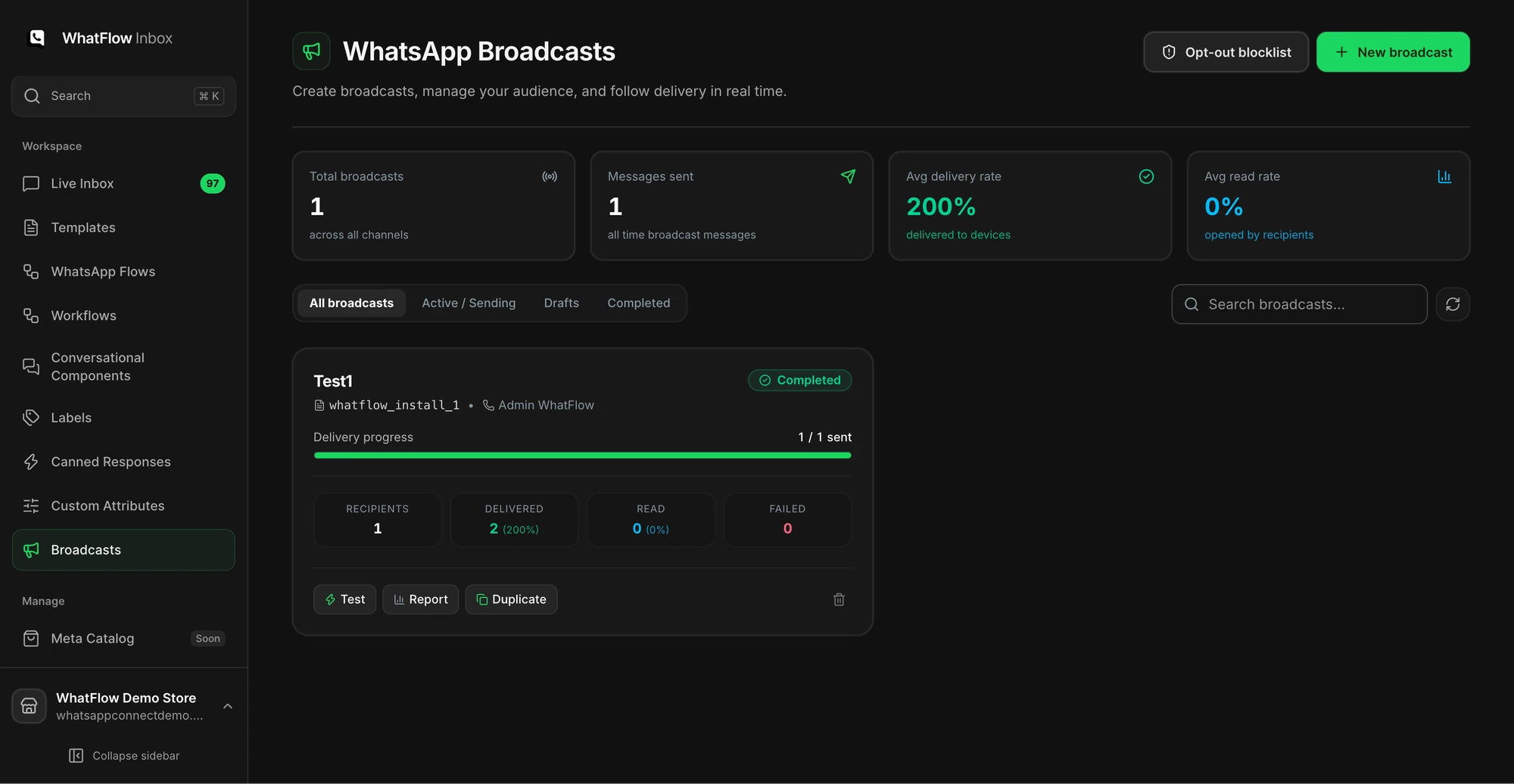
WhatFlow is built on the official Meta WhatsApp Cloud API. You create templates in its template editor, get them approved by Meta, then send broadcasts to customers you select from Shopify or from a CSV or Excel audience you map in. A broadcasts dashboard shows campaign status and delivery. Our guide to running and measuring a WhatsApp broadcast covers the full routine.
The WhatFlow Inbox broadcast dashboard with campaign status and delivery overview, in a demo store with sample data.
The automated side matters as much as campaigns: abandoned checkout recovery, COD confirmation with reply buttons, order and shipping updates, back-in-stock alerts and review requests all run from the same app, and native Shopify Flow triggers and actions let you build your own. When customers reply, chats land in a shared team inbox with no seat fees.
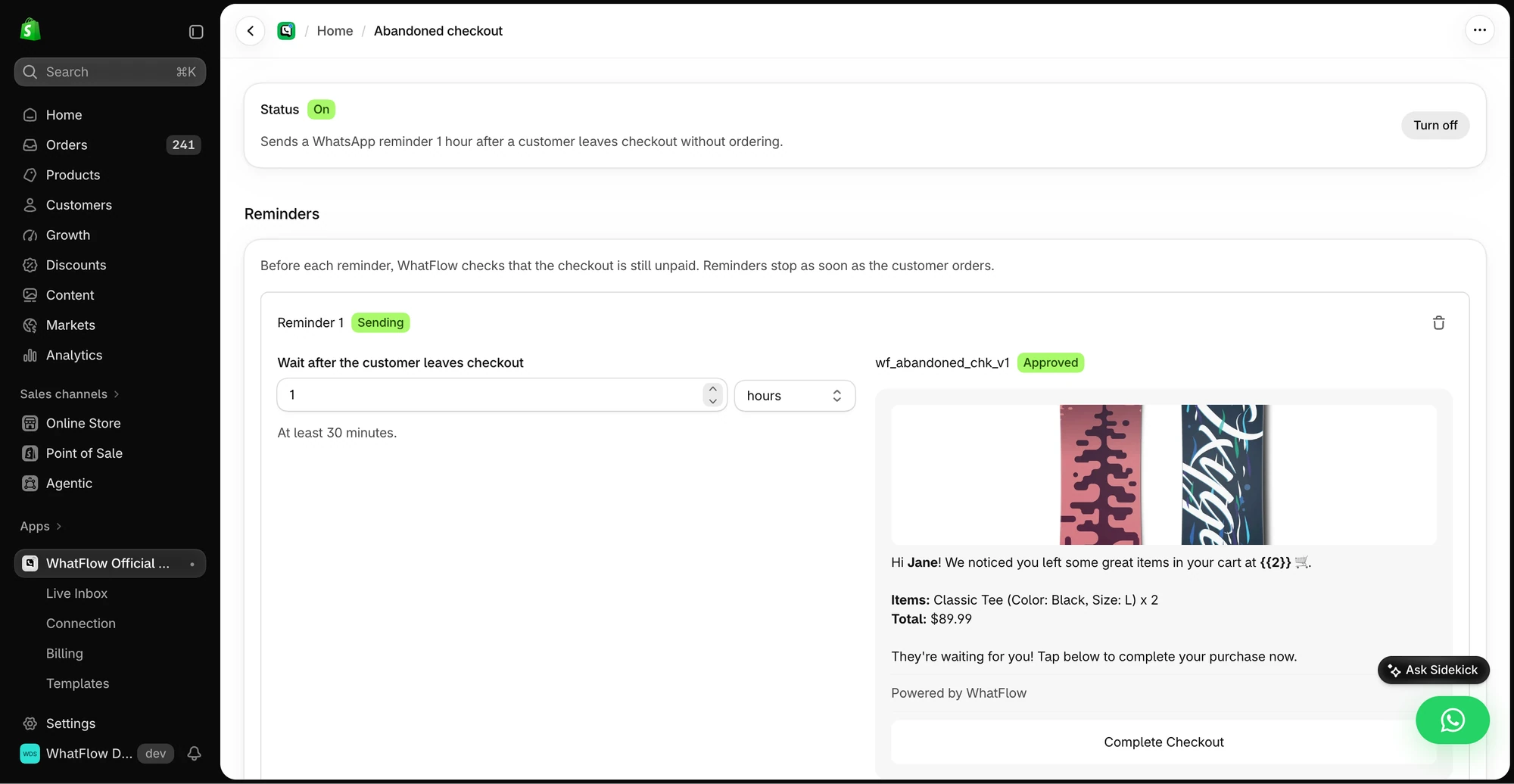
Abandoned checkout reminder delay and example message in WhatFlow, shown in a demo store. Nothing was sent.
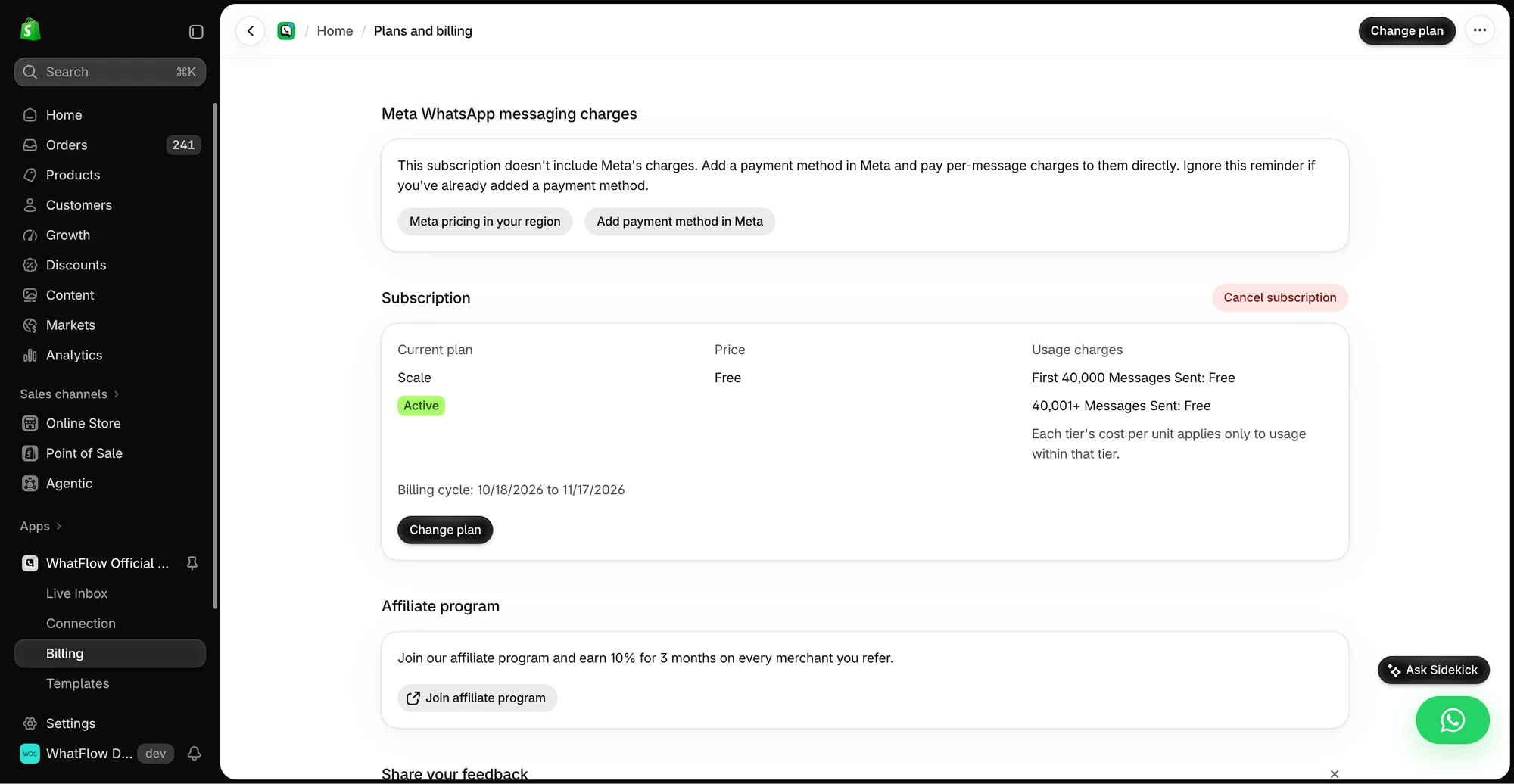
Pricing and rating (as of November 2026): a Free plan with every feature and paid plans from $4.99/month that differ by messaging allowance; see WhatFlow pricing. Meta's per-message charges are billed separately with zero markup.
WhatFlow Billing in a demo store, showing Meta messaging charges separately from the app subscription.
Native Shopify customer-segment sync is coming soon; today you pick customers from Shopify or upload a list. Rated 4.9/5 from 72 ratings when we checked on November 18, 2026.
Honest limitation: WhatFlow doesn't send SMS or email, and because of Meta's US pause it can't deliver marketing templates to US numbers. Compare it with an SMS tool in WhatFlow vs Postscript.
2. Postscript
Who it's for: US brands that want a dedicated, deep SMS program.
Postscript's listing covers campaigns and automations, unlimited segments, a toll-free number, A/B testing, two-way messaging, ROI tracking and flows for cart recovery, welcome, win-back and one-time passwords. It sends SMS and MMS, mentions RCS, and says email is rolling out to brands in phases.
Pricing and rating (as of November 2026): Starter has a $49 monthly minimum spend at $0.009 per SMS and $0.045 per MMS plus carrier fees; Growth is $100/month at $0.008 per SMS; Professional is $500/month at $0.007 per SMS. Each plan includes $100 of credit for the first 30 days, and Growth and Professional list a 30-day trial. Rated 4.7 from 1,206 reviews.
Honest limitation: the listing shows English only and USD billing with no international rates, so it fits US-centred programs best.
3. Klaviyo
Who it's for: stores that want email and SMS on one customer profile, with WhatsApp available too.
Klaviyo's listing describes real-time data from Shopify and 350+ apps, a Composer for cross-channel campaigns, AI-built segments and flow triggers, a Customer Hub and guided setup for forms, a welcome email and an abandoned-checkout flow. Channels include email, SMS and MMS (including transactional SMS and two-way messaging), WhatsApp and mobile push.
Pricing and rating (as of November 2026): a Free plan with 250 active profiles and 500 emails a month; an SMS plan at $15/month with 1,250 SMS/MMS credits including carrier fees; an Email plan from $20/month. Rated 4.7 from 3,450 reviews.
Honest limitation: costs rise with your list size and channel mix, so price out next year's list, not today's. See WhatFlow vs Klaviyo for the WhatsApp side.
4. Attentive
Who it's for: larger brands that want a managed SMS and email program with compliance support.
Attentive lists two-tap signup units for list growth, delivery optimisation, identity data for segmentation and lifecycle messaging, plus in-house TCPA experts and templates. Channels are SMS, email, push and RCS.
Pricing and rating (as of November 2026): free to install, with at least a 30-day free trial, then month-to-month or longer agreements; Attentive bills external charges outside Shopify. Rated 4.7 from 112 reviews.
Honest limitation: the listing doesn't publish prices, so you'll need a sales conversation to know what you'll pay. See WhatFlow vs Attentive.
5. Omnisend
Who it's for: small and mid-size stores that want affordable email with SMS added.
Omnisend covers email campaigns and templates, popups and signup forms, automations for abandoned cart, welcome and post-purchase, AI segmentation and recommendations, web push, and an MCP connection for ChatGPT or Claude. Support is 24/7, including on Free.
Pricing and rating (as of November 2026): Free for up to 250 contacts and 500 emails a month; Standard from $16/month; Pro from $59/month with SMS starting at $0.007 per message. Rated 4.7 from 3,219 reviews.
Honest limitation: SMS pricing is only shown on Pro, and the listing doesn't mention WhatsApp. More in WhatFlow vs Omnisend.
6. Shopify Messaging
Who it's for: stores that want to start with campaigns inside Shopify before paying for a specialist tool.
Shopify Messaging lets you send email, SMS and WhatsApp campaigns from Shopify, with templates, segmentation, automations such as abandoned cart and welcome series, Sidekick help for branded emails, and results tracking. It works with Shopify Flow.
Pricing and rating (as of November 2026): free to install; the first 10,000 emails each month are free, then from $1 per 1,000 emails. The listing doesn't show SMS or WhatsApp per-message pricing. Rated 4.8 from 4,873 reviews.
Honest limitation: SMS and WhatsApp pricing aren't on the listing, so check costs in Shopify before a big send. Our WhatFlow vs Shopify Messaging page explains where a dedicated WhatsApp app adds more.
7. Mailchimp
Who it's for: email-first stores that want to add SMS later.
Mailchimp's listing covers automated welcome, abandoned cart and back-in-stock emails, Shopify segment sync, single-use discount codes, SMS discounts, pop-up forms and revenue attribution in Shopify.
Pricing and rating (as of November 2026): Free; Essentials from $13/month; Standard from $20/month; Premium from $350/month, priced by contacts. SMS is an add-on. Rated 4.8 from 1,590 reviews.
Honest limitation: the listing doesn't show SMS pricing or which countries SMS covers. See WhatFlow vs Mailchimp.
8. Recart
Who it's for: brands that want someone else to run their SMS program.
Recart describes fully managed SMS with AI text campaigns, popups with direct-to-text capture, automations for welcome, abandoned cart and reorders, compliance, analytics and 7-day-click attribution. The Starter plan includes international texting and 1:1 strategy support.
Pricing and rating (as of November 2026): a free option for migration and onboarding; Starter at $299/month with a 7-day trial. Rated 4.7 from 489 reviews.
Honest limitation: $299/month is a big entry point for a small store, and usage rates aren't listed. See WhatFlow vs Recart.
Which should you choose?
US list, serious SMS program: Postscript, or Attentive if you want it managed.
Already on Klaviyo for email: add Klaviyo SMS first; it's the lowest-friction step.
Small budget, email plus a little SMS: Omnisend or Shopify Messaging.
Most customers outside the US: WhatFlow for WhatsApp campaigns, order messages and the conversations they start.
Mixed list: SMS for US numbers, WhatsApp for the rest. It's more work, but each customer gets the channel they actually read.
Free plan available. Templates, COD confirmation, Shopify Flow automations and a shared team inbox with no seat fees. Every feature is included on every plan, including Free.
For US brands that want a dedicated SMS tool, Postscript is the most focused option, and Klaviyo is the easiest pick if you already send email there. Attentive suits larger brands that want a managed, contract-style program.
Can I send WhatsApp marketing messages to US customers?
Not right now. As of November 2026, Meta's documentation says WhatsApp does not currently deliver marketing template messages to users with United States phone numbers, so SMS is still the channel for US promotions.
Is WhatsApp cheaper than SMS for Shopify marketing?
It depends on the country. Meta's marketing rate is $0.0118 per message in India but $0.0625 in Brazil and $0.1365 in Germany as of November 2026, so compare it with the SMS quote you get for each market rather than assuming one is always cheaper.
Do I need consent to send SMS or WhatsApp marketing?
Yes. Both channels need opt-in before you send promotions, and WhatsApp's Business Messaging Policy also requires you to honour opt-outs. Rules differ by country, so check the law where your customers live.
Can one Shopify app send SMS and WhatsApp?
Yes. As of November 2026, Klaviyo and Shopify Messaging both list email, SMS and WhatsApp on their Shopify App Store pages. WhatFlow is WhatsApp only but covers the conversation, order messages and team inbox in depth.