The best back-in-stock app for most Shopify stores depends on the channel. For email, Appikon and CWILL are the most reviewed picks, and Stok adds SMS, WhatsApp and push on paid plans. For WhatsApp restock alerts, WhatFlow includes a product-page request button, a request queue and alerts that link to the exact variant on its Free plan. For free web push, Brevo PushOwl has back-in-stock reminders on its free plan.
How we picked these back-in-stock apps
I'm Safwan, co-founder of WhatFlow. We make a WhatsApp app, and WhatFlow sends back-in-stock alerts on WhatsApp, so it's first wherever WhatsApp is the channel you want. It isn't an email tool, and I've said so plainly in its section.
For the other nine apps I opened each Shopify App Store listing on November 18, 2026 and recorded the rating, review count, plans and channels exactly as listed. I left out apps with only a couple of reviews. Prices here change often, so treat them as "as of November 2026".
A back-in-stock alert is a message sent to shoppers who asked to be told when a sold-out product or variant is available again. Shoppers usually sign up with a "Notify me" button on the product page.
Which channel will shoppers actually see? Email is cheap and universal. WhatsApp lands where many shoppers check all day and lets them reply. SMS sits in between. Web push only reaches shoppers who allowed notifications in that browser. Our take on the main trade-off is in WhatsApp vs email back-in-stock alerts.
Variant-level, not just product-level. A shopper who wanted medium olive doesn't want an alert because large black came back.
How does the free plan cap you? Ten or 20 emails a month is a trial, not a plan. Check the cap against a typical restock.
What does each message cost? Email is usually included up to a limit. SMS and WhatsApp are often charged per message on top.
Does it collect the right consent? An email sign-up isn't WhatsApp consent. If you'll message on WhatsApp, the form has to say so. Collecting WhatsApp opt-ins on Shopify covers the wording.
Preorders too? Several apps here bundle preorders and waitlists, which saves you a second app.
1. WhatFlow WhatsApp Business API
Who it's for: Stores whose shoppers live on WhatsApp and want restock alerts there, without bolting on another app.
Standout features:
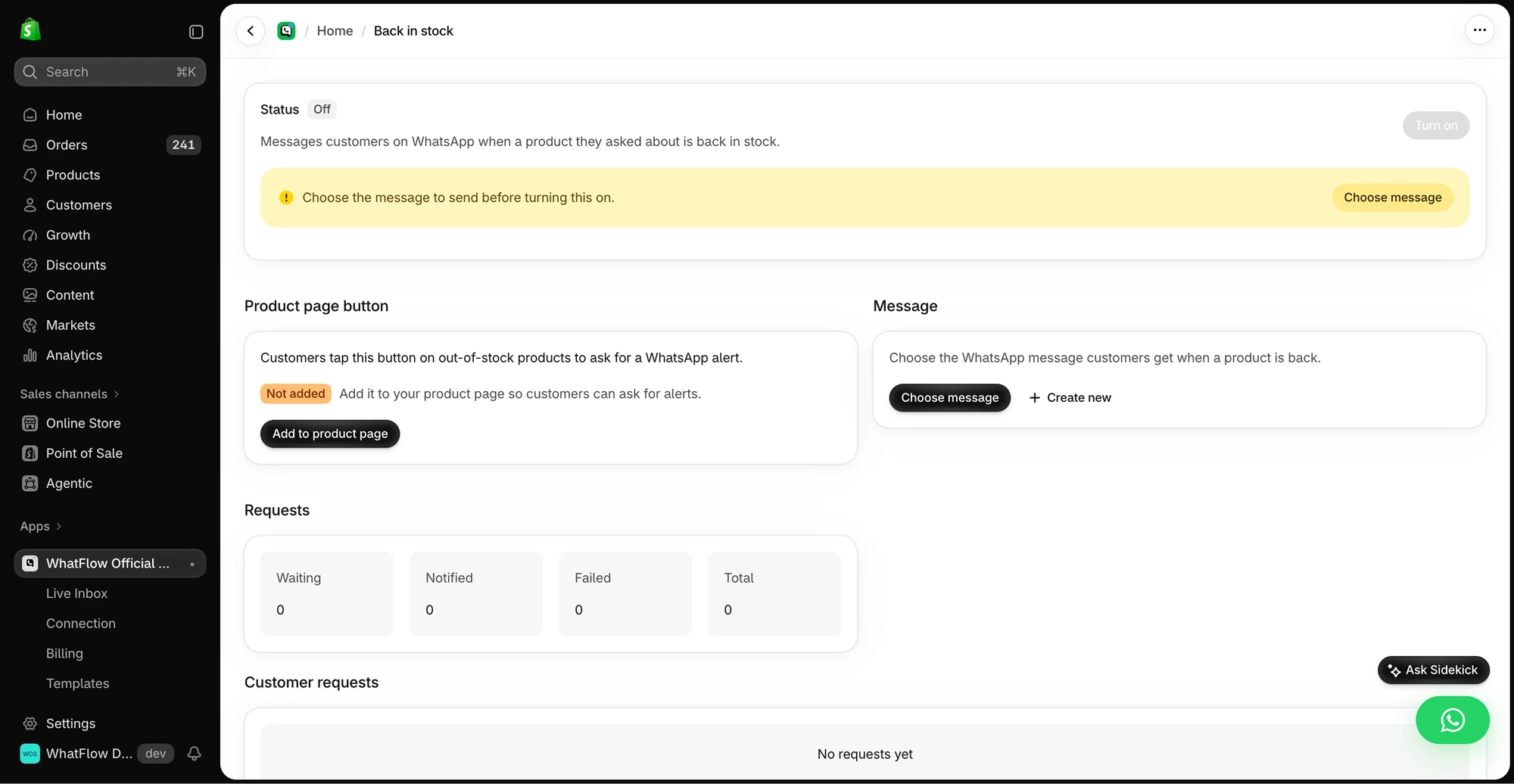
A back-in-stock button on the product page that lets shoppers ask for a WhatsApp alert when a sold-out variant returns.
A request queue so you can see who's waiting for what.
Alerts sent with an approved WhatsApp template that you choose, linking back to the exact product or variant the shopper asked for.
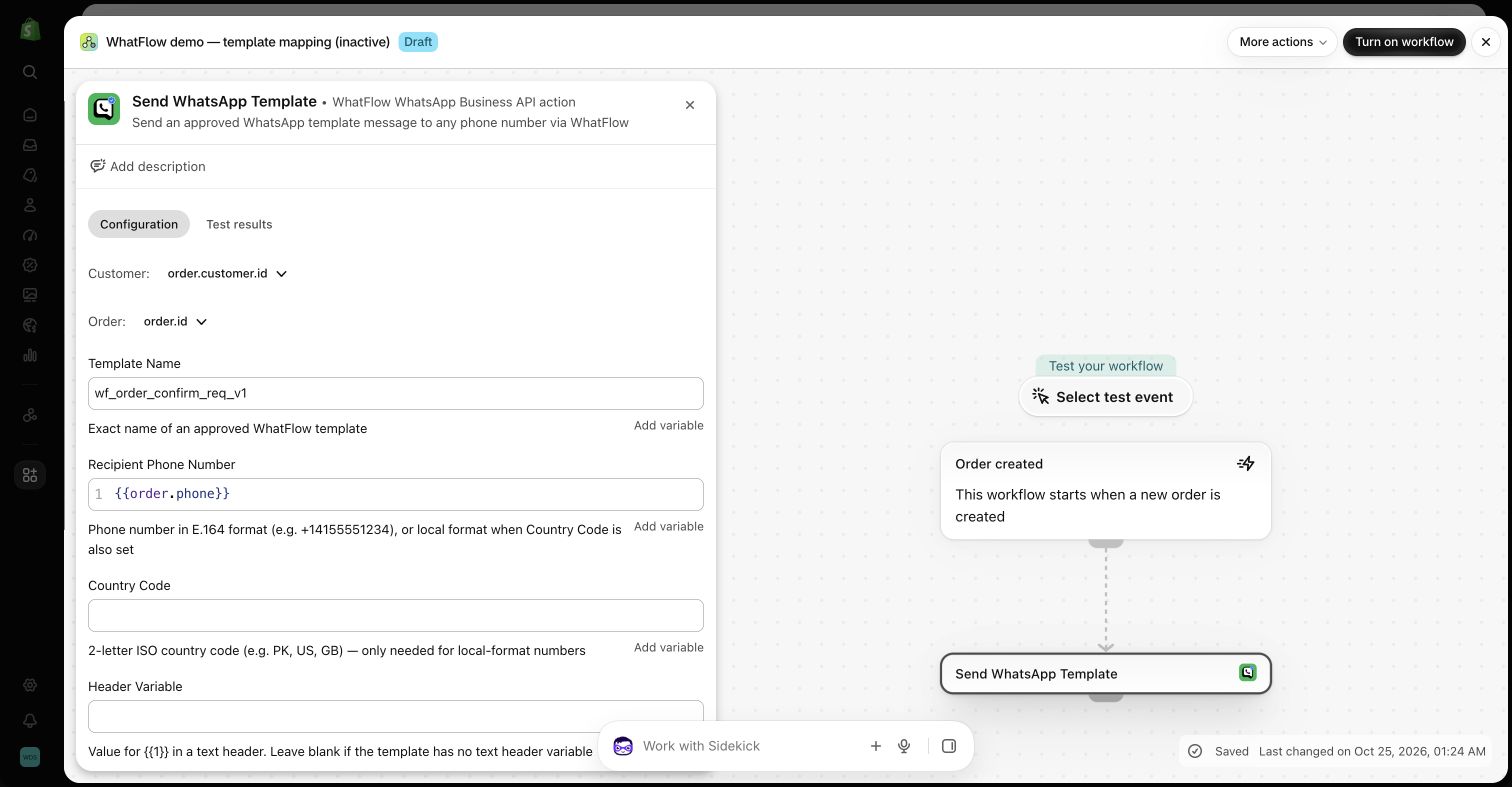
Native Shopify Flow actions, if you'd rather drive alerts from Flow's back-in-stock trigger and customer tags (send WhatsApp templates from Shopify Flow shows the action).
Replies land in a shared team inbox with no seat fees, so "Does it run small?" gets answered before the size sells out again.
The back-in-stock button, request queue and message setup in the WhatFlow demo store. Nothing was sent.
A restock alert that gets clicks:
Hi Maya, good news: the Oat Linen Shirt in M is back in stock. We've only got a few. Tap below to grab yours before they go again.
Pricing and rating (as of November 2026): Back-in-stock is included on every plan, including Free, with paid plans from $4.99 a month (WhatFlow pricing). Meta charges per delivered template, billed separately with no markup. Rated 4.9/5 from 72 ratings (checked November 18, 2026).
Honest limitation: WhatFlow sends restock alerts on WhatsApp only. If you also want email alerts for shoppers who don't use WhatsApp, run an email app such as Appikon or Stok alongside it.
Who it's for: Stores that want a long-established email and SMS restock app with integrations.
Standout features: Automatic back-in-stock and back-order notifications by email and SMS, customizable sign-up forms, waitlists, demand analytics, and Klaviyo and Mailchimp integration from Starter. Collection-page integration on Pro and a countdown timer on Premium.
Pricing and rating (as of November 2026): Free (10 emails a month); Starter $19.99 a month (300 emails), Pro $29.99 (1,000) and Premium $49.99 (3,000), each with a 7-day trial. SMS costs $0.05 to $0.40 per message depending on length. Rated 4.8 from 1,457 reviews.
Honest limitation: The free plan's 10 emails a month won't cover a single decent restock, and WhatsApp isn't listed.
3. Back in Stock, Notify Me: Stok
Who it's for: Budget-conscious stores that want email, SMS, WhatsApp and push alerts plus preorders in one app.
Standout features: Back-in-stock, price-drop and sale alerts, scheduled resends, product and collection widgets, preorders with deposits and partial payments, templates in 27 languages, and demand and inventory reports. Built for Shopify badge.
Pricing and rating (as of November 2026): Free (20 emails a month); Plus $10, Pro $20 and Business $49.99, each with a 7-day trial and launch discounts listed for 2026. SMS and WhatsApp cost from $0.02 per message on paid plans. Rated 4.9 from 122 reviews.
Honest limitation: SMS and WhatsApp are per-message add-ons, so a big restock to a long waitlist costs more than the plan price suggests.
4. CWILL Back in Stock Notify Me!
Who it's for: Small stores that want simple email alerts at a low monthly price.
Standout features: Automatic email notifications, a back-in-stock button and pop-up on product and collection pages, minimum stock thresholds, per-location inventory alerts, and auto-translation into several languages on Pro.
Pricing and rating (as of November 2026): Free (10 notifications a month); Essential $9.90 (50) and Pro $29 (3,000, with SMS billed by region), with a 14-day trial. Rated 4.8 from 628 reviews.
Honest limitation: SMS is Pro-only and WhatsApp isn't listed.
5. Swym Back in Stock Alerts
Who it's for: Larger catalogs that want restock lists feeding an email or SMS platform such as Klaviyo or Omnisend.
Standout features: A Notify Me button, pre-order and restock lists, "Coming soon" alerts, AI in-stock recommendations for out-of-stock products, batch sending, multi-location support and a REST API on Premium.
Pricing and rating (as of November 2026): Starter $19.99 a month (up to 1,000 alert requests), Pro $59.99 and Premium $99.99, each with a 30-day trial. Rated 4.5 from 444 reviews.
Honest limitation: There's no free plan, and several of the most recent reviews (October and November 2026) report the app failing to load in Shopify admin. Read the latest reviews before you install.
6. Back in Stock Alert & Preorder (Crawlapps)
Who it's for: Stores that want restock alerts and preorders with deposits from one newer app.
Standout features: A Notify Me waitlist, automatic restock alerts and reminders, preorders with deposits and automatic balance collection, a low-stock counter, and Klaviyo and PushOwl integrations. Built for Shopify badge.
Pricing and rating (as of November 2026): Free (100 email restock alerts a month); Starter $9.99 (adds SMS and WhatsApp), Standard $19.99 and Pro $39.99, each with a 5-day trial. SMS and WhatsApp prices depend on country. Rated 5.0 from 40 reviews.
Honest limitation: It launched in July 2025, so 40 reviews is a short track record next to Appikon or CWILL.
7. Brevo PushOwl: Email, Push, SMS
Who it's for: Stores that want free restock reminders by web push alongside basic email marketing.
Standout features: Back in Stock reminders and price-drop alerts on the free Basic Bundle, plus newsletters and pop-ups; cart recovery, SMS and shipping updates on paid bundles.
Pricing and rating (as of November 2026): Basic Bundle free (500 web push a month); Plus $19 a month and Power $79. Rated 4.8 from 2,321 reviews.
Honest limitation: Web push reaches only shoppers who allowed notifications in their browser, which is a smaller group than your email or WhatsApp list. See WhatFlow vs PushOwl.
8. Klaviyo: Email Marketing & SMS
Who it's for: Stores already running their email marketing in Klaviyo.
Standout features: Back-in-stock emails as a campaign type, alongside email, SMS, WhatsApp and mobile push marketing, segmentation and pop-ups.
Pricing and rating (as of November 2026): Free up to 250 active profiles and 500 emails a month; Email from $20 a month; SMS from $15. Rated 4.7 from 3,450 reviews.
Honest limitation: The listing names back-in-stock emails, not SMS or WhatsApp restock alerts. See WhatFlow vs Klaviyo.
9. Kanal: WhatsApp Marketing & AI
Who it's for: Brands that want WhatsApp restock alerts as one flow inside a full WhatsApp marketing suite.
Standout features: Visual WhatsApp flows for back-in-stock alerts, abandoned carts, welcome messages and post-purchase upsells on the official API, plus an AI agent and SMS, iMessage and RCS on Scale.
Pricing and rating (as of November 2026): Free plan listed; Pro $89 a month; Scale $149. Rated 5.0 from 144 reviews.
Honest limitation: It's priced as a marketing suite, so $89 a month is a lot if restock alerts are all you need. See WhatFlow vs Kanal.
10. DelightChat (DC: WhatsApp Marketing + API)
Who it's for: Teams already using DelightChat as their WhatsApp helpdesk.
Standout features: Optional back-in-stock alerts on top of an omnichannel inbox, cart recovery, COD flows and broadcasts.
Pricing and rating (as of November 2026): Back-in-stock is a $20-a-month add-on on Scale ($99) and $30 on Growth ($299). Rated 4.9 from 223 reviews.
Honest limitation: It isn't available on the $29 Startup plan, so restock alerts start at $119 a month. See WhatFlow vs DelightChat.
Which back-in-stock app should you choose?
Small store, mostly email: CWILL or Stok on a paid tier. Their free plans are fine for testing.
Established store with Klaviyo: Swym or Appikon feeding Klaviyo, or Klaviyo's own back-in-stock emails.
Fashion, beauty or drops where WhatsApp is how customers talk to you: WhatFlow for WhatsApp alerts, with replies landing in the same inbox your team already works.
You want every channel and preorders in one app: Stok or Back in Stock Alert & Preorder.
Free and nothing else: PushOwl's web push reminders, accepting the smaller reach.
Plenty of stores run two: an email app for everyone, and WhatsApp for shoppers who opted in to WhatsApp. That's the setup I'd use for a fashion brand where sizes sell out in a day.
Write the restock alert before you need it
Whichever app you choose, the message does the selling. A few rules I'd stick to:
Name the exact variant. "Your size M is back" beats "Good news, it's back!"
One link, straight to that variant. Not the homepage, not the collection.
Be honest about stock. If you got 12 units back, say "a small restock". Don't invent scarcity.
Send once. A shopper who asked for one alert wants one alert, not a sequence.
Let them reply. On WhatsApp the best restock alerts start a conversation.
A second example, for a store where the restock is a pre-announced drop:
Hi Daniel, the Trail Runner 2 in UK 9 is back from 10am today. You asked us to tell you first, so here's the link before we post it anywhere else.
If a product is brand new rather than restocked, the same mechanics work as a launch waitlist; our product launch waitlist on WhatsApp guide covers that version. And if you'd rather trigger alerts from inventory changes yourself, WhatFlow's Shopify Flow integration lets you send the template from any Flow trigger.
What WhatsApp restock alerts cost
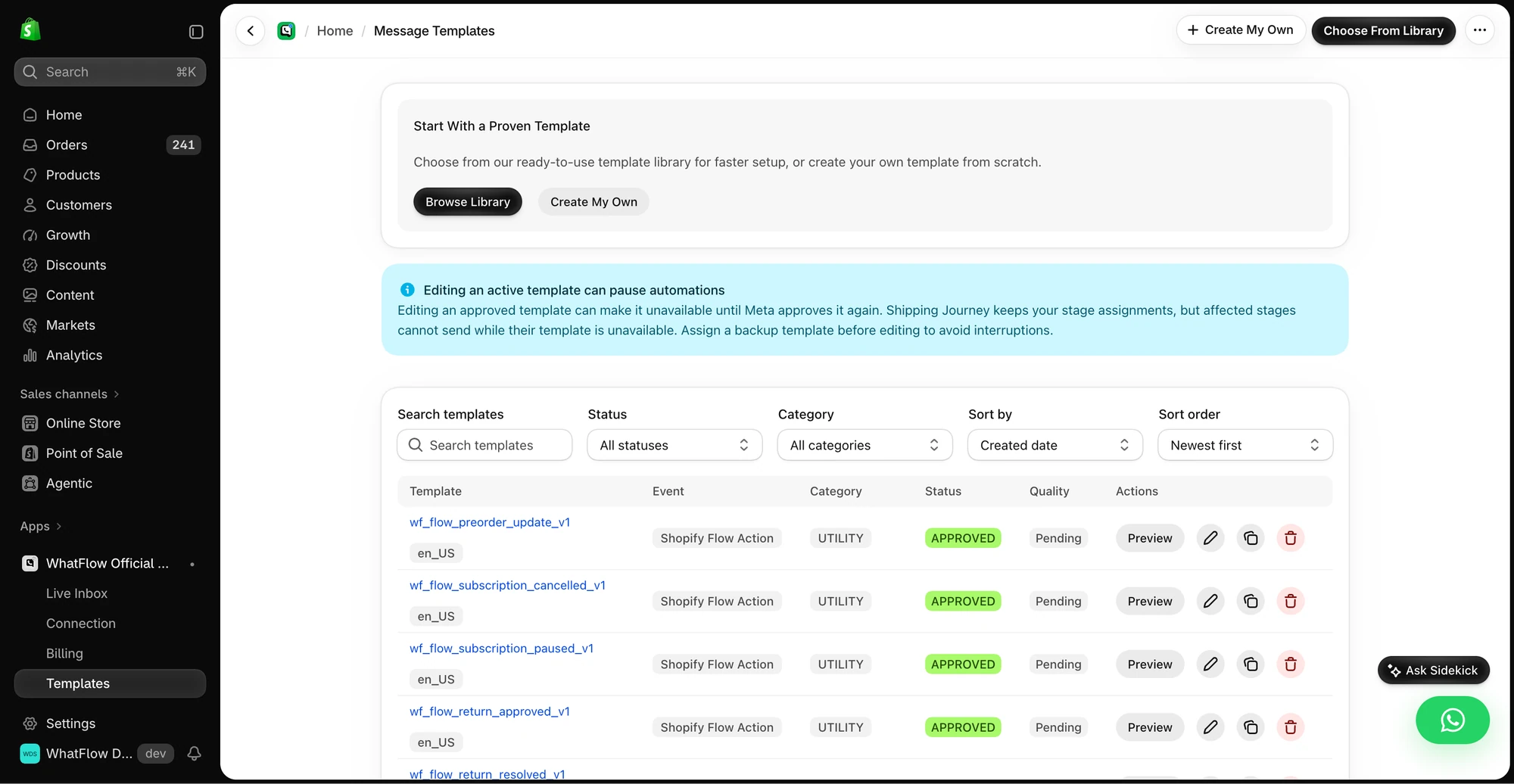
Meta decides a template's category, and a restock alert promotes a product, so expect it to be treated as marketing in many cases. Our marketing vs utility templates explainer has the detail.
The WhatFlow template manager showing category and approval status, demo store.
As of November 2026, Meta charges $0.0118 per delivered marketing template to India, $0.025 to North America, $0.0576 to Saudi Arabia and $0.0635 to the UK (Meta's pricing). Say 400 shoppers in India are waiting on a restocked kurta. The whole alert costs about $4.72 in Meta charges, which one sale covers several times over.
Keep the request focused on the product the shopper asked for. If you also want to send them broader offers, ask for that permission separately. If you'd rather build alerts in Shopify Flow, our back-in-stock alerts on WhatsApp guide walks through the Flow route with customer tags.
WhatFlow's Send WhatsApp Template action in a demo Shopify Flow workflow. Nothing was sent.
Run WhatsApp for your Shopify store with WhatFlow
Free plan available. Templates, COD confirmation, Shopify Flow automations and a shared team inbox with no seat fees. Every feature is included on every plan, including Free.
Pick the channel first, then the app. Email apps like Appikon, Stok and CWILL are cheap and reach everyone. If your customers live on WhatsApp, WhatFlow adds a restock button, a request queue and variant-level WhatsApp alerts on its Free plan, and the replies land in your team inbox.
For email alerts, Appikon (1,457 reviews) and CWILL (628) are the most reviewed picks in this list as of November 2026, while Stok and Back in Stock Alert & Preorder add SMS and WhatsApp on paid plans. For WhatsApp restock alerts with a product-page button and request queue, WhatFlow includes them on its Free plan.
Can Shopify send back-in-stock alerts without an app?
Shopify Flow has a Product variant back in stock trigger, but you still need a way to collect sign-ups and an app to send the message. WhatFlow's send-template action in Flow can send the WhatsApp alert to customers you've tagged.
Are WhatsApp back-in-stock alerts better than email?
WhatsApp alerts land in the chat app many shoppers check all day, and a shopper can reply with a question straight away. Email is cheaper per alert and reaches people without WhatsApp, so many stores offer both.
How much does a WhatsApp back-in-stock alert cost?
A restock alert promotes a product, so Meta often treats it as a marketing template. As of November 2026, Meta charges $0.0118 per delivered marketing template to India, $0.025 to North America and $0.0635 to the UK, on top of your app's plan.