
Publisher disclosure: this comparison is written by WhatFlow. Competitor capabilities are based on the linked public documentation; the WhatFlow screenshots come from our demo store. Examples are illustrative, and results depend on your store and configuration.
WhatFlow and DelightChat at a glance
| Consideration | WhatFlow | DelightChat |
|---|---|---|
| What the product is built around | WhatsApp for Shopify on the official Meta Cloud API: admin extensions, Shopify Flow triggers and actions, COD confirmation, catalog sharing and an enterprise-ready team inbox. | Shopify WhatsApp marketing and support: broadcasts, cart recovery, COD verification, order updates, catalog, chatbot and Shopify Flow integration. |
| Pricing and billing units | Free plan; paid plans from $4.99/month by messages sent. Meta fees separate. | Startup $29, Scale $99, Growth $299 per month, each with a marketing-contact allowance; Meta fees passed through without markup (as of November 2026). |
| Feature access | Every feature on every plan, including Free. | Core WhatsApp features on all paid plans; back-in-stock alerts are a paid add-on (+$10 to +$30/month by plan). |
| Team access | No seat fees at any team size. | 5 team members on Startup, 20 on Scale, 50 on Growth; unlimited team members aren't included on these plans. |
| Storefront entry point | Free-forever WhatsApp buttons that match your Shopify theme. | Check which storefront widget your DelightChat plan includes. |
| Free plan | Yes, with every feature and the first 100 messages. | Plans start at $29/month. |
| Shopify App Store rating | 5.0 out of 5 from 55 ratings (November 5, 2026). | 4.9 out of 5 from 223 reviews (November 5, 2026). |
For most Shopify stores, WhatFlow is better value than DelightChat. WhatFlow is an official Meta Cloud API app with every feature on every plan, a team inbox with no seat fees at any size, and pricing that follows messages sent, starting free. DelightChat is a well-rated app with a similar Shopify feature set, but its plans start at $29/month and tie both team size and marketing contacts to the tier you buy.
One misconception worth clearing up: WhatFlow isn't an unofficial-API tool for small shops. WhatFlow WhatsApp Business API runs on the official Meta Cloud API and is enterprise-ready, with inbox assignment and filters, no seat fees at any team size, Shopify Flow automation, COD confirmation, catalog sharing and Shopify admin extensions. And it's still the easiest start for a new store. Our linked-device Chat Automation app is a separate, older entry-level product.
WhatFlow vs DelightChat at a glance
WhatFlow | DelightChat | |
|---|---|---|
Free plan | Yes, every feature | No, from $29/month |
Team members | No seat fees at any size | 5 / 20 / 50 by plan |
Pricing unit | Messages sent | Plan + marketing contacts |
COD, cart recovery, catalog | Every plan | Every plan |
Shopify Flow | Native triggers and actions | Integration included |
Shopify App Store rating | 5.0/5 from 55 ratings | 4.9/5 from 223 reviews |
DelightChat details are from its pricing page and both ratings from the Shopify App Store, all checked November 5, 2026.
Credit where it's due: DelightChat passes Meta's message fees through without markup and includes a lot on every plan. The difference is in how the price grows.
How much does DelightChat cost as your team grows?
As of November 2026, DelightChat lists:
- Startup, $29/month: 5 team members, 2,500 marketing contacts a month ($10 per extra 1,000).
- Scale, $99/month: 20 team members, 10,000 marketing contacts ($5 per extra 1,000).
- Growth, $299/month: 50 team members, 30,000 marketing contacts ($3 per extra 1,000).
Now a store with 10 people answering WhatsApp (support, warehouse, a couple of sales staff) that sends about 15,000 messages a month to roughly 6,000 customers. Startup is out because it covers five team members. That puts you on Scale at $99/month.
On WhatFlow, 15,000 messages fits Growth at $29/month, with all ten people in the inbox. Add five seasonal staff for Eid or Diwali and it's still $29. Meta's per-message fees apply on both apps. Current WhatFlow amounts are on our pricing page, and the team growth comparison shows why this matters more each year.
When testing WhatFlow and DelightChat, ask: Can a second agent tell who owns the conversation without asking? In WhatFlow, use Needs reply and Closing soon, claim a conversation, then check Shopify order context and leave a private note. The team inbox walkthrough gives you a repeatable test for two agents, with no per-seat fee.
Which handles Shopify workflows better?
Both apps cover the main jobs: cart recovery, COD confirmation, order updates and catalog sharing, with a Shopify Flow integration. WhatFlow's Flow support is native triggers and actions, so incoming messages and order replies can kick off any Flow workflow, and Flow can send templates, text or media. Sidekick can draft those workflows for you.
Hi Meera, your order #7714 has shipped. Track it here, and reply if anything looks off.
If Meera replies "wrong size in the box," the message lands in the team inbox, assigned to returns, with a saved reply ready. Our shipping-delay guide and shared inbox guide cover the handoff.
What about back-in-stock alerts?
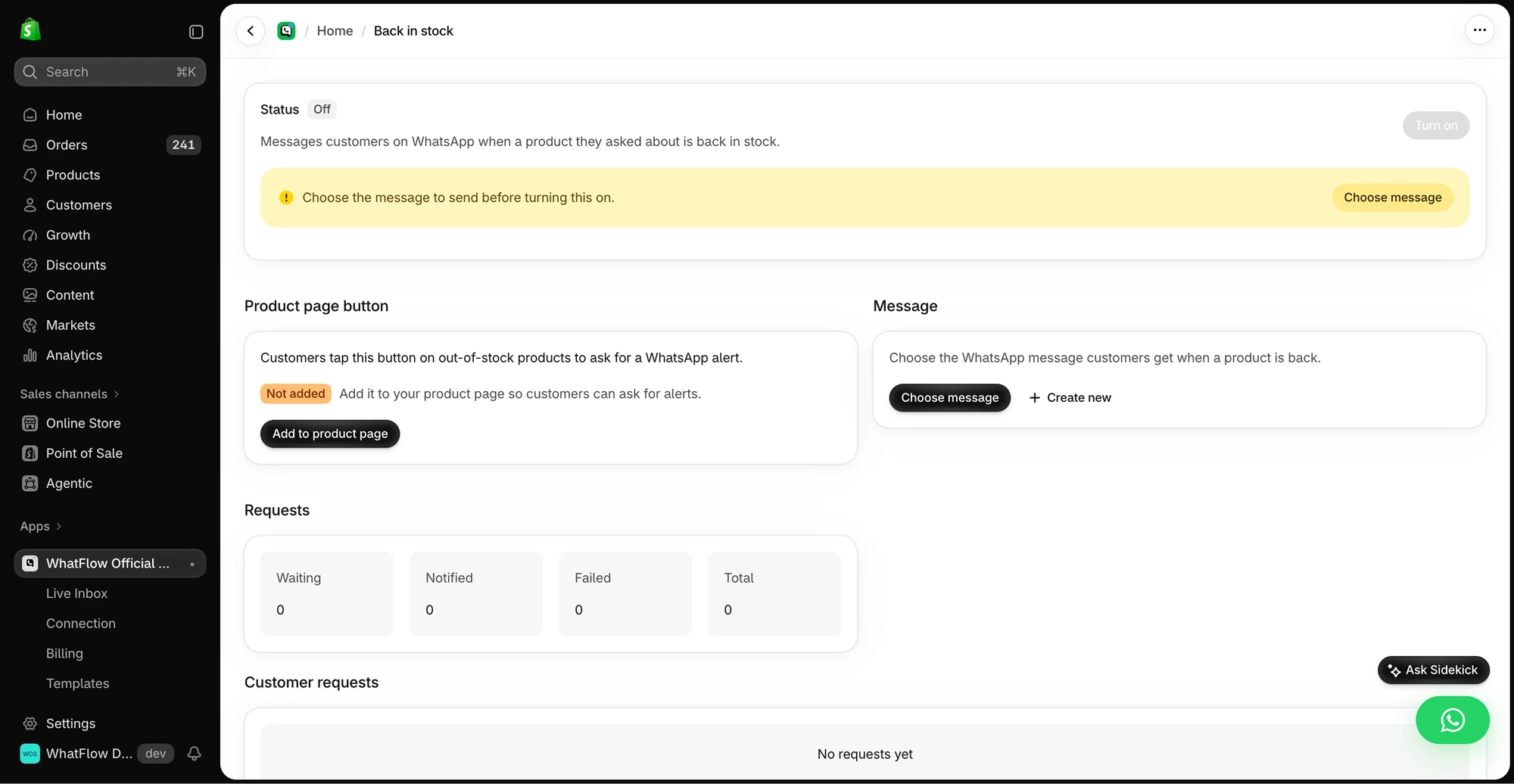
DelightChat sells back-in-stock alerts as a paid add-on (+$10, +$20 or +$30 a month by plan). If your back-in-stock app connects to Shopify Flow, WhatFlow's send-template action can deliver the alert on WhatsApp at no extra app cost. Our back-in-stock WhatsApp guide walks through it.
When DelightChat might still make sense
Choose DelightChat if you want a WhatsApp chatbot builder and ROI analytics in the same app and your team fits inside its member limits.
The bottom line
WhatFlow and DelightChat cover similar Shopify ground, but WhatFlow gets you there for less: a Free plan with every feature, no seat fees at any team size and no contact tiers, on the official Meta Cloud API. Start free and pay more only when you send more.
Questions worth asking
Is WhatFlow a good DelightChat alternative for Shopify?
Yes. WhatFlow covers the same core Shopify WhatsApp jobs (cart recovery, COD confirmation, order updates, catalog, broadcasts, Shopify Flow) with a Free plan, no seat fees at any team size and no contact tiers. DelightChat is a good app too, but team size and marketing contacts are tied to its $29 to $299 plans.
How much does DelightChat cost compared with WhatFlow?
As of November 2026, DelightChat lists Startup at $29/month (5 team members), Scale at $99 (20) and Growth at $299 (50), with Meta fees passed through. WhatFlow starts free, paid plans start at $4.99/month, and every plan includes every feature with no seat fees.
Does WhatFlow charge per inbox seat?
No. WhatFlow's team inbox has no seat fees at any team size, on every plan including Free.
Are WhatFlow features restricted on the free plan?
No. Every WhatFlow feature is on the Free plan, including COD confirmation, cart recovery, catalog sharing and Shopify Flow actions. Paid plans add message allowance, and the theme-matched button is free forever.
Does WhatFlow limit marketing contacts like DelightChat?
No. WhatFlow prices by messages sent, not by contacts. DelightChat's plans include 2,500, 10,000 or 30,000 marketing contacts a month, with extra contacts billed per 1,000.
Sources and methodology
We checked these primary sources on November 5, 2026. Vendor pages describe advertised capabilities, rather than independent performance tests. Confirm current pricing, plan limits and availability with each provider.
- DelightChat homepage
DelightChat's description of its Shopify WhatsApp marketing and support product.
- DelightChat WhatsApp integration guide
DelightChat's documentation for connecting the WhatsApp API on paid plans.
- WhatFlow WhatsApp Business API on the Shopify App Store
WhatFlow plans, included sends, Shopify workflows and the 5.0/5 rating from 55 ratings (checked November 5, 2026).
- WhatsApp Business Platform pricing
Meta's per-message charges, which apply on top of either app's subscription.
- DelightChat pricing
DelightChat plan prices, team-member and marketing-contact allowances and add-ons, checked November 5, 2026.
- DelightChat on the Shopify App Store
DelightChat listing rating of 4.9/5 from 223 reviews, checked November 5, 2026.