
Publisher disclosure: this comparison is written by WhatFlow. Competitor capabilities are based on the linked public documentation; the WhatFlow screenshots come from our demo store. Examples are illustrative, and results depend on your store and configuration.
WhatFlow and Postscript at a glance
| Consideration | WhatFlow | Postscript |
|---|---|---|
| Built for | Shopify stores of any size, from first sale to large support teams. Admin extensions, native Shopify Flow triggers and actions, COD confirmation and a team inbox on the official Meta Cloud API. | A Shopify marketing platform with SMS at its centre. It knows ecommerce well; the difference is the channel and how you pay for it. |
| Pricing | Free plan, paid plans from $4.99/month (Plus is $9.99 for 5,000 sends). No seat fees. Meta's WhatsApp charges are billed separately. | Starter is $0/month with a $49 monthly minimum spend. SMS is $0.009 and MMS $0.045 per message, plus carrier fees (as of November 2026). |
| Feature access | Every feature on every plan, including Free. Plans only change message allowances and rates. | Starter lists campaigns, automations and unlimited segments, inside that $49 minimum and per-message pricing. |
| Team inbox | Shared WhatsApp inbox with assignment, filters and saved replies. No seat fees, so add the whole team. | Its pricing page doesn't list an inbox-seat price. Confirm who on your team can reply to texts. |
| Storefront WhatsApp button | Theme-matched WhatsApp chat buttons, free forever. | Postscript's sign-up tools focus on growing an SMS subscriber list. |
WhatFlow vs Postscript is really WhatsApp vs SMS. Postscript is a good Shopify SMS platform, strongest with US shoppers. WhatFlow is a WhatsApp app built for Shopify, strongest wherever customers already chat on WhatsApp. If that's your audience, WhatFlow wins: it starts free with every feature, has no seat fees, and sends photos, buttons and product cards without MMS pricing.
WhatFlow vs Postscript at a glance
WhatFlow | Postscript | |
|---|---|---|
Channel | SMS and MMS | |
Entry cost | Free plan; paid from $4.99/month | $0 subscription, $49 monthly minimum |
Rich media | Images, buttons, product cards in WhatsApp | MMS at $0.045 per message plus carrier fees |
Two-way chat | Shared team inbox, no seat fees | Check reply access on your plan |
Shopify Flow | Native WhatFlow triggers and actions | Check its integration list |
Postscript figures are from its pricing page as of November 2026. WhatFlow's Business API app is rated 5.0 out of 5 from 55 ratings on the Shopify App Store, as of November 5, 2026.
One thing to clear up, because merchants still ask: WhatFlow WhatsApp Business API runs on the official Meta WhatsApp Cloud API, not an unofficial workaround. Your number connects through Meta's Embedded Signup, templates are approved by Meta, and the setup that suits a two-person shop holds up for a 50-person support team, with inbox assignment and filters, no seat fees at any team size, and Shopify Flow automation that scales with your order volume. (Our older Chat Automation app uses a linked device; it's a separate, entry-level product.)
How much does it cost: WhatsApp on WhatFlow vs SMS on Postscript?
Postscript's Starter plan says $0, but there's a $49 monthly minimum. SMS is $0.009 per message and MMS $0.045, plus carrier fees. So a quiet month still costs $49.
WhatFlow's Free plan is actually free: every feature, 100 sends. After that, Starter is $4.99 for 2,000 sends and Plus $9.99 for 5,000. Meta charges per delivered template message on top, by country and category (Meta's pricing). Since October 1, 2026, Meta only treats the first 1,000 service replies per business number per month as free, and utility templates sent inside the customer service window are now charged too (Meta's pricing doc).
Say you want to send 3,000 product-launch messages with a photo. On Postscript that's MMS: 3,000 × $0.045 = $135 before carrier fees. On WhatFlow it's a WhatsApp template with an image, covered by Plus at $9.99, plus Meta's marketing-template rate for your countries. The real advantage is what happens next: customers reply in the same WhatsApp thread and your team answers from one inbox.
For the channel comparison in more depth, see WhatsApp vs SMS for Shopify.
What WhatsApp does that SMS can't
A WhatsApp message can carry an image, quick-reply buttons and a live product card from your catalog. A customer who taps a button gives you a structured answer your Shopify Flow can act on. Here's a COD confirmation that does real work:
Hi Priya, your order #3318 (₹2,190, cash on delivery) is ready to ship. Tap Confirm to send it today, or Change address if anything's wrong.
In WhatFlow, that button reply triggers Shopify Flow to tag the order as confirmed, or route the address change to a person. Read WhatsApp vs SMS for COD confirmations if you sell cash on delivery.
The inbox: where WhatsApp campaigns turn into sales
Send a launch message and people ask questions. "Does the 50ml come in a gift box?" "Can I get it by Saturday?" WhatFlow's team inbox has no seat fees, so everyone who can answer can be in it, with assignment, filters and saved replies. You can share the product card straight from the chat with live catalog sharing.
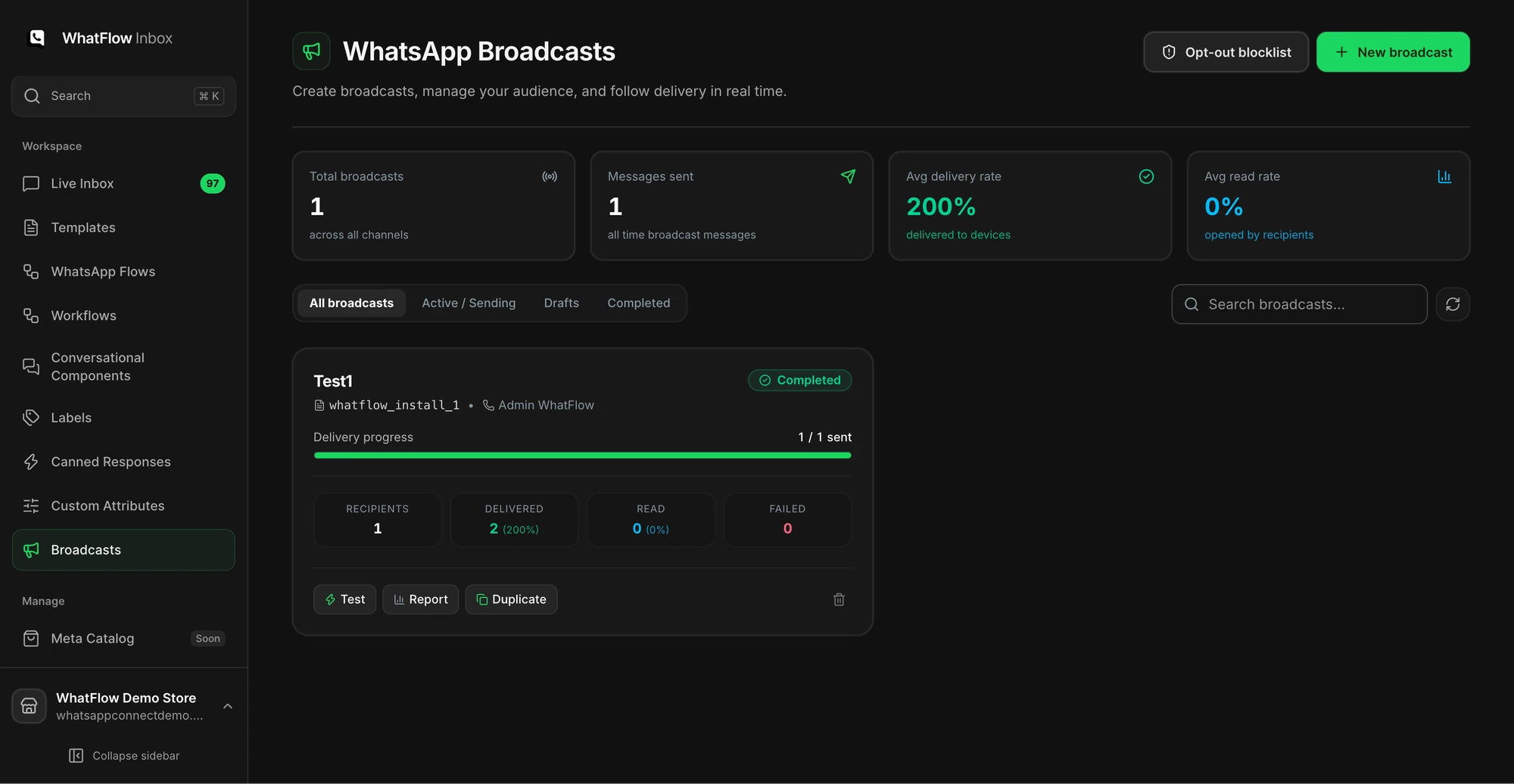
When testing WhatFlow and Postscript, ask: Which Shopify audience do you already use? In WhatFlow, test a Shopify customer or segment send, then try scheduling a separate Inbox broadcast from a spreadsheet or existing conversations. The campaign walkthrough shows the test send, reply handoff and recipient report.
How do you set up WhatFlow on Shopify?
- Install WhatFlow WhatsApp Business API from the Shopify App Store.
- Connect your WhatsApp number through Meta's Embedded Signup, right inside Shopify admin.
- Turn on the free theme-matched WhatsApp button so shoppers can start a chat from your store.
- Pick one template to start with (COD confirmation, abandoned checkout or a shipping update), map the Shopify fields in the template editor and submit it to Meta for approval.
- Invite everyone who answers customers to the team inbox. There are no seat fees, so don't ration logins.
Meta reviews every template, so submit yours early. If one gets rejected, these fixes cover the usual reasons.
When Postscript might still make sense
Pick Postscript only if most of your customers are in the US or Canada, don't use WhatsApp, and you're building an SMS marketing program. That's where SMS reach is strongest. If you sell across WhatsApp-first markets, or run COD, WhatFlow is the better fit, and many stores use both.
The bottom line
If your customers are on WhatsApp, don't pay MMS rates to send them a picture. WhatFlow gives you rich WhatsApp messages, COD confirmation, Shopify Flow and a no-seat-fee inbox, starting free with paid plans from $4.99. Install it, run one campaign through the preflight checklist, and compare the replies you get.
Questions worth asking
Is WhatsApp better than SMS for a Shopify store?
If your customers already use WhatsApp, usually yes for conversations: WhatsApp carries images, buttons and product cards, and customers reply in the same thread. WhatFlow runs that on the official Meta Cloud API from a Free plan with every feature. SMS still reaches US shoppers who don't use WhatsApp.
How much does Postscript cost compared with WhatFlow?
Postscript's Starter plan has a $0 subscription but a $49 monthly minimum, with SMS at $0.009 and MMS at $0.045 per message plus carrier fees, as of November 2026. WhatFlow starts free, with paid plans from $4.99/month and no seat fees; Meta bills WhatsApp charges separately.
Does WhatFlow charge per inbox seat?
No. WhatFlow's team inbox has no seat fees, so your support, sales and fulfilment people can all answer WhatsApp without the bill changing. You pay for a message plan, and Meta bills its WhatsApp charges separately, as it would with Postscript.
Is the WhatFlow Free plan limited?
No features are held back. The Free plan includes templates, Shopify Flow triggers and actions, COD confirmation, catalog sharing and the team inbox. Paid plans from $4.99/month only add message allowance at lower rates, and the theme-matched WhatsApp button is free forever.
Sources and methodology
We checked these primary sources on November 5, 2026. Vendor pages describe advertised capabilities, rather than independent performance tests. Confirm current pricing, plan limits and availability with each provider.
- Postscript: official product and commercial information
Postscript's pricing page, checked November 2026: Starter $0 subscription, $49 monthly minimum, SMS $0.009, MMS $0.045, plus carrier fees.
- WhatFlow WhatsApp Business API on the Shopify App Store
WhatFlow's plans (Free, and paid from $4.99/month), included sends, Shopify Flow and admin features, and its 5.0/5 rating from 55 ratings, checked November 5, 2026.
- WhatsApp Business Platform pricing
Meta's per-message WhatsApp pricing by country and template category, billed separately from any app or platform fee.