As of November 2026, WhatsApp for Shopify stores in Egypt costs $0.0036 per delivered utility or authentication message and $0.0644 per marketing message on Meta's official WhatsApp Business Platform, with the first 1,000 service replies per number each month free. What matters most in Egypt: cheap COD confirmations, Egyptian Arabic templates, and Law 151 of 2020, which now requires consent and a licence for electronic marketing.
I'm Safwan, co-founder of WhatFlow, a WhatsApp app for Shopify. Egypt is one of the markets where I see the biggest gap between what people expect WhatsApp to cost and what it actually costs. Order messages are almost free. Campaigns aren't. Here's how the numbers and the rules work.
How much does WhatsApp cost for a Shopify store in Egypt?
Meta charges per delivered template message. The rate depends on the message category and the country calling code of the person you send to, so every message to a +20 number is billed at Egyptian rates, wherever your company sits. Messages that aren't delivered aren't charged.
Egypt's rate card, in USD, effective October 1, 2026 and current as of November 2026:
Message type
Typical Shopify use
Meta rate per message (USD)
Marketing template
Sale announcement, new collection, win-back offer
$0.0644
Utility template
Order confirmation, COD confirmation, shipping update
Free-form reply in the 24-hour window, after 1,000 free a month
$0.0036
Some definitions. A utility template is a pre-approved message about something the customer already did, like placing an order. A marketing template is promotional. The customer service window is the 24 hours after a customer's last message, when your team can send free-form service messages without a template.
Since October 1, 2026, service replies are free only for the first 1,000 per business phone number per month, then charged at the utility rate. Utility templates sent inside an open service window are charged too; they used to be free.
The authentication-international rate only applies to big senders: the business has to be based outside Egypt and have sent more than 750,000 authentication messages to these markets in a rolling 30 days. A Cairo store sending OTPs to Egyptian customers pays $0.0036.
Worked examples
Say you sell sneakers from Cairo and deliver nationwide.
1,000 order confirmations: 1,000 × $0.0036 = $3.60.
A 5,000-recipient campaign: 5,000 × $0.0644 = $322.00, if every message is delivered.
A heavy support month: 3,000 service replies means 2,000 charged: 2,000 × $0.0036 = $7.20.
One COD order, start to finish: confirmation, shipped and delivered updates are three utility messages, about $0.011 per order.
Look at the ratio. A marketing message to Egypt costs about 18 times a utility message. I'd put COD confirmation, shipping updates and support on WhatsApp straight away, because they cost almost nothing, and treat every campaign like a paid ad: small, segmented, and measured. Budgeting WhatsApp by cost per outcome shows the method, and WhatsApp broadcasts customers don't block covers the sending side.
Utility and authentication rates drop further at high monthly volume through Meta's volume tiers. And when a chat starts from a click-to-WhatsApp ad, replying opens a free entry point window that may stay open for up to 7 days, with no Meta charges for your messages to that customer during it. That's a cheaper route to promotions in Egypt than a cold broadcast.
Meta's charges are separate from your WhatFlow plan. WhatFlow passes them through with zero markup and Meta bills you directly. See the country table and calculator on WhatFlow pricing, or the explainer on WhatsApp Business API pricing.
What currency will you be billed in?
Not Egyptian pounds. As of November 2026, EGP isn't one of the billing currencies Meta lists for the WhatsApp Business Platform, so you'll choose one of the listed currencies, most likely USD. The currency is fixed when the messaging account is created. Make sure the card or payment method you add can pay in that currency.
What's different about WhatsApp for Shopify stores in Egypt?
COD confirmation comes first
If cash on delivery is on your checkout, every COD order is an unpaid promise until the courier collects. Shopify marks manual-payment orders like COD as payment pending until you mark them paid. A failed delivery costs you shipping both ways and ties up stock. At $0.0036 a message, asking first is one of the cheapest fixes you'll ever make. Our COD confirmation message templates have wording you can adapt.
Imagine a customer in Alexandria orders two pairs in different sizes, planning to keep one. A WhatsApp confirmation with Confirm and Cancel buttons surfaces that before dispatch, and a short reply from your team fixes the order. How to cut your RTO rate on Shopify COD shows how to measure the effect.
Egyptian Arabic templates
Meta's template languages include both Arabic (ar) and Arabic (EGY) (ar_EG). For everyday order updates I'd write in a friendly Egyptian dialect rather than formal Arabic; it reads like a message from a shop, not a bank. WhatFlow templates are language-agnostic, so you can keep an Egyptian Arabic version and an English version of the same template.
A COD confirmation in Egyptian Arabic:
أهلاً أحمد 👋 طلبك رقم #3051 بـ 1,850 جنيه وصلنا، والدفع عند الاستلام. دوس "تأكيد" عشان نشحنه النهارده، أو "إلغاء" لو غيّرت رأيك.
Buttons: تأكيد / إلغاء.
The shipping update:
طلبك رقم #3051 خرج للشحن 🚚
تابع الشحنة من هنا:
{{tracking link}}
And in English, for customers who ordered in English:
Hi Ahmed, your order #3051 (EGP 1,850, cash on delivery) is ready. Tap Confirm and we'll ship it today, or Cancel if you've changed your mind.
Right-to-left: test the details
Arabic runs right to left, while order numbers, prices with commas, tracking links and English brand names run left to right. In the middle of an Arabic sentence they can show up in a strange order. Put links on their own line at the end, keep one digit style (Shopify sends Western digits), keep button labels short, and send each Arabic template to your own phone before switching it on. The template languages guide explains how to manage several versions.
Ramadan, Eid and Fridays
Friday is the main day off in Egypt, and plenty of offices close on Saturday too. I'd keep promotions away from Friday midday prayers and test Thursday evening and Saturday sends against your own order data. Selling in the Gulf too? See our guides for WhatsApp for Shopify in Saudi Arabia and WhatsApp for Shopify in the UAE.
During Ramadan, activity moves to the evening after iftar. Don't send at iftar itself, and send fewer messages, not more. Ramadan 2027 is expected to begin around February 7 or 8, depending on the moon sighting, so submit your Ramadan and Eid templates in January. Our Ramadan, Eid and Diwali campaign guide has the planning calendar and message examples.
Egypt's data protection and WhatsApp marketing rules
This isn't legal advice. It's what a Shopify store owner selling in Egypt should know as of November 2026.
Law No. 151 of 2020 (Personal Data Protection Law). Egypt's data protection law came into force three months after its 2020 publication. It applies to personal data processed electronically and is overseen by the Personal Data Protection Center. Here's what matters for WhatsApp, from the English translation published by Andersen in Egypt:
Article 17 bans electronic direct marketing unless you have the person's prior consent, the message clearly identifies who sent it, you have a valid address, the message says it's for direct marketing, and there's a clear, easy way to opt out.
Article 18 says the marketing purpose must be clear, you can't disclose the person's contact details, and you keep records of their consent for three years from the last message you sent.
The Executive Regulations are now in force. They were issued as Ministerial Decision No. 816 of 2025 on November 1, 2025 and made public on December 25, 2025, according to CMS. The law gives businesses one year from the regulations' issuance to get compliant, so CMS expects enforcement from around November 1, 2026, with some uncertainty about whether the Center will count to the end of 2026 instead. Either way, the grace period is over or nearly over.
Three points in the regulations affect a Shopify store:
A licence for direct electronic marketing. The regulations require senders of direct marketing to hold a valid licence from the Center and to get explicit consent. If you send WhatsApp campaigns to Egyptian customers, ask a local adviser whether your business needs one.
Delete on withdrawal. When someone withdraws consent, you erase the personal data you hold for marketing.
Cross-border transfers. CMS reports that transfers outside Egypt, including to cloud services, need a licence or authorisation. Shopify and Meta are foreign platforms, so this is on your list too.
WhatsApp's own rules. The WhatsApp Business Messaging Policy requires opt-in before you message someone, requires you to honour opt-outs, and lets you start conversations only with approved templates.
So in practice: ask for WhatsApp opt-in at checkout in Arabic and English, store when each customer agreed, label promotional templates as offers, and honour "stop" immediately. How to collect WhatsApp opt-ins on Shopify covers wording and placement.
Setup checklist for an Egyptian Shopify store with WhatFlow
WhatFlow WhatsApp Business API runs on Meta's official WhatsApp Cloud API. Every feature is on every plan, including Free, and there are no seat fees on the shared inbox.
Connect through Embedded Signup. Install WhatFlow and connect your WhatsApp Business account with Meta's Embedded Signup from Shopify admin, then check Connections shows your sender.
Use a +20 number and a recognisable display name that matches your store brand. The green tick guide explains verification.
Add a payment method for Meta in a currency Meta supports.
Write Egyptian Arabic and English templates. Pick a starting draft in Template Library, map variables in Message Editor, then check language, category and approval status in Templates. Keep marketing wording out of utility templates, or Meta may recategorise them.
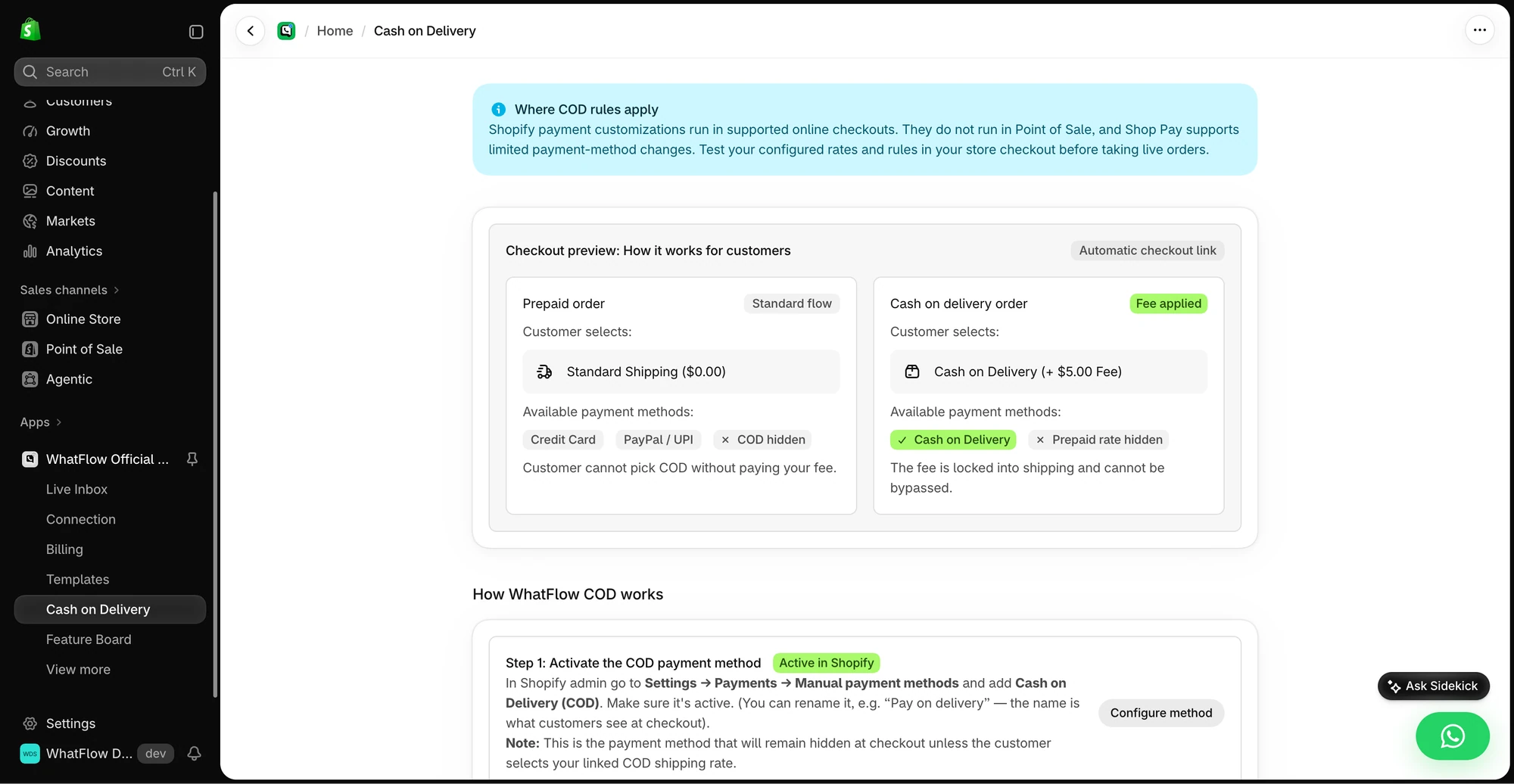
Set up COD. In Cash on Delivery, choose the manual payment method WhatFlow should manage, select COD shipping rates if you use them, and preview eligible and ineligible checkouts. Attach your approved confirmation template.
Tag orders from replies. Confirm and Cancel buttons can tag or cancel orders through Shopify Flow. For riskier orders, FlowSense COD order review adds a review step.
Add OTP verification in OTP Verification, choosing a placement your store supports and checking the order tag added on success.
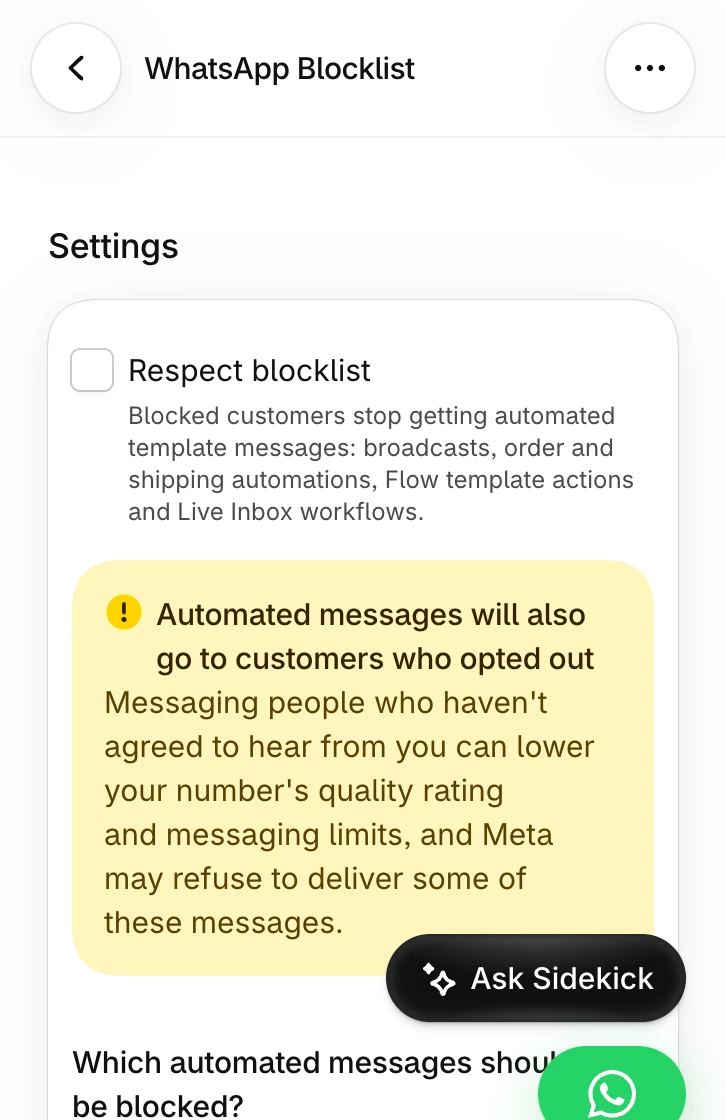
WhatFlow Blocklist settings in a demo store, with the warning shown when suppression is off
Run WhatsApp for your Shopify store with WhatFlow
Free plan available. Templates, COD confirmation, Shopify Flow automations and a shared team inbox with no seat fees. Every feature is included on every plan, including Free.
Put COD confirmation and shipping updates on WhatsApp this week. In Egypt they cost a fraction of a cent each and pay for themselves with the first failed delivery you avoid. Sort out consent records and the marketing licence question before you send campaigns, then plan Ramadan 2027 templates in January.
Frequently asked questions
How much does a WhatsApp utility message cost in Egypt?
As of November 2026, Meta charges $0.0036 per delivered utility or authentication template sent to an Egyptian (+20) number. That makes 1,000 order confirmations cost $3.60.
Why are WhatsApp marketing messages so expensive in Egypt?
Meta prices categories separately. In Egypt a marketing template costs $0.0644 as of November 2026, about 18 times the $0.0036 utility rate, so campaigns cost far more than order updates.
Can Egyptian businesses pay Meta for WhatsApp in Egyptian pounds?
No. EGP isn't one of the billing currencies Meta lists for the WhatsApp Business Platform as of November 2026, so you'll be billed in one of the listed currencies such as USD.
Does Egypt's data protection law cover WhatsApp marketing?
Yes. Article 17 of Law No. 151 of 2020 bans electronic direct marketing without the person's prior consent, a clearly identified sender and an easy way to opt out, and the 2025 Executive Regulations add a licence requirement for direct electronic marketing.
Is Egypt's Personal Data Protection Law in force?
Yes. The law has been in force since 2020, and its Executive Regulations were issued on November 1, 2025 with a one-year window for businesses to comply, which law firm CMS reads as ending around November 1, 2026.
What WhatsApp costs an Indian Shopify store, the INR billing deadline, COD confirmation, Hindi and regional templates, and what the DPDP Act asks of you.