Messaging customers in Pakistan on the official WhatsApp Business Platform costs $0.015 per delivered utility template (order confirmations, shipping updates) and $0.0473 per marketing template, as of November 2026. For a Pakistani Shopify store, three things matter more than the rate card: confirming cash-on-delivery orders before dispatch, writing templates the way customers actually read (Urdu or Roman Urdu), and getting opt-in right while Pakistan's data protection bill is still a bill.
I'm Safwan, and I run WhatFlow. Pakistan is one of the countries we hear from most, and the questions are almost always the same: what will Meta charge me, will buyers actually reply on WhatsApp, and how do I stop paying for parcels that come back. This guide answers those, with real Meta figures and a setup you can copy.
How much does WhatsApp for Shopify cost in Pakistan?
Meta charges per delivered template message, by category and by the recipient's country. A template is a message Meta has approved in advance; you need one for anything you send outside the 24-hour customer service window, which is the 24 hours after a customer last messaged you. Inside that window you can reply freely.
Here's Meta's USD rate card for Pakistani numbers, effective October 1, 2026 and current as of November 2026:
WhatsApp for Shopify in Pakistan: costs, COD and rules | WhatFlow
$0.015
Authentication-international
$0.075
Service (free-form reply), after 1,000 free per number per month
$0.015
Two rule changes from October 1, 2026 catch people out. Service replies are free only for the first 1,000 delivered per business phone number each month; after that each one costs the utility rate. And utility templates sent inside an open customer service window are now charged too. Both are in Meta's pricing documentation.
The authentication-international rate only applies to a business based outside Pakistan sending OTP templates to +92 numbers, and only once that business crosses Meta's eligibility threshold of over 750,000 messages in a rolling 30 days (Meta's authentication-international rules). A Lahore or Karachi store messaging local buyers pays the normal $0.015.
Worked example: 1,000 COD confirmations
Say you take 1,000 COD orders in November and send each buyer one order confirmation template with Confirm and Cancel buttons.
1,000 utility templates × $0.015 = $15.00 in Meta fees.
When buyers reply with a question ("kab tak aayega?"), your answers count as service messages. The first 1,000 each month are free on that number.
If one in ten of those confirmations stops you shipping a parcel nobody wanted, the maths is not close. Courier charges on a returned COD parcel will usually dwarf 1.5 cents. Our guide to the RTO rate for Shopify COD stores shows how to measure that properly with your own numbers. Indian stores run the same numbers at a lower utility rate, as our WhatsApp for Shopify in India guide shows.
Worked example: a 5,000-recipient campaign
Now say you send an Eid sale announcement to 5,000 opted-in customers.
5,000 marketing templates × $0.0473 = $236.50 in Meta fees, if all are delivered.
That's real money, so I'd segment hard: past buyers in the last 90 days, people who clicked last campaign, and so on. Our Ramadan, Eid and Diwali campaign guide covers timing. One way to cut the bill: conversations that start from a click-to-WhatsApp ad open a free entry point window that Meta says may stay open for up to 7 days, and Meta doesn't charge for template or service messages to that customer while it's open.
Billing currency
PKR isn't on Meta's list of WhatsApp billing currencies as of November 2026, so Pakistani stores are billed in USD or another supported currency. WhatFlow passes Meta's charges through with zero markup, and your WhatFlow plan is a separate subscription. The WhatFlow pricing page has the country rate table and a calculator, and our explainer on WhatsApp Business API pricing goes deeper on categories.
How Pakistani buyers shop, and what it means for WhatsApp
COD is the default, so confirmation is the job
Cash on delivery is how a large share of Pakistani shoppers pay online, and the pain is familiar: fake orders, buyers who change their mind, wrong numbers, and riders bringing parcels back. Many stores still have a team member calling every order, or pay for robocalls.
Assalam o Alaikum Bilal, thanks for your order #1042 from Zari Studio: 2 lawn suits, Rs 7,800, cash on delivery to Gulberg III, Lahore. Tap Confirm and we'll dispatch today, or Cancel if you no longer need it.
Keep the amount and city in the message. A buyer who ordered by mistake will cancel right there, which is exactly what you want.
Wallets and prepaid nudges
Mobile wallets such as JazzCash and Easypaisa are familiar to many Pakistani buyers, and some stores offer a small discount for paying upfront. WhatFlow doesn't take payments inside chat, so the pattern is a link: if your Shopify checkout supports a wallet or card gateway, the confirmation or a follow-up can point to it. Don't push prepayment on everyone. Use it for high-value orders or buyers who have refused a parcel before.
Urdu, Roman Urdu or English?
Plenty of customers read English fine, but lots of them type in Roman Urdu, and many older buyers prefer Urdu script. Meta supports Urdu (ur) and English as template languages, and there's no separate code for Roman Urdu, so pick one code and stick with it per template.
My advice: write order confirmations in simple English with a Roman Urdu line, and test an Urdu-script version for older audiences. For example:
Aapka order #1042 (Rs 7,800) confirm karne ke liye Confirm dabayein. Agar order nahi chahiye to Cancel dabayein.
WhatFlow templates work in any language WhatsApp supports, and you can keep several language versions of the same template. Our guide to WhatsApp template languages for order updates shows how to route each customer to the right one.
What are Pakistan's data protection and marketing rules?
This isn't legal advice, but here's where things stand as of November 2026.
No dedicated data protection law yet. Pakistan has not enacted a comprehensive personal data protection law. The Personal Data Protection Bill has been through several drafts but, as far as I can find, still hasn't passed Parliament and received assent. DLA Piper's country summary, updated March 2026, says the same. Check for news before you rely on that, because it could change quickly.
PECA 2016 already applies. The Prevention of Electronic Crimes Act 2016 makes it an offence to obtain, sell or use someone's identity information without authorisation, and it has a spamming offence. The Khyber Pakhtunkhwa government's summary of the PECA spamming provision quotes the key part for stores: anyone "engaged in direct marketing shall provide the option to the recipient" to unsubscribe. Fines apply for repeat offences.
WhatsApp's own rules are stricter than the law, and they're enforced. The WhatsApp Business Messaging Policy says you may only message people who gave you their number and opted in to hearing from you, that you must honour opt-out requests made on or off WhatsApp, and that outside the 24-hour window you can only send approved templates. Break these and your number's quality rating drops, which limits how many people you can reach.
Treat order confirmations and marketing differently. Someone who placed a COD order expects a confirmation; they didn't necessarily sign up for your weekly sale.
Put "Reply STOP to unsubscribe" on marketing templates, and actually suppress those numbers. WhatFlow has opt-outs and a blocklist for this.
Don't buy number lists. Ever.
Setup checklist: WhatsApp for your Pakistani Shopify store with WhatFlow
WhatFlow WhatsApp Business API is built on the official Meta WhatsApp Cloud API, rated 4.9/5 from 72 ratings on the Shopify App Store (checked November 18, 2026). It's used by stores from one-person brands to large teams, because the shared inbox has no seat fees and every feature is on every plan, including Free. Here's the order I'd set things up in. If you're new to all this, our guide on how to add WhatsApp to Shopify walks through the basics first.
Connect through Meta Embedded Signup. Install the app and connect your WhatsApp Business account from Shopify admin. You'll create or pick a Meta business portfolio during the flow.
Use a Pakistani number and a recognisable display name. A +92 number your customers already know builds trust. Pick a display name that matches your store name, since Meta reviews it.
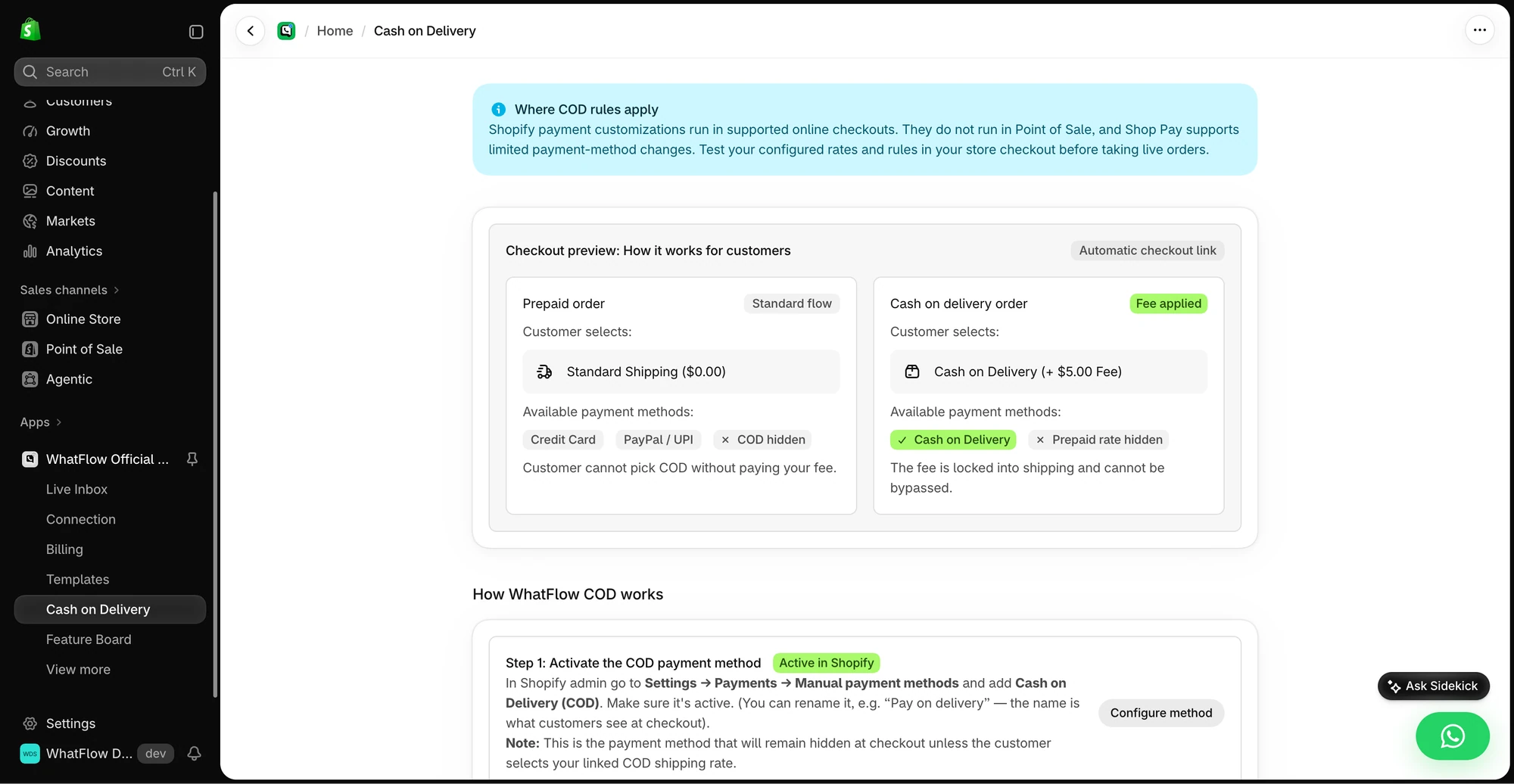
Set your COD rules. In Cash on Delivery, choose the manual payment method WhatFlow manages and, if you use a separate COD shipping rate, select it. Preview eligible and ineligible checkouts.
Turn on COD confirmation with reply buttons. Use an approved utility template with Confirm and Cancel. Buyer replies can tag or cancel orders through Shopify Flow.
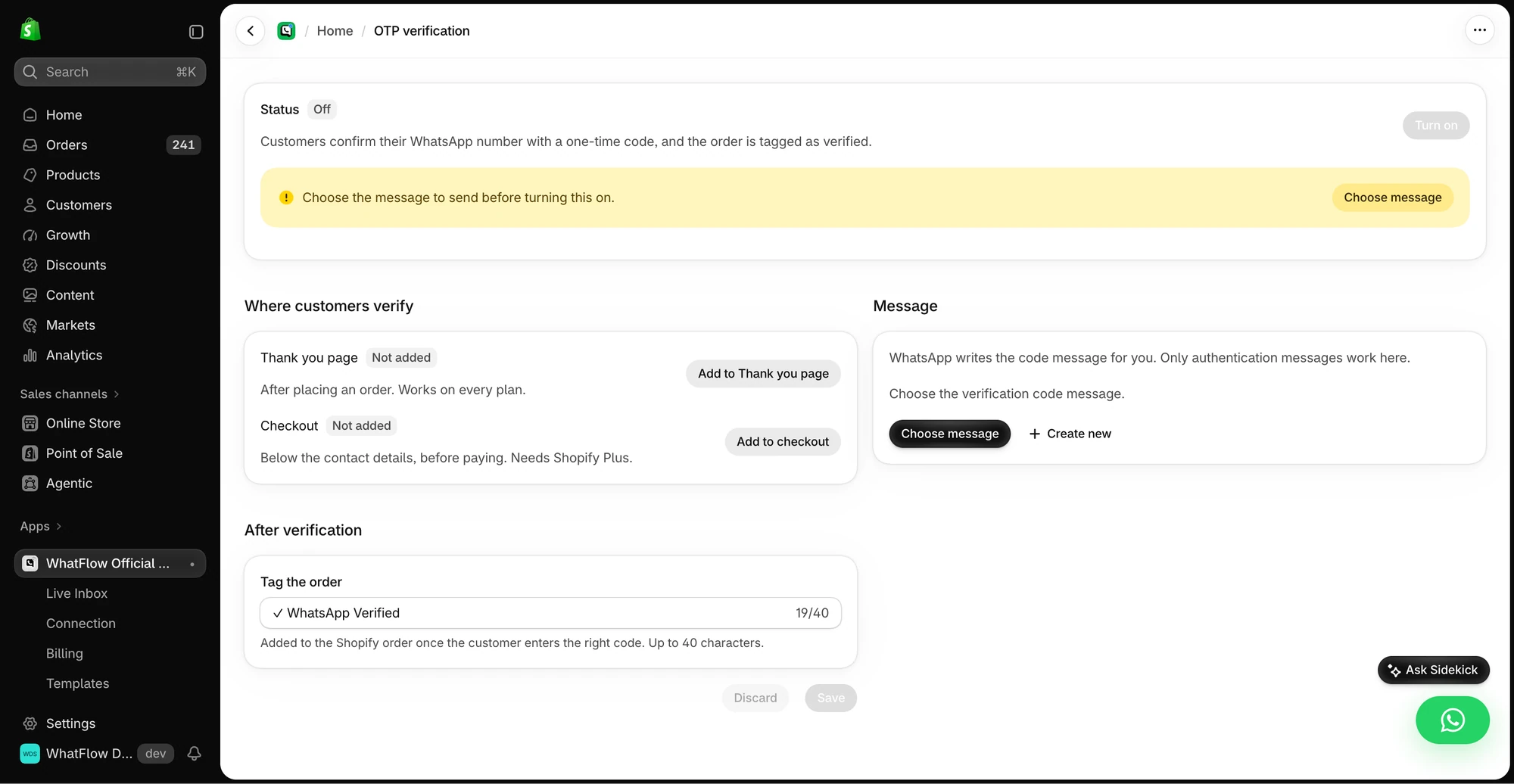
Add OTP verification for risky cases. WhatFlow can verify the phone number with a one-time code and tag the Shopify order on success. A verified number only proves the buyer had the phone, so keep a dispatch rule.
Write templates in your customers' language. English plus Roman Urdu for confirmations, and Urdu-script versions where your audience prefers them.
Add order and shipping updates. WhatFlow sends shipping-journey updates (label, carrier pickup, in transit, delivered), which cut "where is my order" chats. Starter copy is in our order confirmation message examples.
Consider FlowSense for a second look. FlowSense uses order and delivery outcomes to flag COD orders that may need a closer look before dispatch. Read its consent screen before enabling.
WhatFlow demo store: COD rules with a sample checkout preview. Sample data, nothing sent.
The COD and OTP setup guide has the full click-by-click, including the test cases to run before going live (confirm, cancel, no reply, and a buyer with two open orders).
WhatFlow demo store: OTP placement options and the Shopify order tag used after verification.
For the review layer, the FlowSense COD order review guide explains how to turn a flag into a fair next step instead of an automatic cancel. A flag is a reason to check, not proof of fraud.
What a no-reply follow-up should say
The confirmation won't get a reply every time. People are busy. A second utility template a few hours later is cheap at $0.015:
Hi Bilal, your order #1042 (Rs 7,800) is ready to dispatch. Please tap Confirm so our rider can deliver tomorrow, or Cancel if you've changed your mind.
After that, I'd hand it to a person in the inbox rather than auto-cancelling. A quick call from a teammate on a high-value order is still worth it.
Run WhatsApp for your Shopify store with WhatFlow
Free plan available. Templates, COD confirmation, Shopify Flow automations and a shared team inbox with no seat fees. Every feature is included on every plan, including Free.
If you only do one thing, switch COD confirmation calls to a WhatsApp template with buttons and tag the replies in Shopify. At $15 per 1,000 orders in Meta fees, it pays for itself the first time it stops a parcel going out to someone who didn't want it. Then add Urdu or Roman Urdu versions, and only after that start spending on marketing campaigns. Compare COD confirmation apps for Shopify if you want to see the alternatives side by side.
Frequently asked questions
How much does a WhatsApp order confirmation cost in Pakistan?
As of November 2026, Meta charges $0.015 per delivered utility template to a Pakistani number, so 1,000 COD confirmations cost about $15 in Meta fees. Your WhatsApp app's own subscription is separate.
Does Pakistan have a data protection law for online stores?
As of November 2026, Pakistan hasn't enacted a dedicated personal data protection law; the Personal Data Protection Bill is still a draft. The Prevention of Electronic Crimes Act 2016 already covers misuse of identity information and spamming, and it requires direct marketers to offer an unsubscribe option.
Can I send WhatsApp templates in Roman Urdu?
Yes. Meta reviews the text you submit, and Roman Urdu is just Urdu written in Latin script. Meta has no separate Roman Urdu language code, so pick one code (Urdu or English) and use it consistently for that template.
Is WhatsApp cheaper than robocalls for COD confirmation in Pakistan?
It depends on your call provider's rates, but a WhatsApp utility template costs $0.015 per delivered message in Pakistan as of November 2026, and the buyer's tap on a button can update the Shopify order automatically. A call still needs someone, or a system, to log the answer.
Can a Pakistani Shopify store be billed by Meta in rupees?
No. PKR isn't one of the billing currencies Meta lists for the WhatsApp Business Platform as of November 2026, so expect to pay Meta in USD or another supported currency.