Shopify customer support metrics are the handful of numbers that tell you whether customers get fast, correct help: first response time, resolution time, CSAT, contact rate, WISMO share and reopen rate. Each has a simple formula. Track them weekly, and on WhatsApp set response targets well inside Meta's 24-hour customer service window.
Most small Shopify teams I talk to measure support by feel. "We're on top of it" until Black Friday, when nobody is. The fix isn't a big dashboard. It's six numbers, defined the same way every week, so you can see whether a new hire, a saved reply or a shipping update actually helped. Below are the definitions, formulas, a worked example and what changes when your support runs on WhatsApp.
The six support metrics at a glance
Metric
Formula
What it tells you
First response time (FRT)
Time of first human reply − time of customer's first message
How long customers wait to hear from a person
Resolution time
Time conversation resolved − time of customer's first message
Report time metrics as a median, not an average. One chat that sat over a long weekend will wreck an average and tell you nothing about a normal day. If you want one extra number, add the share of conversations answered within your target (say, within one hour).
First response time
First response time is how long a customer waits between sending their first message and getting the first reply from a person.
FRT = time of first human reply − time of customer's first message
Three rules make it honest:
Don't count auto-replies. An automatic "thanks, we'll get back to you" is fine to send, but it's not a response. Stop the clock at the first message that comes from a person or genuinely answers the question.
Decide on business hours. Either measure in calendar hours (what the customer experiences) or business hours (what your team controls). I'd report both if a lot of messages arrive overnight.
Measure per conversation, not per message. If a customer sends five messages in a row, the clock starts at the first.
Resolution time is how long it takes from the customer's first message until their issue is fixed and the conversation is closed.
Resolution time = time resolved − time of customer's first message
"Resolved" needs a definition your whole team uses. Mine: the customer has what they need, or you've done everything you can and told them so. A conversation waiting on a courier isn't resolved; it's pending. If your team closes chats to make the queue look tidy, you'll see it in the reopen rate.
CSAT (customer satisfaction score)
CSAT is the percentage of surveyed customers who say they were satisfied with the help they got.
CSAT (%) = responses of 4 or 5 on a 1–5 scale ÷ all responses × 100
Ask one question, right after resolution, in the same channel:
Thanks for chatting with us, Sara. How happy are you with the help you got today? Reply 1 (not at all) to 5 (very).
Keep it to one question and accept that only some customers answer. Low response counts swing CSAT a lot, so look at it monthly unless you have plenty of replies. Running CSAT and NPS surveys on WhatsApp covers wording and timing, including when a survey needs a template.
Contact rate
Contact rate is how many support conversations your store creates for every order.
Contact rate (%) = support conversations ÷ orders × 100
Use the same period for both. Pull the order count from the Shopify Orders page (you can filter and export orders for a date range) and the conversation count from your inbox. Contact rate is the metric that tells you whether support is getting easier or harder to run as you grow. If orders double and contact rate stays flat, you need more people. If contact rate falls, your pages, policies and proactive messages are doing their job.
WISMO share
WISMO means "where is my order?". WISMO share is the percentage of conversations that are just order-status questions.
You need a way to count them, which is where labels come in (more below). WISMO is the most avoidable contact there is. A customer who gets a shipping update when the parcel is picked up rarely messages to ask where it is.
Reopen rate
Reopen rate is the share of resolved conversations where the customer comes back about the same issue.
Pick a window (say, 7 days after resolution) and only count a reopen if it's the same issue. A customer who comes back next month about a new order isn't a reopen. A high reopen rate usually means agents are closing too early or giving half-answers.
Worked example (hypothetical numbers)
Say you run a fashion store in the UAE with three agents on a shared WhatsApp inbox. Here's a made-up week:
Input
Count
Orders
1,400
Support conversations
280
Conversations labelled WISMO
98
Conversations resolved
250
Reopened within 7 days
20
CSAT survey replies
80
Replies scoring 4 or 5
66
Median first response time
47 minutes
Median resolution time
5.5 hours
Contact rate = 280 ÷ 1,400 × 100 = 20%
WISMO share = 98 ÷ 280 × 100 = 35%
Reopen rate = 20 ÷ 250 × 100 = 8%
CSAT = 66 ÷ 80 × 100 = 82.5%
The story in these made-up numbers is WISMO. More than a third of the queue is order-status questions. Switch on one reliable shipping update, and in a few weeks you'd expect WISMO share and contact rate to fall, which frees your agents for the conversations that need a person. That's how the metrics should be used: to pick the next fix, not to grade people.
How the WhatsApp 24-hour window changes your targets
WhatsApp support has a rule email doesn't. When a customer messages you, Meta opens a 24-hour customer service window. Inside it, you can send any free-form reply. Outside it, you can only send an approved template message. Each new customer message resets the 24 hours; your own replies don't.
What that means for your metrics:
First response time must sit well inside 24 hours. A customer who writes at 11pm on Friday needs a reply before 11pm Saturday, or your agent has to reopen the chat with a template instead of just answering. I'd set a target in hours, not "next business day".
Long resolutions need a plan. If a refund or courier claim takes four days and the customer goes quiet, your follow-up will need a template. Keep approved utility templates ready for "update on your request" messages.
Volume now has a cost. From October 1, 2026, Meta gives each business phone number 1,000 free service messages per month and charges from the 1,001st. Utility templates sent inside an open window are charged too. Fewer avoidable contacts (lower WISMO share, lower reopen rate) now saves money as well as time. See pricing for Meta's rates by country.
Proactive messages like shipping updates also need the customer's opt-in under the WhatsApp Business Messaging Policy, so collect it at checkout.
How to measure these on WhatsApp with WhatFlow
Measuring is mostly about structure: every conversation has an owner, a type and a clear end. WhatFlow's Team Inbox is built around exactly that.
Assignment: one owner per conversation
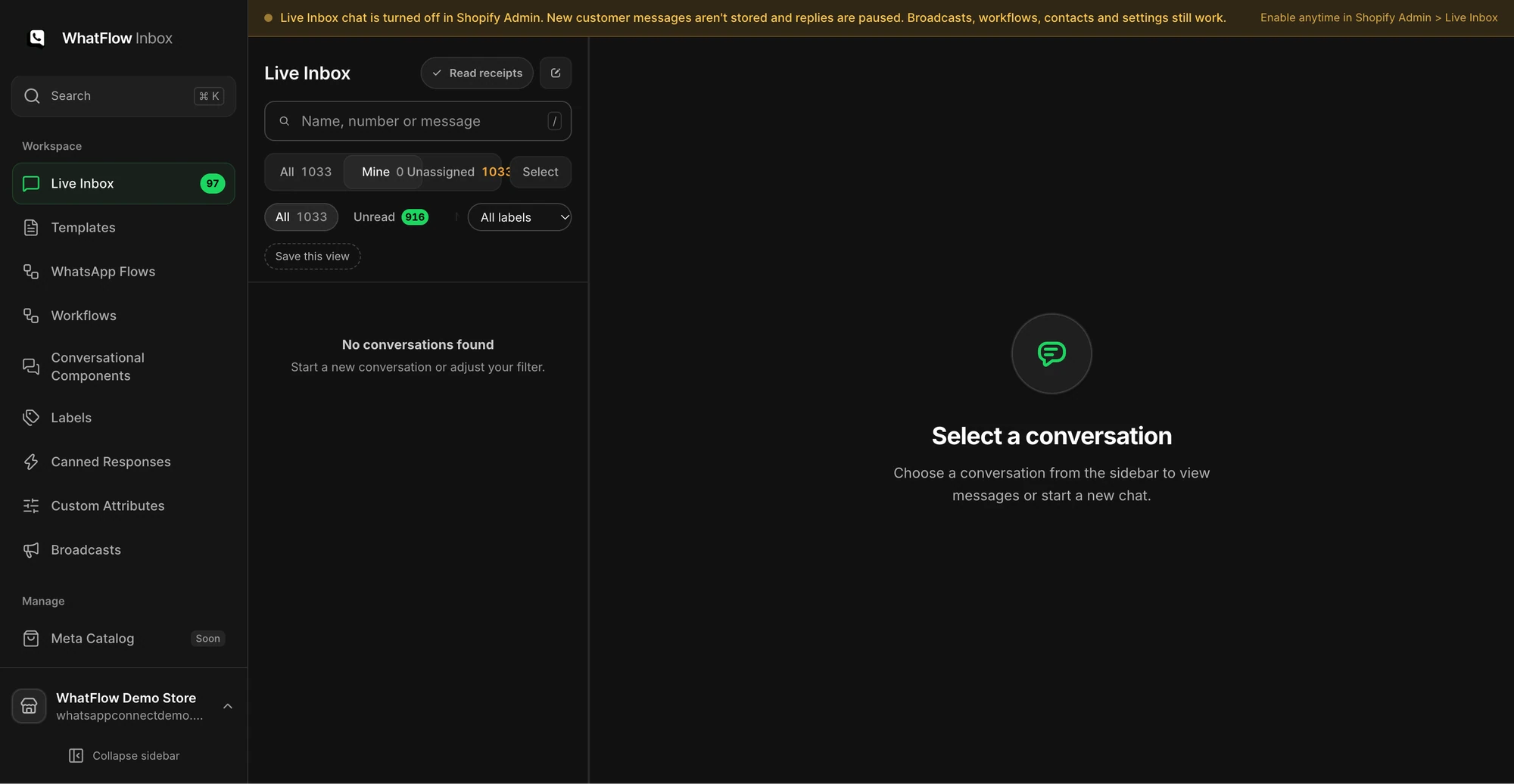
The Inbox has assignment filters, including a Mine view and unassigned chats, so nothing sits unclaimed. One owner per conversation is what makes first response time and resolution time meaningful; if three people half-answer a chat, nobody owns the clock. WhatFlow charges no seat fees, so every agent who needs access can have it, which is why a 20-person team costs the same in seats as a team of two.
Demo store Inbox with the Mine assignment filter selected and no open chats.
Labels: count WISMO and every other contact type
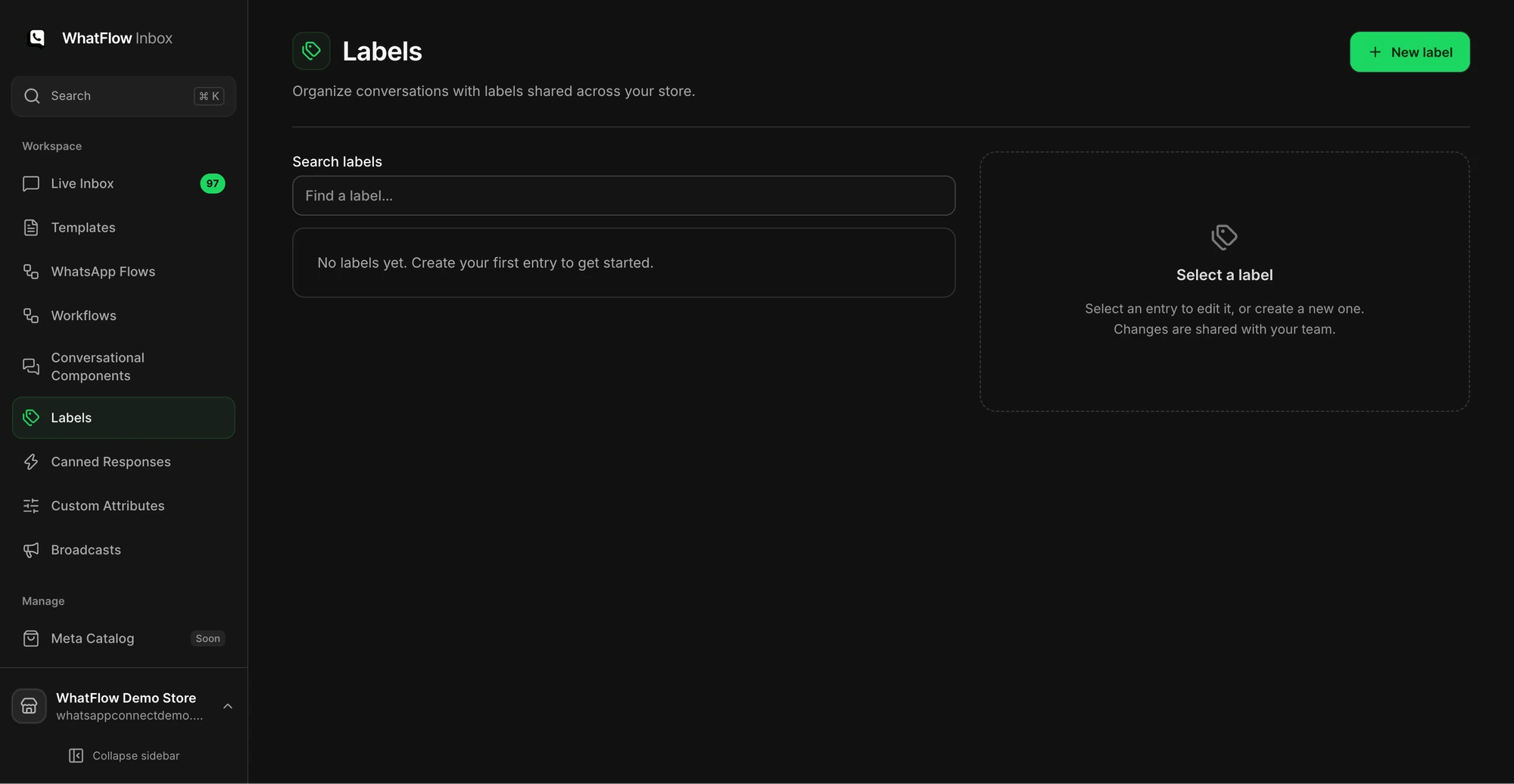
Labels group conversations by type of work, such as address changes or returns. Create a small, fixed set (WISMO, returns, address change, product question, payment, other) and ask agents to label every conversation before closing it. That gives you WISMO share and a breakdown of contact rate by reason. Keep the list short; a dozen overlapping labels and nobody uses them consistently.
Demo store Inbox labels settings. Labels shown are examples.
Canned responses: faster, consistent first replies
Canned responses are saved answers your team inserts and personalises before sending. They cut first response time on repeat questions without sounding robotic, as long as you leave out details that change per order. For example:
Hi Omar, your order #4127 left our warehouse this morning. You can track it here: [link]. If it hasn't moved in 2 days, reply here and I'll chase the courier.
If the window has closed, WhatFlow's template picker is where you choose an approved template instead. Saved replies that don't sound robotic has more wording, and the Team Inbox setup guide covers assignment, labels, private notes and canned responses step by step.
A weekly measurement routine
If your tools don't report every metric for you, sampling works fine for a small team:
Every Monday, export last week's order count from Shopify.
Count conversations by label in the Inbox, including WISMO.
Pull 30 random conversations. For each, note the customer's first message time, the first human reply time and the close time. Take the medians.
Count reopens within 7 days among those resolved.
Tally CSAT replies.
Write one sentence on what you'll change this week.
Checklist to improve your support metrics
Define FRT, resolution, reopen and WISMO once, in writing, and share it with the team
Report medians for time metrics, plus the share answered within target
Exclude auto-replies from first response time
Set a WhatsApp first response target well inside 24 hours, including weekends
Assign every conversation to one owner
Label every conversation before closing it
Save canned responses for your top five questions
Keep approved utility templates for follow-ups after the window closes
Switch on one reliable shipping update to cut WISMO
Fix the page or policy behind your most common contact reason
Free plan available. Templates, COD confirmation, Shopify Flow automations and a shared team inbox with no seat fees. Every feature is included on every plan, including Free.
WhatFlow WhatsApp Business API gives Shopify teams a shared WhatsApp inbox on the official Meta WhatsApp Cloud API, with assignment, labels, canned responses and no seat fees, so adding agents doesn't add app costs. Every feature is on every plan, from the Free plan to paid plans from $4.99/month. If you're weighing a WhatsApp-first inbox against a ticketing tool, our WhatsApp inbox vs helpdesk tickets comparison lays out the trade-offs, and the Inbox page shows what's included.
What's the difference between first response time and resolution time?
First response time is how long a customer waits for the first human reply. Resolution time is how long it takes until their problem is actually solved, which can span several replies and days.
Should an auto-reply count as a first response?
No. An automatic acknowledgement doesn't help the customer, so start the first response clock at their message and stop it at the first reply from a person or a reply that actually answers the question.
How does the WhatsApp 24-hour window affect support response time?
You can only send free-form replies within 24 hours of the customer's last message. If you miss that, you need an approved template to reopen the conversation, so your first response target on WhatsApp must sit well inside 24 hours.
How do I calculate CSAT for a Shopify store?
Ask resolved customers one question, such as how satisfied they were on a 1 to 5 scale, then divide the number of 4 and 5 answers by the total number of answers and multiply by 100.
What is WISMO in ecommerce support?
WISMO stands for where is my order. WISMO share is the percentage of support conversations asking about order status, and it usually falls when you send proactive shipping updates.
Explains the 24-hour customer service window, the template requirement outside it, and the 1,000 free service messages per business phone number per month from October 1, 2026.
Copy-ready order cancellation messages for WhatsApp and SMS: customer requests, out of stock, failed payment checks, unconfirmed COD and partial cancels.