Best Shopify Helpdesk Apps in 2026: 8 Compared Honestly
Gorgias, Zendesk, eDesk, Re:amaze, Help Scout and more compared on price model, rating and channels, plus when a WhatsApp team inbox is the better buy.
The best Shopify helpdesk app for most email-led support teams is Gorgias, because agents can edit, refund and cancel orders inside a ticket. Zendesk suits larger teams that already run on it, and Help Scout is the gentlest start with a free plan. If your support mostly happens on WhatsApp, WhatFlow gives you a shared team inbox with no seat fees.
I'm Safwan, co-founder of WhatFlow. WhatFlow isn't an email helpdesk and I won't pretend it is. What I see often, though, is a store in Dubai or São Paulo paying for six helpdesk seats while most of its customer messages arrive on WhatsApp and get answered from someone's personal phone. That's a tooling mismatch, and it's the main thing this list tries to help you avoid.
How we picked
I opened each app's Shopify App Store listing on November 18, 2026 and took ratings, review counts, plans and channels from it. Apps I couldn't verify there were dropped: Richpanel's listing says it isn't currently available on the Shopify App Store, so it's not here. Ratings and prices are as of November 2026 and they change, so check the listing before you sign up. WhatFlow is our product; I've ranked it first for WhatsApp-first teams only and said where a real helpdesk is the better call. Limitations come from what each listing states, not from benchmarks I've run.
Email, live chat, WhatsApp, Instagram, Messenger, SMS, phone
How to choose a Shopify helpdesk
Helpdesks look similar on a feature grid. The differences that hurt later are the pricing unit and the channel mix.
Count your channels honestly. Export a month of conversations. If email is most of it, buy a helpdesk. If WhatsApp is most of it, a WhatsApp inbox will fit better, and our comparison of a WhatsApp inbox vs helpdesk tickets explains why tickets feel clumsy for chat.
Know what you're billed on. Zendesk charges per agent. Gorgias and eDesk charge by ticket volume. Willdesk charges by conversation. WhatFlow charges by message allowance with no seat fees. Each model rewards a different kind of team.
Check the Shopify actions you need. Gorgias, Zendesk, eDesk and Help Scout all list order actions such as refunds or cancellations from the helpdesk. Make a list of the three actions your agents do most and test them in the trial.
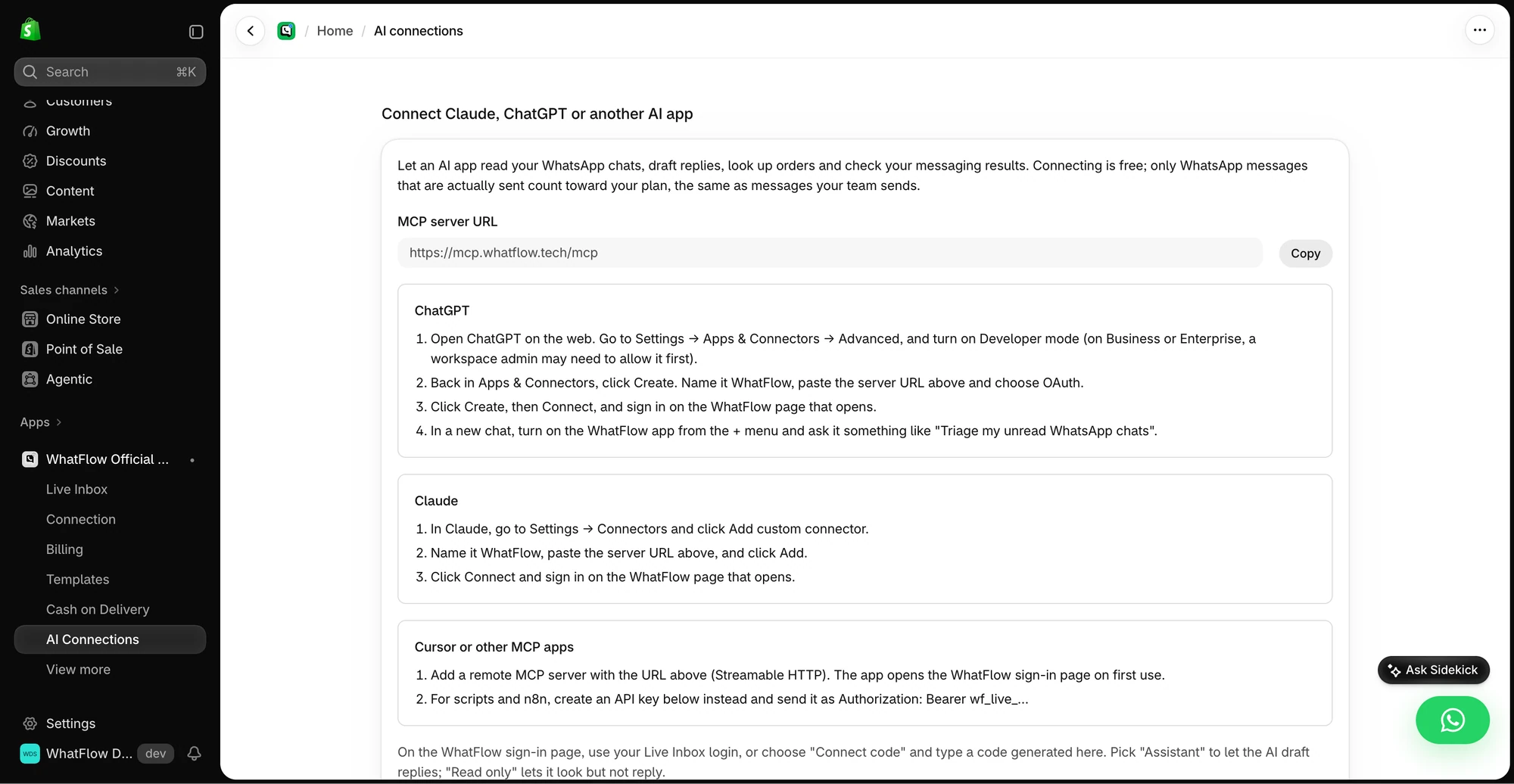
Decide where AI lives. Most helpdesks here sell AI agents or AI resolutions on top of the plan. WhatFlow takes the other route: bring your own AI through Shopify Sidekick or the WhatFlow MCP connector, with a draft mode so a person signs off every reply.
The AI Connections setup in WhatFlow for ChatGPT, Claude and Cursor, in a demo store.
That matters for cost as much as control. Helpdesk AI is often billed per resolution or per AI conversation, so a busy month raises the bill. If your team already pays for ChatGPT or Claude, connecting it to the inbox adds no per-resolution fee, and nothing goes to a customer until an agent approves the draft.
Here's a worked example of why the pricing unit matters. Say you have 8 people answering customers during a sale. On Zendesk's Suite Team plan at $55 per agent per month (billed annually), that's $440 a month before add-ons. On Gorgias Basic, agent count isn't the constraint: you pay $60 for 300 tickets and $40 per extra 100. On WhatFlow, 8 agents cost the same in seats as 2. None of these is wrong; they just reward different shapes of team.
1. WhatFlow WhatsApp Business API
Who it's for: support teams where WhatsApp is the main channel, including large teams that don't want per-seat bills.
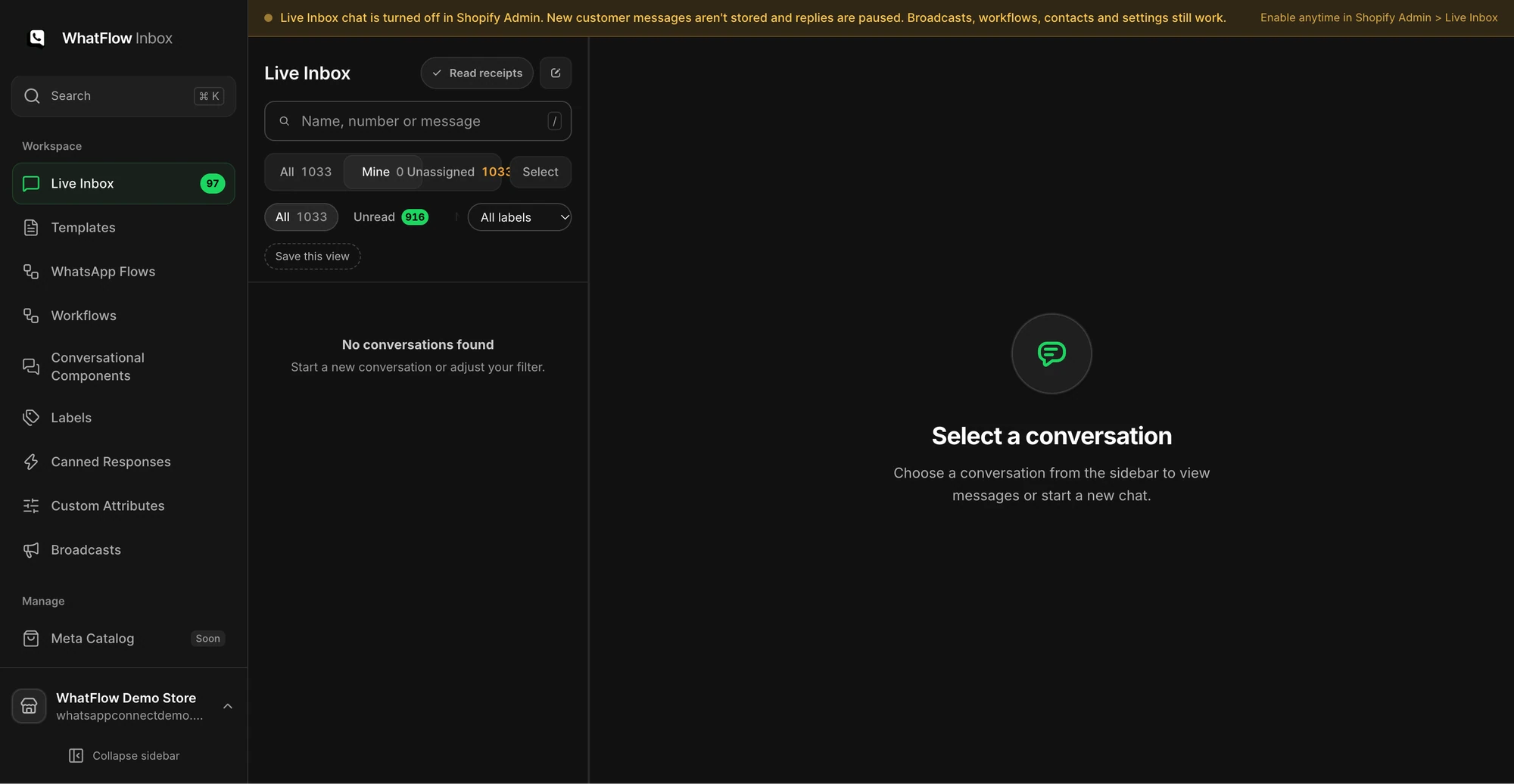
WhatFlow is built on the official Meta WhatsApp Cloud API and lives inside Shopify admin. The team inbox has assignment queues, filters, labels, custom attributes for contacts and conversations, and canned responses. Agents see their own queue with the Mine filter, and a lead can reassign chats when someone goes off shift. Our walkthrough of working a Shopify support queue in WhatFlow shows a typical day.
The WhatFlow Inbox assignment queue with the Mine filter selected, in a demo store with no open chats.
There are no seat fees on any plan, so a 50-person team pays the same in seats as a 2-person team. Every feature is on every plan, including Free.
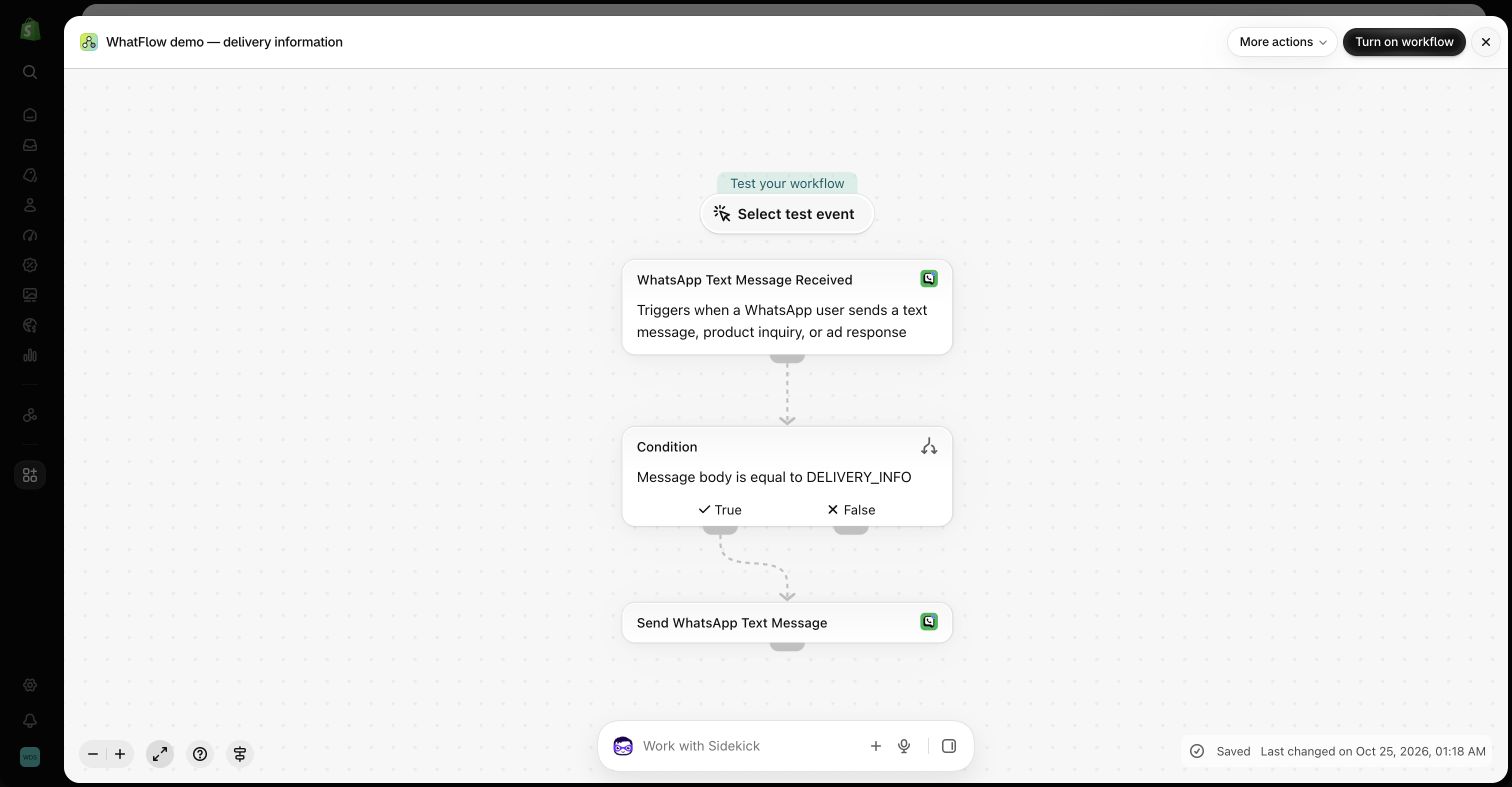
Automation runs through Shopify itself. WhatFlow has native Shopify Flow triggers and actions, including incoming-message and order-reply triggers, so you can route or tag chats with the same tool you already use for order operations. The inbox also has a workflow library and signed webhooks if you want to push events to your own systems.
An inactive Shopify Flow workflow that checks an incoming WhatsApp message before replying, in a demo store.
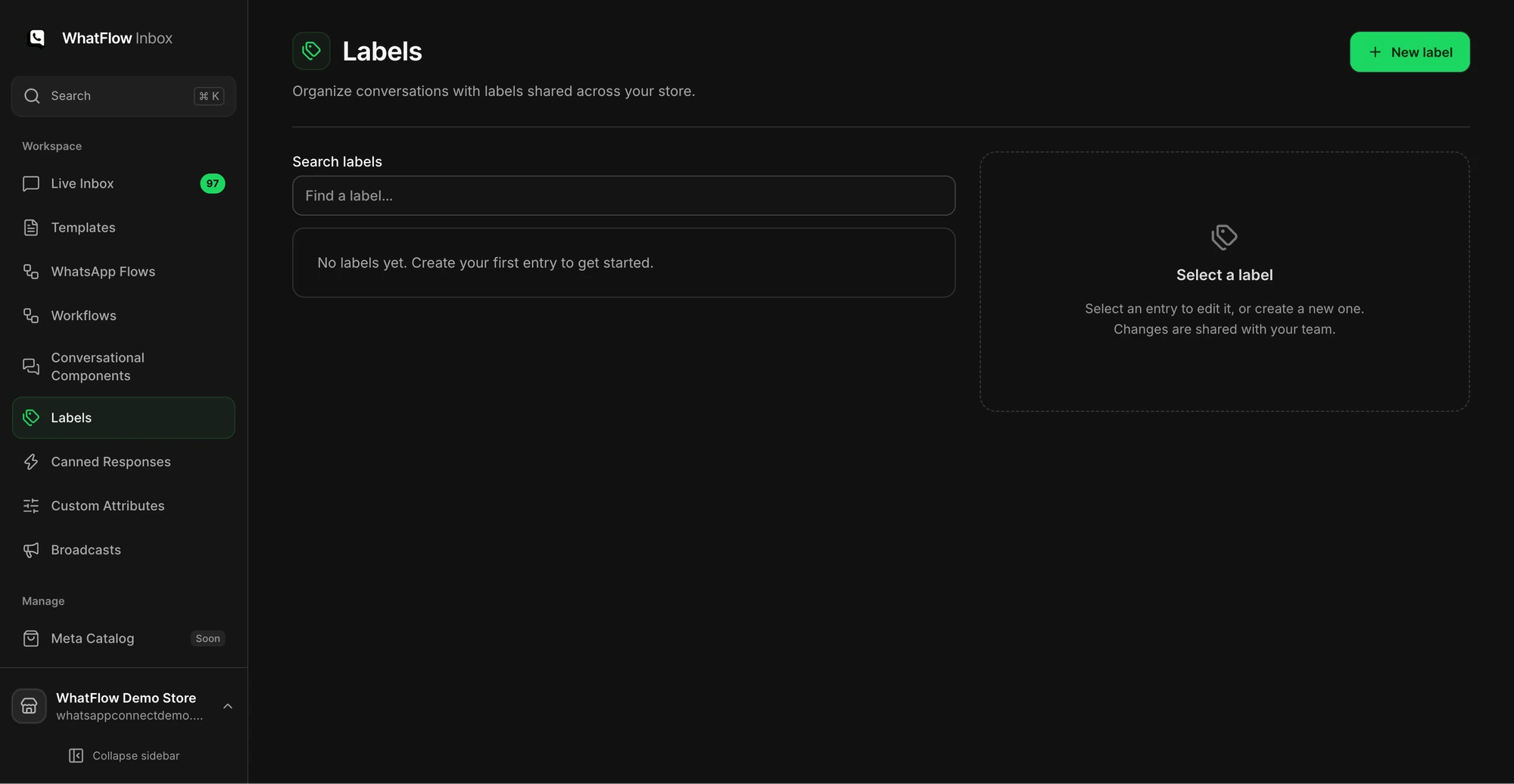
Labels and custom attributes do the job that ticket fields do in a helpdesk. Tag a chat "Return" or "Pre-sale", and store an order number or VIP tier on the contact.
The WhatFlow Inbox labels manager in a demo store.
Pricing and rating (as of November 2026): a Free plan and paid plans from $4.99/month that differ only by messaging allowance; see WhatFlow pricing. Meta's WhatsApp charges are billed separately at cost. Rated 5.0/5 from 85 ratings when we checked on November 24, 2026.
Honest limitation: WhatFlow doesn't handle email tickets, phone or social DMs. If a large share of your support is email, keep a helpdesk for it. Plenty of teams run WhatFlow for WhatsApp alongside Help Scout or Gorgias for email.
2. Gorgias
Who it's for: Shopify stores with real email and chat volume that want order actions inside every ticket.
Gorgias is the most Shopify-focused helpdesk here. Agents can edit, refund and cancel orders inside a ticket, see order history next to the conversation, and use rules, macros and auto-tagging. The listing highlights an AI Agent that answers FAQs and order questions and hands off with context, plus an AI Shopping Assistant and revenue tracking. Channels listed are email, SMS, live chat, phone and social media.
Pricing and rating (as of November 2026): Starter at $10/month (3 agents, 50 tickets, $0.40 per extra ticket); Basic at $60/month (unlimited agents, 300 tickets); Pro at $360/month; Advanced at $900/month. Each has a 7-day trial; the AI Agent is an add-on. Rated 4.3 from 709 reviews.
Honest limitation: you pay by ticket, so a spike in "where is my order?" emails shows up straight on the bill, and WhatsApp isn't named among the listing's channels. See WhatFlow vs Gorgias.
3. Zendesk
Who it's for: larger support organisations that need mature routing and already know Zendesk.
Zendesk's Shopify app puts customer and order data next to tickets and lets agents process refunds and cancellations from the Zendesk Support sidebar. The listing says it covers messaging, phone, chat, email and social media, and you can embed live chat in your storefront.
Pricing and rating (as of November 2026): Suite Team at $55, Suite Growth at $89, Suite Professional at $115 and Suite Enterprise at $150, each per agent per month billed annually, with a 14-day trial. Rated 3.2 from 96 reviews.
Honest limitation: per-agent pricing climbs fast as you hire, and the Shopify app's rating is the lowest of the helpdesks here. Our WhatFlow vs Zendesk page covers the WhatsApp side.
4. eDesk
Who it's for: sellers who also sell on marketplaces and want every channel in one place.
eDesk, from xSellco, centralises conversations in one inbox, offers a 24/7 chatbot and AI-assisted replies, and lets agents adjust Shopify orders without switching tabs. A pre-sales feature aims to turn conversations into orders. Channels listed are email, SMS, live chat, chatbot, phone and social, and its integrations include Amazon, TikTok Shop, Klaviyo, Instagram and WhatsApp.
Pricing and rating (as of November 2026): Starter at $59/month (300 tickets); Growth at $199/month (1,000 tickets); Professional at $399/month (2,000 tickets), each with a 14-day trial. Rated 4.7 from 32 reviews.
Honest limitation: ticket caps are fairly tight on the entry plan, and WhatsApp appears as an integration rather than a core channel. More in WhatFlow vs eDesk.
5. Re:amaze
Who it's for: brands running several stores that want email, chat, SMS and voice in one inbox.
Re:amaze's listing describes one inbox for email, social, SMS and voice across all your stores. Basic includes unlimited email inboxes, social integrations, live chat and chatbots, workflows, macros and an FAQ. Pro adds multi-store, SMS and VOIP integrations and advanced reports; Plus adds staff roles, shifts, departments and satisfaction surveys. AI Agent resolutions are counted per user per month. It integrates with Klaviyo, Loop Returns, ShipStation and Yotpo among others.
Pricing and rating (as of November 2026): Basic at $29/month, Pro at $49/month, Plus at $69/month, and a Starter plan at $59/month that includes 500 responded conversations. Each has a 14-day trial. Rated 4.5 from 180 reviews.
Honest limitation: multi-store and SMS need Pro or above, so the $29 entry plan suits single-store teams. See WhatFlow vs Re:amaze.
6. Help Scout
Who it's for: small, email-first teams that want a calm shared inbox and a free way to start.
Help Scout shows Shopify order details and history beside each conversation and lets agents edit, duplicate, cancel and refund orders without leaving the inbox. The listing also covers AI features (Scout AI, a Copilot, AI summaries), saved replies, auto-assign, tagging, a docs site and reporting. Channels are email, live chat, chatbot, social media and a help centre.
Pricing and rating (as of November 2026): free to install with a Free plan; the listing says Help Scout may bill external charges separately and doesn't show paid plan prices. Rated 3.7 from 19 reviews.
Honest limitation: the rating rests on very few reviews, and you'll need to check paid pricing on Help Scout's own site. Our WhatFlow vs Help Scout page explains how they pair.
7. Willdesk
Who it's for: small stores that want a helpdesk, live chat and order tracking for little money.
Willdesk, by Channelwill, includes ticketing, a workflow builder, a help centre and an AI chatbot that can handle order tracking, returns, cancellations and address updates. It connects email accounts (Gmail, Outlook, Zoho, GoDaddy) and lists Instagram, Messenger and WhatsApp.
Pricing and rating (as of November 2026): a Free plan with 20 conversations and unlimited agents; Basic at $16.90/month (100 conversations); Pro at $89.90/month (1,000 conversations). Paid plans have a 7-day trial; overages and AI conversations are charged separately. Rated 4.7 from 376 reviews.
Honest limitation: conversation caps are low on the entry plans, so busy stores will pay overage.
8. Crisp
Who it's for: teams that want a multichannel inbox priced by seat bundle rather than by ticket.
Crisp lists ticketing, a unified inbox, auto-assign, triggers, escalation, an AI agent and reports. It says it centralises 12 channels, naming email, WhatsApp, Instagram, Messenger and phone.
Pricing and rating (as of November 2026): Free (2 seats); Mini at $45/month (4 seats); Essentials at $95/month (10 seats, adds WhatsApp, Instagram and SMS); Plus at $295/month (20 seats). Paid plans have a 14-day trial. Rated 4.0 from 34 reviews.
Honest limitation: WhatsApp starts at the $95 plan, and extra seats beyond the bundle are listed as an add-on on Plus. See WhatFlow vs Crisp.
Which should you choose?
Picture two stores. The first sells electronics accessories in the UK. Most tickets are email ("my charger arrived faulty"), they need refunds inside the ticket, and five people work the queue. Gorgias or Help Scout is the right buy.
The second sells abayas from Riyadh. Customers send photos on WhatsApp asking about fabric, confirm COD orders by tapping a button, and ask for delivery updates in Arabic. A ticket queue would turn every chat into a form. WhatFlow fits, and the team can grow from three to thirty agents without seat costs, as our team maths on seat-based pricing shows.
The short version:
WhatsApp is most of your support: WhatFlow, with a light email tool beside it if needed.
Email-heavy with Shopify order actions: Gorgias.
Large team already on Zendesk: stay on Zendesk and add WhatsApp separately.
Marketplace seller: eDesk.
Several stores, mid budget: Re:amaze.
Small team, tight budget: Help Scout's Free plan or Willdesk.
If you're setting up a shared queue for the first time, our guide to a shared team inbox for a small Shopify store covers ownership, hours and handoffs whatever tool you choose.
Run WhatsApp for your Shopify store with WhatFlow
Free plan available. Templates, COD confirmation, Shopify Flow automations and a shared team inbox with no seat fees. Every feature is included on every plan, including Free.
Helpdesk pricing is usually the whole bill. With WhatsApp there's also Meta. As of October 1, 2026, Meta lets each business phone number send 1,000 free-form service replies a month inside the 24-hour customer service window, then charges at the utility rate; template messages are charged per delivery (Meta's pricing page). WhatFlow passes these through at cost, and the steps to set up inbox settings and saved replies help keep agents inside the window where replies are cheapest.
For an email-heavy support team that needs order edits and refunds inside tickets, Gorgias is the most Shopify-focused helpdesk. If most of your support happens on WhatsApp, WhatFlow's team inbox does that job with no seat fees, and you can keep a lighter tool for email.
Do Shopify helpdesks charge per agent?
Some do. As of November 2026, Zendesk's listing prices every suite per agent per month, billed annually, while Gorgias and eDesk price by ticket volume and Re:amaze counts AI resolutions per user. WhatFlow has no seat fees on any plan.
Is WhatFlow a full helpdesk?
No. WhatFlow is a WhatsApp team inbox with assignment, labels, custom attributes, canned responses, workflows and Shopify Flow automation. It doesn't handle email tickets, so email-heavy teams pair it with a helpdesk.
Which Shopify helpdesk has a free plan?
As of November 2026, Help Scout, Willdesk and Crisp list free plans on the Shopify App Store, and WhatFlow has a Free plan for WhatsApp support. Gorgias, Zendesk, eDesk and Re:amaze offer free trials instead.
Can a helpdesk handle WhatsApp for a Shopify store?
Several can connect WhatsApp, but check the plan: Crisp adds WhatsApp on its Essentials plan, and eDesk lists WhatsApp as an integration rather than a core channel. A WhatsApp-first app also gives you templates, order messages and COD confirmation that helpdesks don't focus on.