
Publisher disclosure: this comparison is written by WhatFlow. Competitor capabilities are based on the linked public documentation; the WhatFlow screenshots come from our demo store. Examples are illustrative, and results depend on your store and configuration.
WhatFlow and Re:amaze at a glance
| Consideration | WhatFlow | Re:amaze |
|---|---|---|
| WhatsApp connection | Official Meta WhatsApp Cloud API, connected through Meta Embedded Signup inside Shopify admin. | WhatsApp channel powered by Twilio's API for WhatsApp Business; the connected number must be provided by Twilio. |
| Built for Shopify | Shopify-only app with admin extensions and native Shopify Flow triggers and actions. | Multichannel helpdesk with a Shopify App Store app; Shopify is one of several platforms it supports. |
| Pricing and billing units | Free plan; paid plans from $4.99/month, priced by messages sent. Meta fees separate. | Basic $29, Pro $49, Plus $69 per team member per month, or Starter at $59 flat with 500 responded conversations (as of November 2026). Twilio bills $0.005 per WhatsApp message on top. |
| Team inbox seats | No seat fees at any team size, with assignment and filters. | Per team member on Basic, Pro and Plus. Starter allows unlimited team members but caps responded conversations. |
| Feature access by plan | Every feature on every plan, including Free. | Features vary by tier; SMS and Voice channels are listed from Pro. |
| COD confirmation | Template with reply buttons that tag or cancel the Shopify order through Flow. | Not described on Re:amaze's pricing page or WhatsApp integration page. |
| Abandoned checkout recovery and broadcasts | Included on every plan, using Meta-approved templates. | Not described for WhatsApp on Re:amaze's WhatsApp integration page. |
| Catalog sharing | Live Meta product catalog sharing from the inbox. | Not described on the WhatsApp integration page. |
| Shopify App Store rating | 5.0 out of 5 from 55 ratings (WhatsApp Business API, November 5, 2026). | 4.5 out of 5 from 181 reviews (Re:amaze AI Helpdesk & Chat, November 5, 2026). |
| Best fit | Shopify stores where WhatsApp drives sales, COD and support, from solo founders to large teams. | Teams that want one per-seat helpdesk across email, chat, social and voice, with WhatsApp as a side channel. |
If your Shopify store sells, confirms orders and answers customers on WhatsApp, pick WhatFlow over Re:amaze. WhatFlow runs on the official Meta Cloud API, connects from Shopify admin, and puts COD confirmation, abandoned checkout recovery, broadcasts and Shopify Flow actions on every plan. The team inbox has no seat fees. Re:amaze is a solid helpdesk, but you pay per team member and its WhatsApp channel needs a Twilio number.
One correction before we go further. A lot of merchants still file WhatFlow under "unofficial WhatsApp apps for small shops." That's our older linked-device app, WhatFlow Chat Automation. WhatFlow WhatsApp Business API is the official-API product: enterprise-ready, with inbox assignment and filters, no seat fees at any team size, Shopify Flow automation, catalog sharing, admin extensions and a 5.0 rating on the Shopify App Store.
WhatFlow vs Re:amaze at a glance
WhatFlow | Re:amaze | |
|---|---|---|
What it is | WhatsApp app built for Shopify | Multichannel helpdesk |
WhatsApp route | Official Meta Cloud API, Embedded Signup | Twilio API, Twilio-provided number |
Seat pricing | None | $29–$69 per team member per month |
Free plan | Yes, every feature | 14-day trial |
COD, cart recovery, broadcasts | Every plan | Not described for WhatsApp |
Shopify Flow | Native triggers and actions | Not described |
Shopify rating (Nov 5, 2026) | 5.0 (55 ratings) | 4.5 (181 reviews) |
How much does Re:amaze cost compared with WhatFlow?
Re:amaze's pricing page lists Basic at $29, Pro at $49 and Plus at $69, each per team member per month, as of November 2026. There's also a flat Starter plan at $59 a month for unlimited team members, capped at 500 responded conversations (its Shopify listing sells extra conversations in packs of 100 for $15).
WhatsApp adds another bill. Re:amaze's WhatsApp integration runs through Twilio and requires a Twilio-provided number, and Twilio charges $0.005 per WhatsApp message, inbound or outbound.
Say you run five support people on Re:amaze Pro and handle 10,000 WhatsApp messages a month, in and out:
- Re:amaze seats: 5 × $49 = $245/month
- Twilio fees: 10,000 × $0.005 = $50/month
- Total before Meta fees: about $295/month
Now WhatFlow:
- Seats: $0, whether it's five people or fifty
- Plan: Growth at $29/month includes 20,000 messages; Plus at $9.99 includes 5,000
- Total before Meta fees: $29/month on Growth
Add a sixth agent at peak season and Re:amaze goes up $49. WhatFlow doesn't move. Meta's own per-message charges apply to both, and since October 1, 2026 only the first 1,000 service messages per business number each month are free (see Meta's pricing doc). Our WhatsApp Business API pricing guide walks through those fees, and current WhatFlow amounts are on the pricing page.
Which handles Shopify WhatsApp workflows better?
WhatFlow, and it isn't close. Re:amaze treats WhatsApp as an inbound support channel: messages arrive, agents reply. That's useful. But a Shopify store on WhatsApp needs to start conversations too, and outside the 24-hour customer service window WhatsApp only allows Meta-approved templates.
WhatFlow is built around those templates and Shopify events:
- COD confirmation: a template goes out when the order lands, with reply buttons. The customer taps "Confirm" or "Cancel", and Shopify Flow tags or cancels the order. Our guide to turning WhatsApp order replies into Shopify actions shows the full setup.
- Abandoned checkout recovery and order and shipping updates.
- Broadcasts to opted-in customers.
- Native Shopify Flow triggers (incoming message, order reply) and actions (send template, text, media).
- Live catalog sharing from the inbox.
A COD confirmation in WhatFlow reads like this:
Hi Sara, thanks for your order #4821 (2 × Rose Serum, Rs 3,400, cash on delivery). Tap Confirm and we'll ship today, or Cancel if you've changed your mind.
None of that is described on Re:amaze's WhatsApp integration page. You'd be building around it.
Is WhatFlow ready for a large support team?
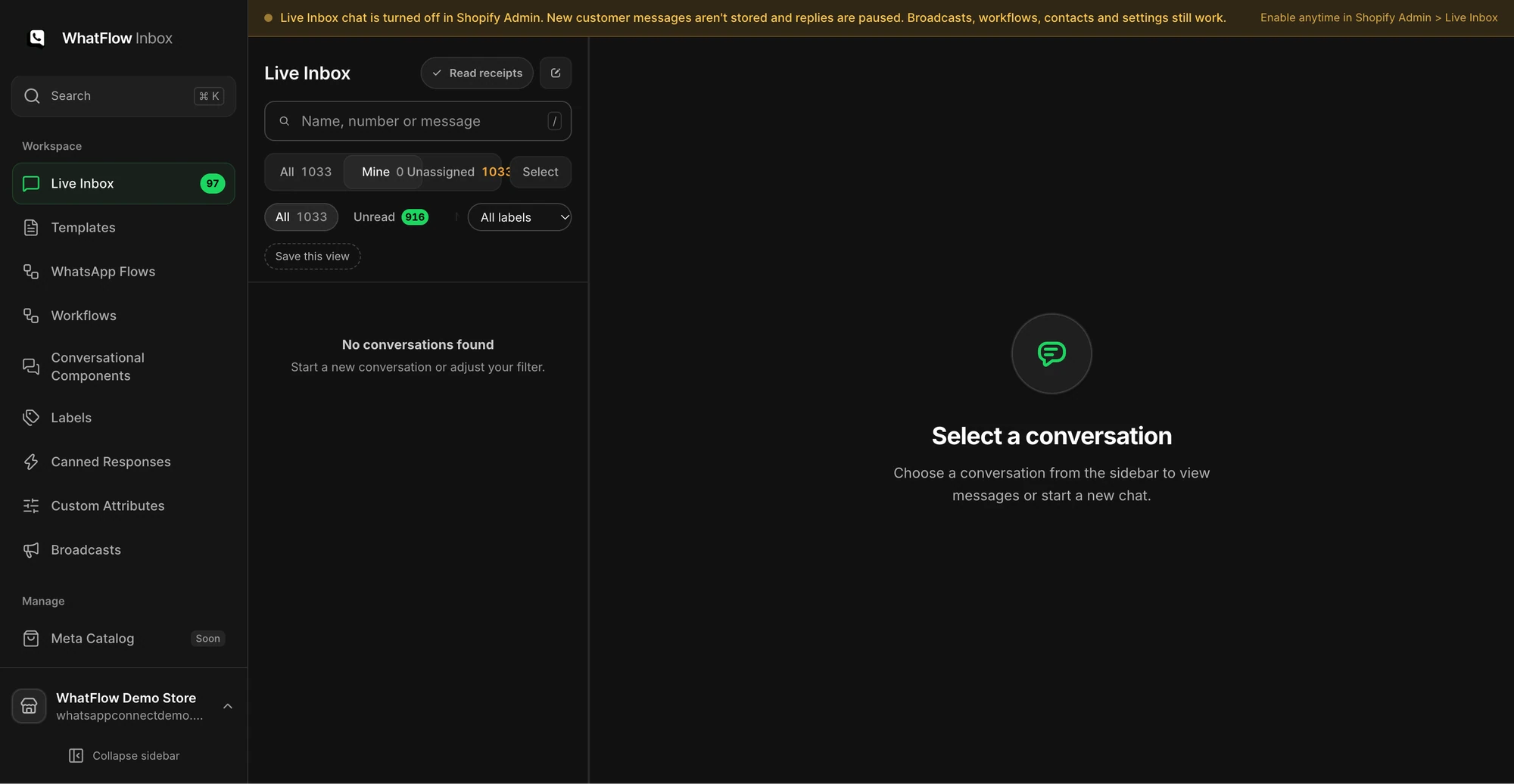
Yes. This is the part people get wrong about us. WhatFlow's team inbox has assignment and filters, saved replies and catalog sharing, and you add as many teammates as you like without seat fees. A 40-person team costs the same in seats as a two-person team: nothing.
When testing WhatFlow and Re:amaze, ask: Can an agent open a matching Shopify order while they reply? In WhatFlow, use Needs reply and Closing soon, claim a conversation, then check Shopify order context and leave a private note. The team inbox walkthrough gives you a repeatable test for two agents, with no per-seat fee.
On Re:amaze, a 40-person team on Pro is 40 × $49 = $1,960 a month in seats alone. The Starter plan avoids seat fees, but its 500 responded conversations a month won't stretch far for a large team.
Then there's the connection. WhatFlow uses Meta Embedded Signup from Shopify admin, so your number, templates and business profile sit on the official WhatsApp Business Platform with no third-party number requirement. For the team side, our shared inbox guide covers ownership rules that keep replies from slipping.
When might Re:amaze still make sense?
Pick Re:amaze only if you specifically need one per-seat helpdesk that handles email, live chat, social, SMS and voice together, with AI agent resolutions, and WhatsApp is a minor channel for you. Plenty of stores run both: Re:amaze for email tickets, WhatFlow for WhatsApp.
The bottom line
Re:amaze is a helpdesk that can receive WhatsApp. WhatFlow is a WhatsApp operation built for Shopify, on the official Meta Cloud API, with COD confirmation, cart recovery, broadcasts and Flow automation on every plan, and no seat fees as your team grows. Start on the Free plan, move to $4.99 when you need more messages, and keep every feature the whole way.
Questions worth asking
Is WhatFlow a good Re:amaze alternative for WhatsApp on Shopify?
Yes. WhatFlow is built for WhatsApp on Shopify, runs on the official Meta Cloud API and includes COD confirmation, cart recovery, broadcasts, catalog sharing and Shopify Flow actions on every plan. Its team inbox has no seat fees.
How does Re:amaze connect to WhatsApp?
Re:amaze's WhatsApp integration is powered by Twilio's API for WhatsApp Business, and the business number must be provided by Twilio. Twilio charges $0.005 per WhatsApp message, inbound or outbound, on top of Meta's fees.
How much does Re:amaze cost for a five-person team?
On Re:amaze's Pro plan at $49 per team member per month (as of November 2026), five people cost $245 a month before Twilio and Meta charges. WhatFlow charges no seat fees, so the same five people share one plan starting at $0.
Does WhatFlow have AI like Re:amaze?
Not built in. Re:amaze sells AI agent resolutions, while WhatFlow has no built-in AI bot and no per-resolution AI fees. Instead, WhatFlow's MCP connector lets you connect Claude, ChatGPT or Cursor to read chats and draft replies that a person approves. WhatFlow also focuses on Shopify WhatsApp automation through templates and Shopify Flow, plus a human team inbox with no seat fees.
Sources and methodology
We checked these primary sources on November 5, 2026. Vendor pages describe advertised capabilities, rather than independent performance tests. Confirm current pricing, plan limits and availability with each provider.
- Re:amaze pricing
Per-team-member plans (Basic $29, Pro $49, Plus $69), Starter at $59 flat with 500 responded conversations, and AI resolution charges, checked November 5, 2026.
- Re:amaze WhatsApp Business integration
States the integration is powered by Twilio's API for WhatsApp Business and requires a Twilio-provided number.
- Re:amaze AI Helpdesk & Chat on the Shopify App Store
Re:amaze's Shopify plans and its 4.5/5 rating from 181 reviews, checked November 5, 2026.
- Twilio WhatsApp pricing
Twilio's $0.005 per-message fee for WhatsApp, inbound or outbound, checked November 5, 2026.
- WhatFlow WhatsApp Business API on the Shopify App Store
WhatFlow plans, included messages and the 5.0/5 rating from 55 ratings, checked November 5, 2026.
- WhatsApp Business Platform pricing documentation
Meta's per-message pricing, including the October 1, 2026 changes to free service messages.