Shopify vs PrestaShop in 2026: costs, upkeep and a verdict
Shopify vs PrestaShop in 2026: hosted SaaS vs free open-source software, with real plan prices, hosting, modules vs apps, EU tools and WhatsApp options.
Shopify vs PrestaShop comes down to who runs the store's technology. Shopify is hosted software: you pay a monthly plan and Shopify handles hosting, security and updates. PrestaShop is free open-source software you install and maintain on your own hosting, or rent pre-installed through PrestaShop's paid Hosted offer. Pick Shopify unless you want full code control and have someone technical to look after it.
Shopify figures below come from shopify.com/pricing; PrestaShop figures come from prestashop.com and PrestaShop's GitHub repository. All were checked on November 24, 2026.
What is PrestaShop?
PrestaShop is an open-source ecommerce platform written in PHP. It was founded in 2007, and its about page says more than 230,000 stores run on it. In 2026 it joined cyber_Folks, a European tech group, and PrestaShop 9.2 came out in September 2026.
It comes in two offers:
PrestaShop Classic is the free download. The core is licensed under OSL-3.0 (modules under AFL-3.0), per the GitHub repo. You pick a host, install it, and run it. PrestaShop's own offers page says "associated costs (hosting, domain name, etc.) are not included."
PrestaShop Hosted is a paid subscription. PrestaShop installs and hosts the store for you (hosting is with its partner Gandi, 50GB), adds a bundle of services and gives you support six days a week. PrestaShop's Hosted page says it's based on PrestaShop 8.
Basic $25, Grow $65, Advanced $399 a month (monthly billing); $19, $49, $299 billed yearly; Plus from $2,300
Free download (OSL-3.0)
€29 excl. VAT a month, or €24 a month on annual payment
Hosting
Included
You buy it
Included (Gandi, 50GB)
Updates and security
Shopify handles them
You do; an Update Assistant module helps
Hosting and installation handled; based on PrestaShop 8
Developer needed?
Optional
Usually, at least for setup
Optional for setup
Extensions
Shopify App Store apps
PrestaShop Marketplace modules and themes (3,200+)
Same Marketplace
Built-in EU tools
Via settings and apps
Via modules
Automatic VAT by customer country, GDPR and cookie assistant
Automation
Shopify Flow, free on Basic and up
Modules or custom code
Includes PrestaShop Automation with Klaviyo
Support
Shopify support
Help docs, community, paid support plans
Email, live chat or phone, six days a week
Trial
3 days free, then $1 a month for 3 months
Download and install
14 days free
How much does PrestaShop really cost compared with Shopify?
On paper PrestaShop wins: free beats $25 a month. In practice, the free download is the start of the bill.
A working PrestaShop Classic store needs:
Hosting that meets the requirements. PrestaShop's GitHub README lists a web server with PHP 8.1+ and MySQL 5.6+ (or MariaDB/Percona) for PrestaShop 9.0, plus a database tool such as phpMyAdmin.
A domain and an SSL certificate, depending on your host.
Someone to install and configure it. PrestaShop's own FAQ says it "requires some technical knowledge, especially to install your store on a server," and to customise it. There are more than 250 certified PrestaShop agencies if you'd rather hire one.
Paid modules and themes for features beyond the core.
Time for updates, security patches and checking modules still work after each one.
I can't give you an honest total for that, because hosting and developer rates vary enormously between, say, Lyon, Casablanca and Karachi. What I can tell you: for a team of one to twenty with no developer on staff, Shopify usually works out cheaper overall, and much cheaper in hours.
PrestaShop Hosted narrows the gap. At €24 a month (annual, excl. VAT) you get hosting, installation, support and a pre-installed set of services. That's close to Shopify Basic's $19 a month on yearly billing. The trade is that you're back on a subscription, so the "free and open" argument mostly disappears, though you keep data ownership and PrestaShop's module ecosystem.
Shopify is a plan plus apps. Basic is $25 a month on monthly billing ($19 on yearly), Grow is $65 with five additional staff accounts, Advanced is $399 with fifteen. Shopify's pricing page says third-party transaction fees may apply if you use a payment provider other than Shopify Payments, at a rate that depends on your plan, so check that before you pick a gateway.
Hosting and maintenance: the real difference
This is the part that decides it for most people.
On Shopify there's no version to upgrade. You log in, and the platform is current. Checkout, hosting, SSL and security patches are Shopify's job. The cost is less low-level control: you customise what Shopify's themes, apps and APIs allow.
On PrestaShop Classic, the code is yours. You can change anything, and you're responsible for everything. Major versions move: the Hosted offer runs on PrestaShop 8 while Classic is on 9.x, and PrestaShop 9.2 shipped in September 2026. Every upgrade means testing your theme and each module. PrestaShop does ship an Update Assistant module to make that easier, but someone still has to run it, test checkout afterwards and roll back if something breaks.
Say a module update breaks your checkout at 9pm on a Friday during a sale. On Shopify, an app might misbehave, but checkout itself is Shopify's to keep running. On self-hosted PrestaShop, it's your developer's phone that rings. If you don't have that person, that's your answer.
Modules vs apps
Both have large ecosystems.
PrestaShop modules come from the PrestaShop Marketplace (PrestaShop says more than 3,200 themes and modules) and from independent developers. Modules install into your store's code and you manage them from the back office. That gives them deep access, and it's also why module conflicts after upgrades are a familiar PrestaShop headache.
Shopify apps run outside your store and connect through Shopify's APIs and admin. They don't touch Shopify's core, so there's no core upgrade to re-test them against. Many also plug into Shopify Flow, which lets apps trigger each other without code.
For most small teams, Shopify's model is the safer one. For a store that needs deep custom logic in checkout or pricing and has a developer on hand, PrestaShop's openness is the point.
Is PrestaShop better for European stores?
PrestaShop's Hosted offer is clearly built with the EU in mind. It's priced in euros excluding VAT, it calculates VAT automatically based on the customer's country of residence, and it includes a Legal Assistant for GDPR compliance and cookie management. PrestaShop is also now part of a European group, which matters to merchants who care about keeping their stack European. PrestaShop says its software is available in more than 75 languages.
Shopify stores sell across Europe too, and Shopify runs the hosting and checkout for you. But Shopify doesn't package an "EU bundle" the way PrestaShop Hosted does, so you'll set up tax and consent through Shopify's settings and apps yourself.
My take: if EU compliance tooling in one box and European ownership are deciding factors, PrestaShop Hosted deserves a serious look. If you sell across Europe and beyond (the Gulf, South Asia, Latin America), Shopify's app ecosystem and hosted checkout carry more weight.
WhatsApp and customer messaging on each platform
Neither platform has WhatsApp built in, so both rely on add-ons.
On PrestaShop, you'll find third-party WhatsApp modules ranging from simple chat buttons to order-notification modules. Some connect to Meta's WhatsApp Business platform: Webkul's order notifications module, for example, asks for a Meta App ID, Phone Number ID, Business Account ID and a permanent token during setup. That works, but you're wiring a Meta developer app yourself and keeping the module working through each PrestaShop upgrade.
On Shopify, WhatsApp apps install from the Shopify App Store and connect through Shopify's admin. WhatFlow WhatsApp Business API runs on Meta's official WhatsApp Cloud API, and you connect your number through Meta's Embedded Signup without creating a developer app. You get order and shipping updates, abandoned checkout recovery, COD confirmation and a shared team inbox with no seat fees, so a growing support team doesn't mean a growing seat bill. Everything is on every plan, including the Free plan; see WhatFlow pricing.
The rules are the same everywhere. Outside the 24-hour customer service window (the 24 hours after a customer's last message), a business can only send a Meta-approved template, and only to people who opted in, per the WhatsApp Business Messaging Policy. So order updates should fire automatically from store events.
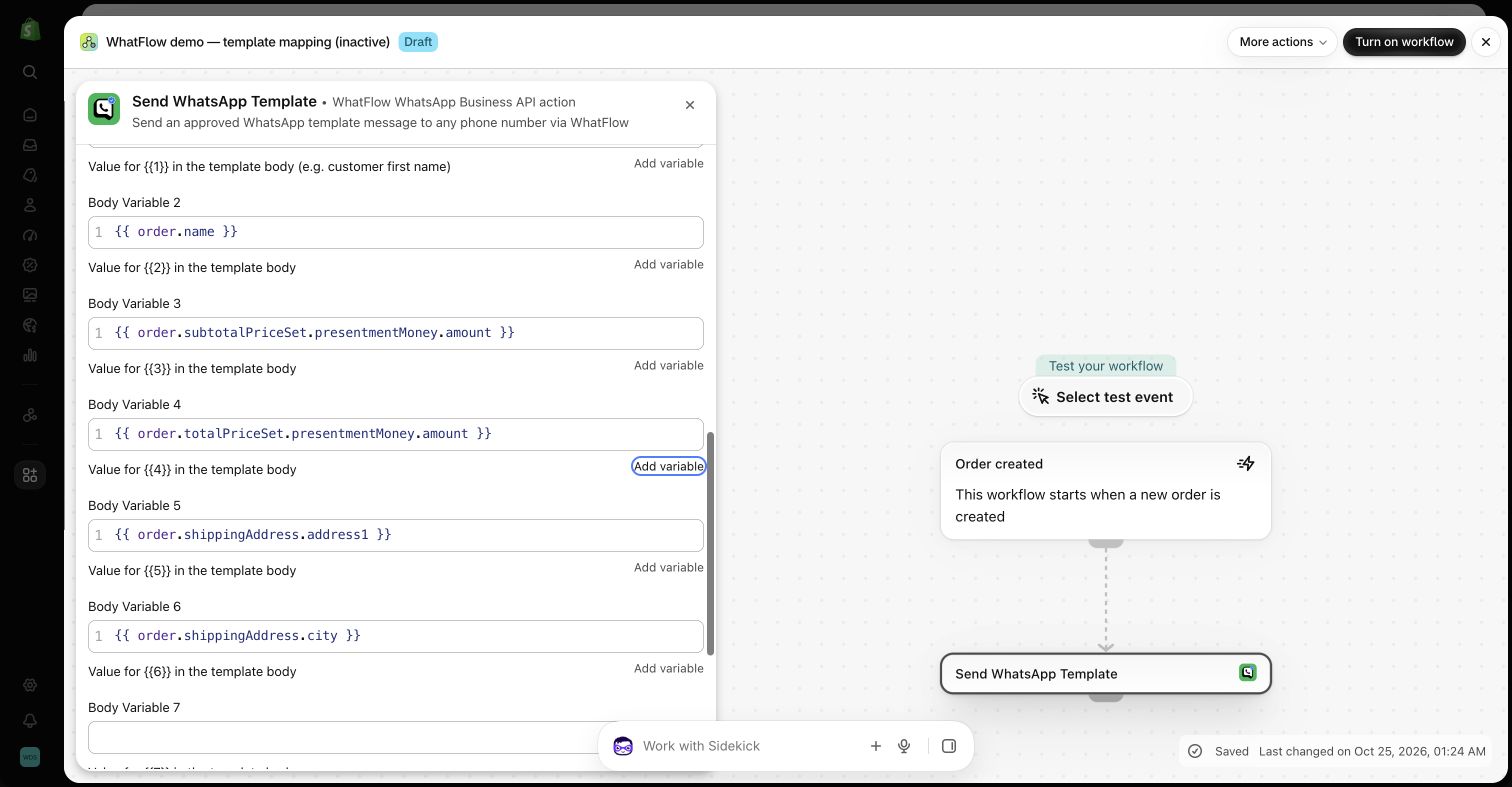
On Shopify that's a Shopify Flow workflow: order created, payment method is COD, send a WhatsApp template. With WhatFlow's Flow triggers and actions, the customer's reply can tag or cancel the order:
Bonjour Camille, merci pour votre commande #2093 : 1 x sac en cuir, 145 €. Tapez Confirmer pour l'expédier aujourd'hui, ou Annuler si vous avez changé d'avis.
WhatFlow template variables mapped to Shopify order fields in a demo-store Flow workflow. Sample data; nothing was sent.
Export products, customers and orders, or use a migration app or Shopify Partner.
Import products first, then customers, then historical orders.
Map every PrestaShop URL to its new Shopify URL and import the redirects, so you keep your search rankings.
Rebuild customer messages: order confirmation, shipping, review requests. Submit WhatsApp templates for approval a week before launch.
Rebuild automations in Shopify Flow instead of porting module logic.
Place test orders on every payment method, then switch the domain.
Who should pick PrestaShop, and who should pick Shopify?
Pick PrestaShop if:
You (or a long-term agency) are comfortable with PHP, hosting and upgrades.
You want full ownership of the code and data, with no platform subscription on Classic.
You sell mainly in the EU and value PrestaShop Hosted's built-in VAT and GDPR tools, or want a European-owned stack.
Pick Shopify if:
You're a team of 1 to 20 without a developer on staff.
You want hosting, security and updates handled, with no upgrade projects.
You'd rather automate with Shopify Flow and apps than custom modules.
You sell in WhatsApp-first, COD-heavy markets where Shopify's app ecosystem is deep.
My verdict: Shopify is the better choice for most stores because it removes the hosting and upgrade work that quietly eats PrestaShop budgets. PrestaShop is a strong pick for technical teams and EU-focused merchants who want control. Comparing other options? See Shopify vs Magento for the other big open-source platform and Shopify vs WooCommerce for the WordPress route.
Run WhatsApp for your Shopify store with WhatFlow
Free plan available. Templates, COD confirmation, Shopify Flow automations and a shared team inbox with no seat fees. Every feature is included on every plan, including Free.
If you're moving to Shopify, the Shopify app cost audit keeps your new app bill honest from day one.
Frequently asked questions
Is PrestaShop really free?
The software is. PrestaShop Classic is a free download, with the core licensed under OSL-3.0, but PrestaShop says hosting, a domain name and other associated costs aren't included. Paid modules, themes and developer time add to that.
How much does PrestaShop Hosted cost?
As of November 2026, PrestaShop's Hosted offer costs €29 a month excluding VAT with no commitment, or €24 a month excluding VAT on annual payment, with a 14-day free trial. It includes hosting with Gandi (50GB), installation and support six days a week.
Is Shopify cheaper than PrestaShop?
Not on software alone, because PrestaShop Classic is free and Shopify Basic is $25 a month on monthly billing. Once you add hosting, updates, security and developer time, Shopify usually costs a small team less in total and far less in attention.
Can I use WhatsApp on PrestaShop?
Yes, through third-party modules, from simple chat buttons to modules that connect to Meta's WhatsApp Business platform for order notifications. On Shopify, apps like WhatFlow run on Meta's official WhatsApp Cloud API and plug into Shopify Flow.
Classic is a free download with hosting and domain costs not included; Hosted from €24 excl. VAT a month annually or €29 monthly, with a 14-day trial (checked November 24, 2026).
Hosted inclusions: Gandi hosting (50GB), installation, automatic VAT calculation, GDPR and cookie tools, support six days a week, based on PrestaShop 8.