Shopify vs Magento (Adobe Commerce): which fits your store in 2026?
Shopify vs Magento in 2026: hosted SaaS vs self-hosted open source and Adobe Commerce, with real costs, upgrades, extensions, B2B and automation compared.
Shopify vs Magento comes down to who runs the platform. Shopify is hosted software: you pay a monthly plan and Shopify handles servers, security and updates. Magento Open Source is free code you host, patch and upgrade yourself, and Adobe Commerce is Adobe's paid edition of it. Pick Shopify unless you have a development team and requirements Shopify genuinely can't meet.
Shopify figures below come from shopify.com/pricing and the Shopify Help Center. Magento and Adobe Commerce facts come from Adobe's documentation and the Magento GitHub repository. All were checked on November 23, 2026.
What's the difference between Magento and Adobe Commerce?
People say "Magento" for three different things, and the costs differ a lot.
Magento Open Source is the open-source core, published on GitHub under the OSL 3.0 licence. Adobe's README describes it as basic ecommerce capabilities to build a store from the ground up. There's no licence fee. You (or your agency) install it on your own servers and look after it.
Adobe Commerce is the licensed edition sold by Adobe. It adds features, including a full B2B suite. It runs on-premises (Adobe's docs say you "host and manage your own infrastructure"), on Adobe's managed cloud infrastructure (Adobe Commerce on Cloud), or as Adobe Commerce as a Cloud Service, Adobe's SaaS version.
Adobe Commerce as a Cloud Service is the newest option. Adobe hosts it, scales it and applies updates, with a 30-day sandbox window to test each update before it reaches production. Custom features live outside the core, built with App Builder, API Mesh, events and webhooks. Its storefront is headless and delivered through Edge Delivery Services; Adobe says Luma storefronts aren't supported.
Adobe doesn't publish Adobe Commerce prices on the pages I could load, and its pricing page timed out every time I tried, so you'll need a quote from Adobe or a partner.
Shopify POS on all plans; POS Pro $89 a month per location
Via extensions
Via extensions or integrations
Trial
3 days free, then $1 a month for 3 months
Download and install
Contact Adobe
How much does Magento really cost compared with Shopify?
Shopify's cost is mostly the plan you pick plus apps. Shopify Basic is $25 a month on monthly billing and covers hosting, checkout, security and platform updates. If you use Shopify Payments there's no extra transaction fee; with a third-party gateway Shopify adds a plan-based fee, though cash on delivery and other manual payments are exempt.
Magento Open Source has no licence fee, which is where the "Magento is free" idea comes from. But a working store still needs:
Hosting that meets Adobe's stack requirements. Adobe's installation guide lists a stack of Nginx or Apache, PHP, MySQL or MariaDB, Redis and a search engine, and recommends at least 2GB of PHP memory. That's not a $5 shared-hosting plan.
A developer to install, configure, theme and deploy it, and to stay on call.
Security patching and version upgrades, on your schedule and at your cost.
Extensions for features Shopify apps would cover, plus the work of keeping them compatible.
I can't give you honest dollar figures for that, because hosting and developer rates vary hugely by country and agency, and Adobe doesn't publish licence prices. What I can say: for a store with one to twenty people and no in-house developer, Shopify will almost always cost less in total, and it'll cost far less in attention.
Where Magento can make financial sense is a business that already pays a development team, has complex catalogue or pricing logic, and would be building custom code on any platform anyway.
What does upgrading Magento involve?
This is the part that bites. On Shopify there's no "version" to upgrade. You log in and the platform is current.
Adobe's lifecycle policy gives each Adobe Commerce version three years of standard support from release, covering quality fixes and security patches. Version 2.4.9 came out on May 12, 2026, with standard support until May 31, 2029. Version 2.4.6 gets extended support until August 31, 2027. Adobe also says it doesn't patch third-party dependencies such as PHP or MySQL once they reach end of life.
On Adobe Commerce on Cloud, Adobe says that from June 1, 2027 it will no longer maintain environments running unsupported versions, and may suspend their traffic. In plain words, an old version can take the store offline. Adobe recommends moving to Adobe Commerce as a Cloud Service, where it handles updates, or upgrading to a supported release.
If you self-host Magento Open Source, the same upgrade treadmill is yours. Plan for one meaningful upgrade project every few years, plus regular security patches in between, and budget developer time for every extension that needs updating alongside it.
Extensions and apps
Both ecosystems are large.
Magento extensions come from the Adobe Commerce Marketplace and from agencies and developers. Classic Magento extensions are PHP modules that run inside your codebase, so they can do almost anything and they can also conflict with each other during upgrades. The SaaS edition moves customisation outside the core, using App Builder apps that upgrade independently.
Shopify apps run outside your store and plug in through Shopify's APIs and admin. You install them from the admin, and because Shopify has no core version for you to upgrade, there's no upgrade project to re-test them against. The trade-off is less low-level control: you customise what Shopify's APIs and Shopify Functions allow, not the core itself.
For most stores, Shopify's model is the safer one. For a store that needs deep custom checkout or pricing logic, Magento's openness is the point.
B2B: where Adobe Commerce is strong
Credit where it's due. Adobe Commerce's B2B suite is broad out of the box:
Company accounts with roles and permissions, and a Pay on Account option for buying on a credit line
Shared catalogs with custom prices per company
Negotiable quotes, where buyer and seller go back and forth on price
Requisition lists for repeat orders
Purchase orders with approval rules
Quick order by product name or SKU
Shopify B2B is available on Basic, Grow, Advanced and Plus, per Shopify's Help Center. Shopify's pricing page shows up to three B2B catalogs on Basic to Advanced and unlimited on Plus. The B2B features you get depend on your plan, so check Shopify's features-by-plan page before you commit.
If you run a wholesale business with negotiated contracts, multi-level buyer approvals and thousands of SKUs per company, Adobe Commerce is a serious contender. If wholesale is a side channel, Shopify plus a sensible process is enough. My guide to handling wholesale enquiries on WhatsApp shows how small teams run B2B without a full portal.
Messaging and automation: Shopify Flow vs custom builds
On Magento, automation usually means code: an extension, a cron job, or (on the SaaS edition) events and webhooks feeding an App Builder app. It's powerful and flexible, and you pay a developer to build and maintain each workflow.
On Shopify, Shopify Flow is a free automation app on Basic, Grow, Advanced and Plus. You pick a trigger ("order created"), add conditions ("payment method is COD") and actions ("send a WhatsApp template", "add tag"). Apps add their own triggers and actions, so they talk to each other without a developer.
That difference matters most for customer messaging. WhatsApp has rules: outside the 24-hour customer service window (the 24 hours after a customer's last message), a business can only send a Meta-approved template, and only to people who opted in, per the WhatsApp Business Messaging Policy. So order updates need to fire automatically from store events, with the right template.
On Shopify, that's a Flow workflow. WhatFlow's WhatsApp Business API app runs on Meta's official WhatsApp Cloud API and adds native Shopify Flow triggers and actions: send a template when an order is created, then react when the customer replies. A COD confirmation might read:
Hi Marco, please confirm order #7781: 2 x ceramic planters, €84, cash on delivery. Tap Confirm and we'll ship today, or Cancel if you've changed your mind.
When Marco taps Confirm, Flow tags the order for the warehouse. If he taps Cancel, Flow can cancel it. No developer, no cron job. Teams scaling past a couple of agents also get a shared inbox with no seat fees, which is why WhatFlow suits growing Shopify teams as well as one-person shops. See send WhatsApp templates from Shopify Flow for the step-by-step.
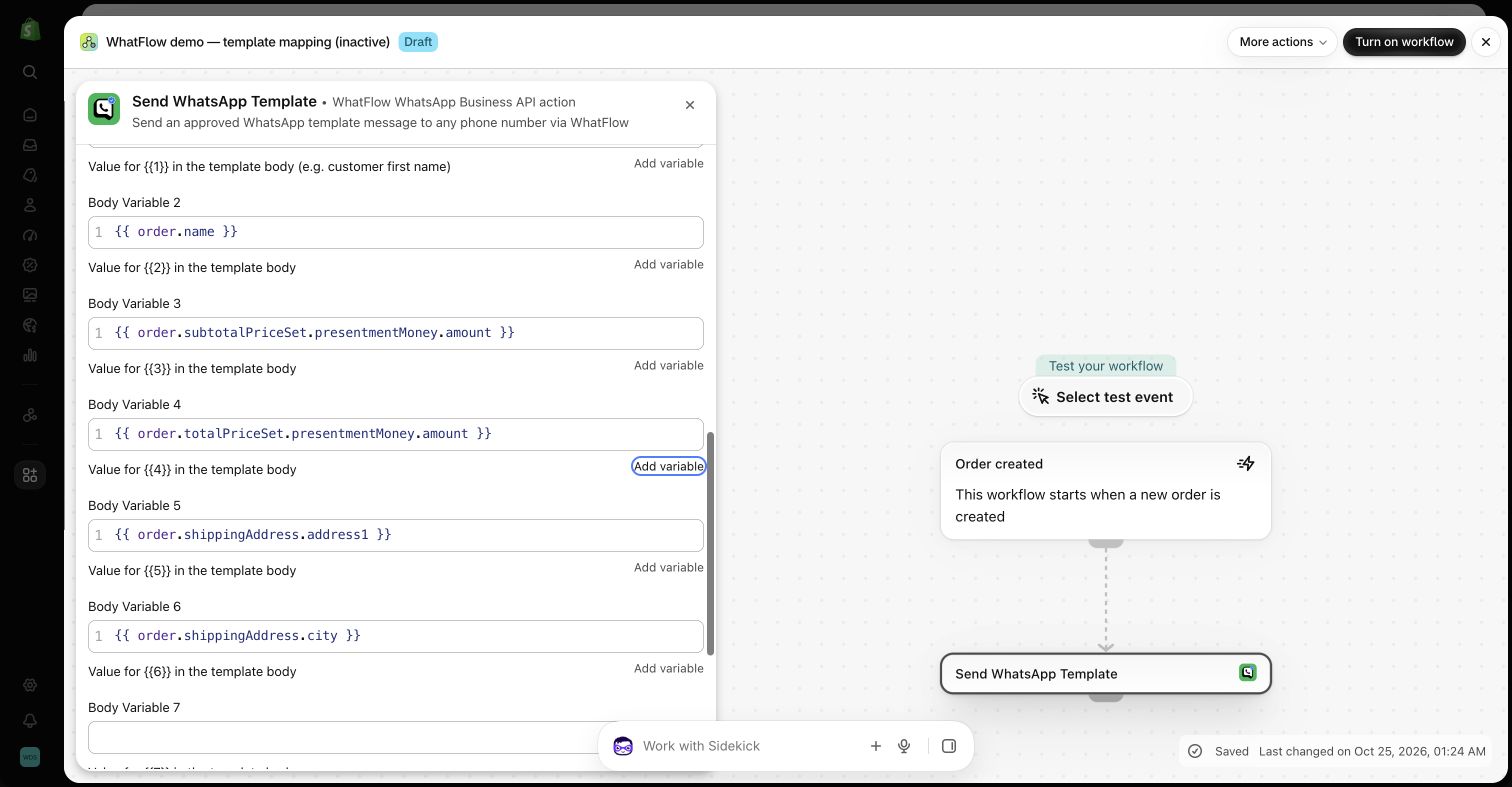
WhatFlow template variables mapped to Shopify order fields in a demo-store Flow workflow. Sample data; nothing was sent.
On Magento, you can get the same result with a WhatsApp extension or a custom integration with Meta's Cloud API. It's doable; just budget the build and the upkeep through each upgrade.
How do you migrate from Magento to Shopify?
Export products, customers and orders, or use a migration app or a Shopify Partner.
Import products first, then customers, then historical orders so they link up.
Map every Magento URL to its new Shopify URL and import the redirects.
Rebuild customer messages: order confirmation, shipping, review requests and WhatsApp templates. Get WhatsApp templates approved a week early.
Rebuild automations in Shopify Flow instead of porting custom code line by line.
Run test orders on every payment method, including COD, then switch the domain.
Who should pick Magento, and who should pick Shopify?
Pick Magento Open Source or Adobe Commerce if:
You have an in-house development team or a long-term agency, and the budget to keep them.
You need deep control over checkout, pricing or catalogue logic that Shopify's APIs can't reach.
You run complex B2B with negotiable quotes, requisition lists and purchase order approvals as core workflows.
You need to host the platform yourself for regulatory or infrastructure reasons.
Pick Shopify if:
You're a team of 1 to 20 without a full-time developer.
You want hosting, security and updates handled, with no upgrade projects.
You'd rather automate with Shopify Flow and apps than custom code.
You sell D2C in COD-heavy, WhatsApp-first markets where Shopify's app ecosystem is deep.
My verdict: Shopify is the better choice for most stores, because it removes the hosting and upgrade burden that eats Magento budgets. Magento and Adobe Commerce are the right tools for complex, developer-backed businesses, especially in B2B. If you're comparing hosted platforms instead, see Shopify vs BigCommerce and Shopify vs WooCommerce.
Run WhatsApp for your Shopify store with WhatFlow
Free plan available. Templates, COD confirmation, Shopify Flow automations and a shared team inbox with no seat fees. Every feature is included on every plan, including Free.
Magento Open Source is open-source software under the OSL 3.0 licence, so the code itself costs nothing to download. You still pay for hosting, a developer, extensions, security and upgrades, which is where the real cost of running Magento sits.
What is the difference between Magento and Adobe Commerce?
Magento Open Source is the free, self-hosted core. Adobe Commerce is Adobe's paid, licensed edition, available on-premises, on Adobe's managed cloud infrastructure, or as Adobe Commerce as a Cloud Service, a SaaS version where Adobe handles updates. Adobe Commerce adds features such as its B2B suite.
Is Shopify cheaper than Magento?
For most small and mid-sized stores, yes. Shopify's plans run from $25 to $399 a month on monthly billing, as of November 2026, with hosting, security and updates included, while a Magento store needs paid hosting and developer time even on the free Open Source edition.
How long is an Adobe Commerce version supported?
Adobe gives each Adobe Commerce version three years of standard support from its release date. For example, version 2.4.9 was released on May 12, 2026, and its standard support ends on May 31, 2029, according to Adobe's lifecycle policy.
Can Shopify handle B2B like Adobe Commerce?
Shopify B2B is available on the Basic, Grow, Advanced and Plus plans, with up to three B2B catalogs below Plus and unlimited catalogs on Plus. Adobe Commerce's B2B suite goes further out of the box, with negotiable quotes, requisition lists and purchase order approval rules.