To handle wholesale enquiries on WhatsApp, treat them as a separate pipeline from retail chats. Ask four or five qualifying questions before sharing prices, send the price list and minimum order quantities only to buyers who fit, assign each lead to one person, and move confirmed buyers onto proper ordering, either Shopify B2B or draft orders with checkout links. Speed and structure win wholesale accounts.
Wholesale enquiries are some of the most valuable messages a small brand gets, and some of the most neglected. They arrive mixed in with "where's my order?" and "do you have this in red?", someone replies "please email us", and the café or boutique that would have ordered every month goes elsewhere. A little process fixes this.
Why do wholesale enquiries go wrong on WhatsApp?
From what I see in merchant inboxes, it's usually one of these:
Nobody owns them. Retail support answers, doesn't know the trade terms, and the chat stalls.
Prices go out too early. The price list PDF goes to everyone, including retail customers who then ask why they can't get that price.
No qualifying. Hours spent quoting a buyer who wanted 5 units.
Slow follow-up. A buyer comparing three suppliers picks the one who replied first with clear terms.
Step 1: Recognise and route wholesale enquiries fast
You can't treat what you can't see. Get wholesale chats out of the retail stream as soon as they arrive.
In WhatFlow, you can do this two ways:
Manually, with inbox assignment and filters: whoever spots a wholesale message assigns it to your wholesale owner.
Automatically, with Shopify Flow. WhatFlow's incoming-message trigger can check for words like "wholesale", "bulk", "stockist" or "trade" and then tag the customer or send an internal notification to your wholesale owner. Routing incoming WhatsApp messages with Shopify Flow shows how to build it.
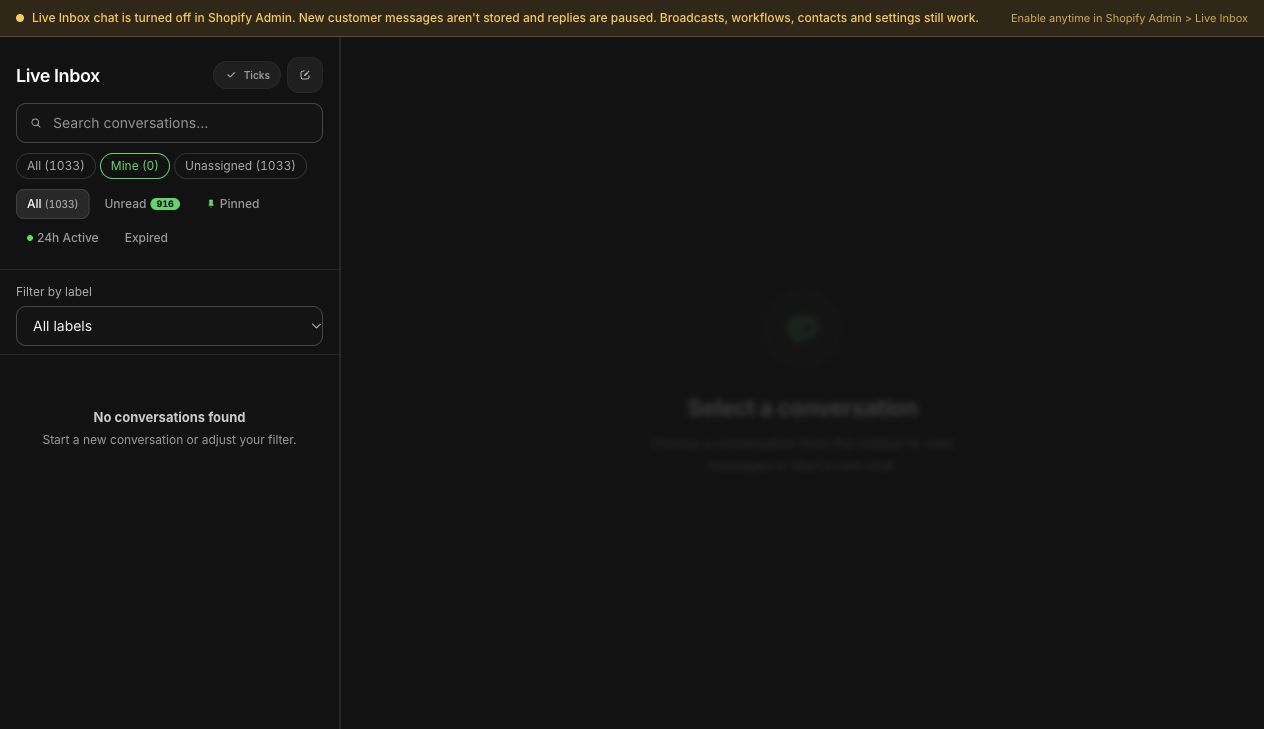
WhatFlow inbox assignment filters, shown in a demo store.
You can also give wholesale buyers their own entry point: a "Wholesale enquiries" WhatsApp link on your stockist page with a pre-filled message like "Hi, I'm interested in wholesale". That message is easy to route.
Step 2: Qualify before you quote
Qualifying isn't gatekeeping. It's how you give a useful answer. Five questions, asked in one friendly message:
Hi Hamza, thanks for your interest in stocking Saffron & Co! So I can send the right info, could you tell me:
Your business name and what kind of business it is (shop, café, online store, distributor)?
Where you're based and where you sell?
Which products you're interested in?
Roughly how many units per order, and how often?
When you'd want a first delivery?
Some buyers answer in one message, some over a day. Either is fine. Once you have the answers, you know which path they're on:
Buyer looks like
What to send
Fits your wholesale criteria
Price list, MOQ, terms, next steps
Too small for wholesale (say, 5 units)
A friendly note, plus your retail link or a bulk discount if you have one
Distributor or large chain
A call with the owner, not a PDF
Outside your shipping area
An honest "not yet", and ask to keep in touch
The "too small" reply matters. Don't make people feel dismissed; some small buyers become big ones.
Thanks Ayesha! Our wholesale minimum is 48 units per order, so for 10 units the best option is our retail store, where orders over 15,000 PKR get free delivery: [link]. If your order grows, message me directly and we'll set up an account.
Step 3: Share the price list and MOQ clearly
MOQ (minimum order quantity) is the smallest order you'll accept at wholesale prices. State it per order and per product if they differ, and explain any case-pack rules.
A clear terms message beats a 12-page PDF:
Here's our wholesale price list: [PDF]. Key terms:
MOQ: 48 units per order, mix and match across the range.
Case packs: 12 units per product.
Lead time: 7 to 10 working days from payment.
First order: paid in full upfront. After three orders, we can discuss terms.
Shipping: quoted by order size and city.
Keep the PDF current. Outdated price lists are the source of many awkward wholesale conversations. If you're changing trade prices, raising prices without losing your best customers has wording that works for B2B buyers too.
WhatsApp is a great place to qualify and build the relationship. It's a poor place to type out 40-line orders. Once a buyer is confirmed, give them a cleaner way to order.
Option A: Draft orders with a checkout link
For the first order or for occasional buyers, build a Shopify draft order with the agreed products and prices, then share the checkout link in WhatsApp. Shopify's Help Center explains how to send a draft-order invoice or copy its checkout link. Payment happens on Shopify checkout, not in the chat.
Option B: Shopify B2B
If wholesale becomes a real part of the business, Shopify's built-in B2B tools are worth a look. As of November 2026, the Shopify Help Center says B2B is available on the Basic, Grow, Advanced and Plus plans. Features documented there include:
Companies: each wholesale buyer is set up as a company in your admin.
Catalogs: custom pricing and product availability per company.
Quantity rules and volume pricing: minimums, maximums, increments and price breaks per product, described in Shopify's quantity rules guide.
Payment terms: net terms of 7 to 90 days or due on fulfillment, set per company location or draft order. Deposits are Plus-only, according to Shopify's payment terms page.
Check your own plan and the Help Center before you set anything up; Shopify changes B2B features fairly often.
Whichever option you use, WhatsApp stays the relationship channel: order questions, reorder nudges, new-product previews, delivery updates.
For a shopper asking which size or variant fits, use WhatFlow's product picker to share the relevant catalog item from the conversation. With catalog cart follow-up configured, WhatFlow can send back a Shopify checkout link. Check Shopify before treating the WhatsApp cart as a paid order. The catalog-to-checkout walkthrough shows the test sequence.
Step 5: Follow up like a supplier they want to keep
Wholesale buyers value reliability over charm. A few messages that build it:
Your order #W-1042 (96 units) has shipped, tracking {{1}}. Delivery expected Thursday. I've included 20 sample sachets of the new cardamom blend for your counter.
Hi Hamza, it's been about 4 weeks since your last order. Based on your usual volume, you might be running low on the 250g tins. Want me to set up the same order? I can have it out by Wednesday.
Remember the 24-hour rule: free-form replies are only allowed within 24 hours of the buyer's last message. After that, you need an approved template, and promotional messages need opt-in. B2B buyers usually welcome restock nudges, but ask once and record their answer.
Who should own wholesale on a small team?
One person. Even if it's the founder for an hour a day. The wholesale owner knows the price list, the terms, each buyer's history and what was promised. Everyone else assigns wholesale chats to them and stays out.
This is where per-seat pricing hurts small brands: adding a part-time wholesale manager to some inboxes means another monthly seat. WhatFlow's team inbox has no seat fees on any plan, so you can add them without thinking about it. No-seat-fee inboxes vs per-seat pricing breaks down the cost difference, and setting up a shared team inbox covers ownership.
Write saved replies for your qualifying message, your "too small" reply and your terms summary. The guide to saved replies that still sound human shows how to keep them warm.
Two wholesale pitfalls
Giving trade prices to retail customers. Once a price list leaks, retail customers will ask for it too. Qualify first, and consider watermarking PDFs with the buyer's business name.
Haggling over chat without writing it down. If you agree a special price or term, put it in the draft order or the B2B catalog the same day. "But you said on WhatsApp…" six months later is no fun for anyone.
Free plan available
Run WhatsApp for your Shopify store with WhatFlow
Templates, COD confirmation, Shopify Flow automations and a shared team inbox with no seat fees. Every feature is included on every plan, including Free.
Create a "Wholesale" tag, decide who owns it, write the five-question qualifying message and the terms summary, and add a wholesale WhatsApp link to your stockist page. That's an hour's work, and every future wholesale enquiry gets a fast, consistent answer. For the selling side of those conversations, shop-floor sales habits for WhatsApp apply just as well to trade buyers.
Frequently asked questions
What should I ask a wholesale buyer on WhatsApp?
Ask for their business name and type, where they sell, which products interest them, the rough quantity per order and how often they'd reorder. Those five answers tell you whether to send a price list or point them to retail.
Should I send my wholesale price list to everyone who asks?
No. Send it after a few qualifying questions. Otherwise retail shoppers and competitors get your trade prices, and you can't tell serious buyers from curious ones.
Does Shopify support wholesale pricing?
Yes. As of November 2026, the Shopify Help Center says B2B is available on the Basic, Grow, Advanced and Plus plans, with company profiles, catalogs with custom pricing, quantity rules, volume pricing and payment terms. Some options, such as deposits, are Plus-only.
How do I stop wholesale enquiries getting lost in my WhatsApp inbox?
Tag and assign them to one person as soon as they arrive. With WhatFlow and Shopify Flow, you can route incoming messages that mention wholesale so they don't sit among retail chats.