
Publisher disclosure: this comparison is written by WhatFlow. Competitor capabilities are based on the linked public documentation; the WhatFlow screenshots come from our demo store. Examples are illustrative, and results depend on your store and configuration.
WhatFlow and Feature-gated plans at a glance
| Consideration | WhatFlow | Feature-gated plans |
|---|---|---|
| What each plan includes | Every feature on every plan, including Free: templates, broadcasts, cart recovery, COD confirmation, Flow triggers and actions, team inbox, catalog sharing. | Higher tiers add features such as automation, integrations or extra inbox tools. |
| What makes you upgrade | Only sending more messages. Plans differ by allowance and overage rate. | Needing one gated feature, even if your message volume hasn't changed. |
| Shopify workflow | Native Shopify Flow triggers and actions available from day one on Free. | Integrations are often placed on a mid or upper tier; check the vendor's plan table. |
| Starting point | Free plan (100 messages/month), then Starter at $4.99/month for 2,000 messages, as of November 2026. | A free trial or a starter tier with a reduced feature set. |
| Team inbox | No seat fees on any plan. | May add per-seat charges on top of the tier price. |
Pick a WhatsApp app that puts every feature on every plan. Feature gating makes you pay a tier jump the moment you need one tool, like Shopify Flow automation or broadcasts, even if you send the same number of messages. WhatFlow includes every feature from the Free plan up; plans differ only by how many messages are included. Your bill grows when your sending grows, and not before.
At a glance
WhatFlow | Feature-gated plans | |
|---|---|---|
Features on the cheapest plan | All of them | A starter subset |
Reason to upgrade | More messages | A locked feature |
Shopify Flow automation | Every plan, including Free | Often a higher tier |
Team inbox seats | No seat fees | Sometimes extra |
Cheapest paid plan | $4.99/month (as of November 2026) | Varies |
What does "all features on every plan" mean at WhatFlow?
It means the store on the Free plan has the same toolbox as the store on Ultimate:
- WhatsApp message templates with a template editor
- Broadcasts and campaigns
- Abandoned checkout recovery messages
- COD order confirmation with reply buttons that can tag or cancel orders via Shopify Flow
- Order and shipping update messages
- Native Shopify Flow triggers and actions
- Shared team inbox with assignment, filters and saved replies, with no seat fees
- Live catalog sharing from the inbox
- Free-forever theme-matched WhatsApp chat buttons
The only thing that changes between plans is the message allowance and the overage rate.
One practical check: Can one team manage messages, order context, and catalog sales? Use the campaign, team inbox and catalog checkout walkthroughs to evaluate the broader WhatFlow Business API workflow alongside recovery and notifications.
How much does feature gating cost you?
Here's a worked example using WhatFlow's published plans (as of November 2026) against a hypothetical gated competitor.
Say you run a small COD store sending 1,500 messages a month: order confirmations and shipping updates. Next month you want to add cart recovery, which adds about 400 messages.
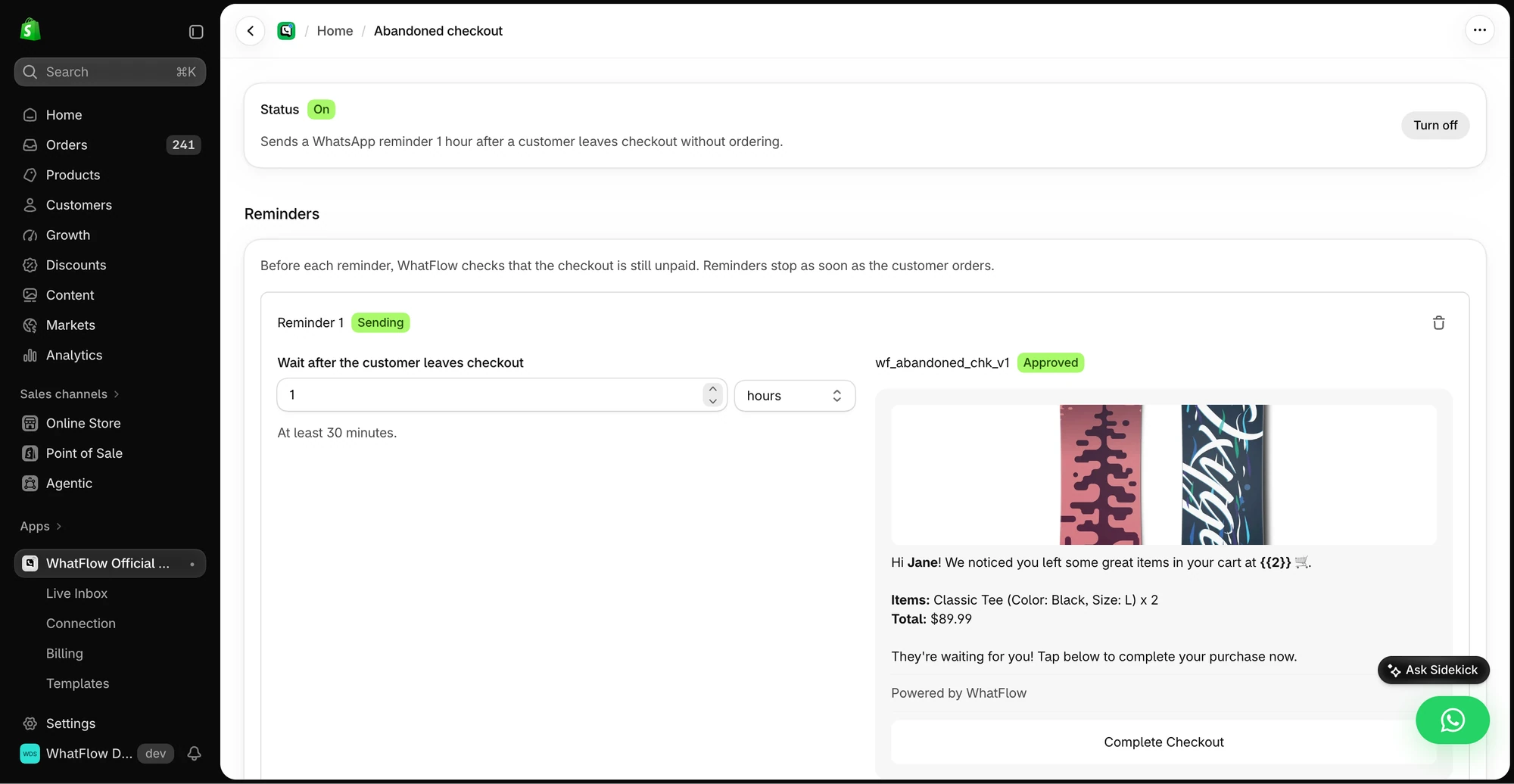
WhatFlow: 1,500 messages fits Starter ($4.99, 2,000 included). Add cart recovery and you're at 1,900, still inside Starter. Cost change: $0.
Hypothetical gated tool: its $15 basic tier covers your volume but cart recovery lives on the $49 "Pro" tier. Cost change: +$34/month for the same message volume.
Scale up and the pattern holds. At 20,000 messages WhatFlow's Growth plan is $29 with 20,000 included, whether or not you use Flow, broadcasts or COD confirmation. All plans and rates are on the pricing page. For a broader audit of add-ons and gates, read auditing Shopify app costs.
Meta's per-message charges apply on top either way. They're Meta's fees, not the app's, and WhatsApp Business API pricing explained covers them.
Why does gating hurt small stores most?
Because small stores grow by adding one workflow at a time. You start with a chat button and COD confirmation. Then shipping updates. Then a monthly broadcast. Then you want a Flow rule that tags orders when the customer replies "Cancel".
On a gated plan, each of those steps is a pricing conversation. On WhatFlow, each is just a new workflow. The first automation guide suggests an order for adding them.
What does this look like in practice?
Imagine a skincare store on WhatFlow Free during its first month. With 100 messages included, it can:
- Add the theme-matched WhatsApp button to product pages.
- Build a COD confirmation in Shopify Flow:
Hi Sara, thanks for your order #1007 (AED 189, cash on delivery). Tap Confirm and we'll ship it tomorrow. [Confirm] [Cancel]
- Answer replies in the team inbox with a colleague, at no seat cost.
When volume passes 100 a month, it moves to Starter for more messages. Nothing it built changes.
Is "every feature on Free" a sign it's a small-store tool?
No. WhatFlow WhatsApp Business API runs on the official Meta WhatsApp Cloud API and is enterprise-ready: a team inbox with assignment and filters, no seat fees at any team size, Shopify Flow automation at scale, COD confirmation, live catalog sharing and Shopify admin extensions. We simply don't hold any of that back on smaller plans. Large stores pick a bigger message allowance (Ultimate is $99 for 75,000 messages, as of November 2026); they don't get different software.
When might a feature-gated plan still make sense?
Pick a gated plan only if a vendor's top tier includes something you specifically need that WhatFlow doesn't offer, such as a built-in AI chatbot (WhatFlow has no built-in AI bot, though WhatFlow's MCP connector lets you bring Claude, ChatGPT or Cursor to draft replies a person approves, with no AI add-on fee), and you're comfortable paying the tier price for it. Compare the tier that actually includes your workflows, not the headline. If contact-based pricing is also in the mix, see message-volume vs contact-based pricing.
The bottom line
You should upgrade because you're sending more, not because a feature is locked. WhatFlow gives every store the full toolset on every plan, starting free, with paid plans from $4.99/month. WhatFlow WhatsApp Business API is rated 5.0/5 from 55 ratings on the Shopify App Store (as of November 5, 2026). Compare that with a free trial that expires.
Questions worth asking
Does WhatFlow lock features behind higher plans?
No. WhatFlow includes every feature on every plan, including Free. Free and paid users get the same tools; plans differ only by message allowance and rate.
How do I compare feature-gated WhatsApp plans?
List the workflows you need now and the next one you'll want, such as COD confirmation then cart recovery. Find the cheapest tier that includes all of them, not the cheapest advertised price.
What's in WhatFlow's Free plan?
Every WhatFlow feature, with 100 messages a month included and $0.01 per message after that, as of November 2026. The team inbox has no seat fees and theme-matched chat buttons are free forever.
Do WhatsApp app plans include Meta's message fees?
No. Meta bills per delivered template message by category and country, separately from any app's plan. Since October 1, 2026, service replies are free only for the first 1,000 per business number each month.
Sources and methodology
We checked these primary sources on November 5, 2026. Vendor pages describe advertised capabilities, rather than independent performance tests. Confirm current pricing, plan limits and availability with each provider.
- WhatFlow plans and Shopify integrations
WhatFlow listing: Free (100 messages, $0.01 after), Starter $4.99 (2,000), Plus $9.99 (5,000), Growth $29 (20,000), Scale $49.99 (40,000), Ultimate $99 (75,000), checked November 5, 2026.
- WhatsApp Business Platform pricing
Meta's overview of WhatsApp Business Platform pricing, billed separately from app plans.
- WhatFlow pricing
Current WhatFlow plan amounts, allowances and rates.
- WhatsApp Business Platform pricing (Meta developer docs)
Meta charges per delivered template message by category and recipient country. Since October 1, 2026, service replies are free only for the first 1,000 per business number each month, and utility templates inside the customer service window are charged.