
Publisher disclosure: this comparison is written by WhatFlow. Competitor capabilities are based on the linked public documentation; the WhatFlow screenshots come from our demo store. Examples are illustrative, and results depend on your store and configuration.
WhatFlow and Contact-based subscription at a glance
| Consideration | WhatFlow | Contact-based subscription |
|---|---|---|
| Best-fit experience | Plans are sized by messages sent. No seat fees, no feature gates, so the bill follows the work. | Billed on stored or active contacts. Can make sense when bundled with audience and cross-channel tools you'll actually use. |
| Costs to include | Your message plan plus Meta's WhatsApp fees. A big historical customer list costs nothing to keep. | The contact tier, which can rise as your list grows even if you don't message more. Meta's fees are still separate. |
| Shopify workflow | Order templates, abandoned checkout, COD confirmation and Shopify Flow, all counted against one simple send allowance. | Depends on the platform. Check how each synced Shopify customer counts toward the contact limit. |
| Starting point | Free plan with every feature and 100 sends, plus theme-matched WhatsApp buttons that are free forever. | Ask for the vendor's exact billable-contact definition before you sync your customer list. |
For most Shopify stores, WhatsApp pricing based on messages sent beats pricing based on contacts stored. You might have 30,000 past customers but message 3,000 of them this month. Contact-based pricing charges you for the 30,000. WhatFlow charges for the messages, keeps every feature on every plan, and adds no seat fees.
Contact pricing can make sense inside a big audience platform you'll use end to end. For WhatsApp order messaging and support, it rarely does.
At a glance
WhatFlow (message-volume) | Contact-based subscription | |
|---|---|---|
Billing unit | Messages sent | Stored or active contacts |
Big old customer list | Free to keep | Can push you into a higher tier |
Busy month | More sends, possibly a bigger plan | Same tier, unless contacts grow |
Features | Same on every plan | Often tiered too |
Team | No seat fees | Varies |
Why stored contacts are the wrong unit for most stores
Your Shopify customer list only grows. Every one-time buyer from three years ago stays on it. But the people you actually message in a month are a small slice: this week's orders, this week's abandoned checkouts, one campaign to customers who opted in.
Billing on contacts means your price rises because your history got longer, not because you did more. That's backwards for a store that mostly sends order updates.
A worked example
Say your store has 30,000 customers in Shopify. In a normal month you:
- send 4,000 order confirmations and shipping updates,
- send 1,500 abandoned checkout reminders,
- run one 4,000-recipient campaign to opted-in customers.
That's 9,500 sends. On WhatFlow, as of November 2026 (Shopify App Store listing), Growth costs $29/month with 20,000 sends included. Plus would cost $9.99 + (4,500 × $0.004) = $27.99, so either plan lands under $30 on the app side. Your 30,000 stored customers don't change that number at all.
On a contact-based plan, you'd first ask: do all 30,000 count, or only "active" ones? Do unsubscribed or duplicate profiles count? Does syncing Shopify customers add them to the bill? The answers decide your tier. Get the vendor's exact billable-contact definition in writing.
In both cases, Meta's per-message fees are extra and depend on the template category and country (Meta pricing). Our WhatsApp Business API pricing guide explains how those work. Current WhatFlow amounts are on our pricing page.
Budget on outcomes, not list size
Message-based pricing also makes it easier to judge whether a message was worth sending. If 1,500 abandoned checkout reminders cost you a known app amount plus Meta's fees, you can compare that directly with recovered orders. Here's how to set that up: budget WhatsApp by cost per useful outcome.
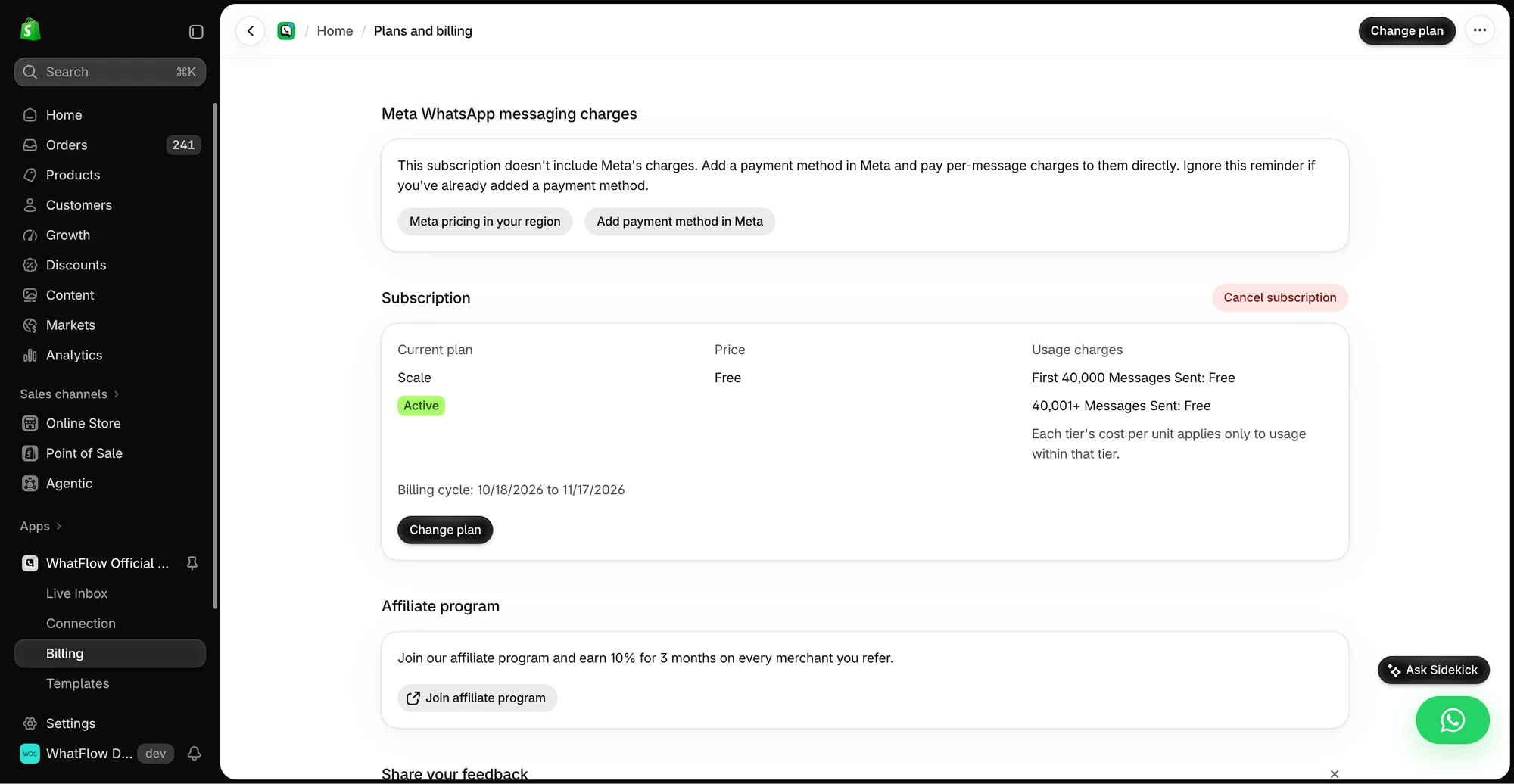
And because every WhatFlow plan includes every feature, picking a plan is purely about volume. You never upgrade just to get Shopify Flow or COD confirmation.
A good next step is to segment that monthly campaign so it goes to the right people, not everyone: segment WhatsApp campaigns around customer needs.
WhatFlow's WhatsApp Business API app runs on the official Meta WhatsApp Cloud API and is rated 5.0 out of 5 from 55 ratings on the Shopify App Store (checked November 5, 2026).
When contact-based pricing might still make sense
Pick a contact-based platform only if you specifically need its wider audience tools (cross-channel profiles, email and SMS journeys from the same database) and you'll use them every week. If WhatsApp order messaging and support are the main job, you're paying for a list, not for results.
The bottom line
Your customer list is an asset. It shouldn't be a bill. WhatFlow prices WhatsApp by what you send, includes every feature on every plan, and starts free. If your volume swings through the year, read seasonal costs vs a fixed contract too.
Questions worth asking
Is message-based or contact-based WhatsApp pricing cheaper for a Shopify store?
For most Shopify stores, message-based pricing is cheaper because you only message a small share of your customer list each month. With WhatFlow, a large list of past customers costs nothing to keep; you pay for sends.
How do I compare the two pricing models?
Take last month's real numbers: how many customers you stored and how many messages you actually sent. Price the contact plan on the first number and the message plan on the second, then add Meta's fees to both.
Does the free WhatFlow plan restrict features?
No. Every WhatFlow feature is on every plan, including Free. Plans differ only by message allowance and rate.
Are Meta's WhatsApp charges included in WhatFlow's price?
No. Meta charges separately for delivered template messages by category and country. Since October 1, 2026, Meta's free customer service replies are capped at the first 1,000 per number per month.
Sources and methodology
We checked these primary sources on November 5, 2026. Vendor pages describe advertised capabilities, rather than independent performance tests. Confirm current pricing, plan limits and availability with each provider.
- WhatFlow plans and Shopify integrations
WhatFlow WhatsApp Business API listing: plan prices, included sends, overage rates and a 5.0 rating from 55 reviews, checked November 5, 2026.
- WhatsApp Business Platform pricing
Meta's per-message pricing, which varies by template category and recipient country and is charged separately from app fees.