
Publisher disclosure: this comparison is written by WhatFlow. Competitor capabilities are based on the linked public documentation; the WhatFlow screenshots come from our demo store. Examples are illustrative, and results depend on your store and configuration.
WhatFlow and WebEngage at a glance
| Consideration | WhatFlow | WebEngage |
|---|---|---|
| What the product is built around | A Shopify WhatsApp app on the official Meta Cloud API: Flow triggers and actions, admin extensions and a team inbox. | A cross-channel lifecycle-marketing platform. WhatsApp campaigns are built in WebEngage and delivered through a connected WhatsApp Service Provider. |
| Pricing and billing units | Published: Free plan, paid plans from $4.99/month by message allowance. Meta fees separate. | No public prices as of November 2026 (demo request). You also contract a WhatsApp Service Provider, which bills separately. |
| Feature access | Every feature on every plan, including Free. Plans differ only by allowance and rates. | Campaigns are created and analysed in WebEngage; delivery status flows back from the provider by webhook. |
| Team access | No seat fees for the team inbox. | Not published. Users are set in your WebEngage contract, and the provider account is separate. |
| Storefront entry point | Free-forever WhatsApp chat buttons matched to your Shopify theme. | Not covered in WebEngage's WhatsApp documentation. |
| Two-way conversations | Shared inbox with assignment, filters, saved replies and catalog sharing. | The WhatsApp guide covers outbound campaigns and delivery tracking, not a reply inbox. |
| WhatsApp connection and scale | Official Meta Cloud API via Embedded Signup; team inbox with assignment and filters, no seat fees at any team size. | WhatsApp is one channel inside a wider engagement platform. |
WhatFlow is the simpler, cheaper way to run WhatsApp on Shopify. It's one Shopify app on the official Meta Cloud API that sends templates, recovers carts, confirms COD orders through Shopify Flow and gives your team a shared inbox with no seat fees. WebEngage is a lifecycle-marketing platform that delivers WhatsApp through a separate provider. Great for a marketing team's journeys. Overkill for order messages.
When testing WhatFlow and WebEngage, ask: Which Shopify audience do you already use? In WhatFlow, test a Shopify customer or segment send, then try scheduling a separate Inbox broadcast from a spreadsheet or existing conversations. The campaign walkthrough shows the test send, reply handoff and recipient report.
WhatFlow vs WebEngage at a glance
WhatFlow | WebEngage | |
|---|---|---|
What you install | One Shopify app | WebEngage plus a WhatsApp Service Provider |
WhatsApp connection | Official Meta Cloud API via Embedded Signup | Through a provider such as Infobip, Gupshup, Kaleyra or ValueFirst |
Public pricing | $0 to $99/month | Demo request (as of November 2026) |
Seat fees | None | Contract-based |
Reply inbox | Yes | Not in the WhatsApp guide |
Shopify Flow | Native triggers and actions | Not advertised |
Why does the two-vendor setup matter?
WebEngage's own WhatsApp documentation describes WhatsApp Service Providers as middlemen between your WebEngage account and the customer. You build the campaign in WebEngage; Infobip, Gupshup, Kaleyra, ValueFirst or another provider sends it.
That's a sensible design for a lifecycle team. For a Shopify store, it means two contracts, two dashboards and two support desks when a template fails. Picture a Tuesday morning: 300 order confirmations went out and 40 show as failed. Is it the journey logic, the provider's template status or your Meta quality rating? With WhatFlow there's one app to check, and it's in your Shopify admin.
How much does WebEngage cost compared with WhatFlow?
WebEngage's pricing page has a "Request Demo" button and no plan prices. Add the WhatsApp provider's fees on top.
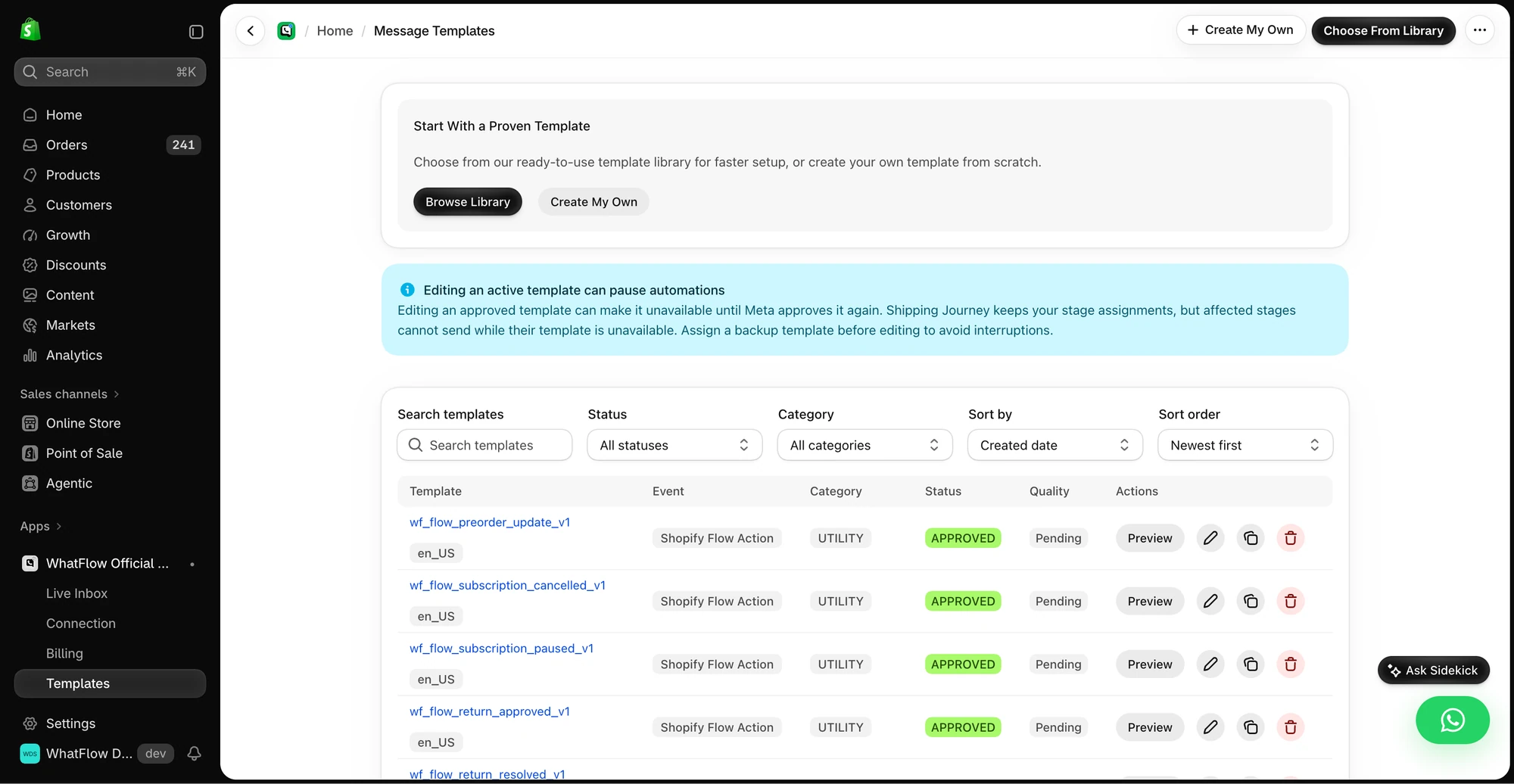
WhatFlow, as of November 2026, publishes everything: Free ($0, 100 messages), Starter ($4.99, 2,000), Plus ($9.99, 5,000), Growth ($29, 20,000), Scale ($49.99, 40,000) and Ultimate ($99, 75,000). Every plan has every feature. Say you send 1,000 order and shipping messages a month: that's Starter at $4.99 on the app side, with three teammates in the inbox at no extra cost. Meta's per-message charges apply for any provider; here's how they work. Check WhatFlow pricing for current rates.
Which handles Shopify order workflows better?
WhatFlow. It was built for this:
- Shopify Flow triggers for incoming messages and order replies, and actions for sending templates, text, images and video.
- COD confirmation with Confirm and Cancel buttons that tag or cancel the order.
- Abandoned checkout recovery and shipping updates from templates mapped to Shopify order fields.
- Review requests that send a link to your review app's form.
A shipping update template might read:
Hi Rahul, your order #2231 is on its way with BlueDart. Track it here: {{tracking_link}}. Reply to this message if anything looks wrong.
When Rahul replies "wrong address!", it lands in the WhatFlow inbox where your team can fix it. The Shopify Flow automation guide shows how to wire these up without code.
Who answers the customer when they reply?
WhatsApp is a two-way channel. That's why customers like it. WebEngage's WhatsApp guide covers outbound campaigns, quick-reply buttons and delivery status, but not where a typed reply goes or who handles it.
WhatFlow puts every reply in a shared inbox with assignment, filters, saved replies and live catalog sharing, and you can add the whole team with no seat fees. That's the piece most marketing platforms leave to another tool. If you're coming from staff phones, see shared inbox vs personal phones.
Is WhatFlow enterprise-ready?
Yes, and this is worth saying plainly because people still assume a Shopify WhatsApp app must be an unofficial, small-shop tool. WhatFlow WhatsApp Business API connects to the official Meta Cloud API through Meta Embedded Signup. The team inbox has assignment and filters so a 20-person support team can split work by agent or status, and there are no seat fees at any team size. Shopify Flow runs the automation, so COD confirmation, order updates and reply routing scale with your order volume, not with headcount. Add live catalog sharing, Shopify admin extensions and a 5.0/5 rating from 55 ratings on the Shopify App Store (as of November 5, 2026). The Free plan makes it the easiest start for a small store, and nothing about it caps a large one.
When WebEngage might still make sense
Choose WebEngage if your marketing team already runs cross-channel journeys across app push, email and web, and you have someone who owns the WhatsApp provider relationship. Many brands in that position keep WebEngage for lifecycle campaigns and use WhatFlow for Shopify order messages and replies.
The bottom line
One app beats two vendors when the job is WhatsApp for a Shopify store. WhatFlow gives you published pricing from $0, every feature on every plan, no seat fees, native Shopify Flow and a 5.0/5 rating from 55 ratings on the Shopify App Store (as of November 5, 2026). Install it, send your first template this week, and read the MoEngage comparison or how to audit app costs if you're still weighing a bigger suite.
Questions worth asking
Is WhatFlow a good WebEngage alternative for Shopify?
For WhatsApp on Shopify, yes. WhatFlow is one app that sends, receives and automates WhatsApp with Shopify Flow on the official Meta Cloud API, with no seat fees. WebEngage is a lifecycle-marketing platform that needs a separate WhatsApp Service Provider to deliver its messages.
How much does WebEngage cost compared with WhatFlow?
As of November 2026 WebEngage doesn't publish prices; its pricing page asks you to request a demo, and the WhatsApp Service Provider is a separate bill. WhatFlow starts free, paid plans run from $4.99 to $99 a month, and Meta's charges are billed separately.
Does WhatFlow charge per inbox seat?
No. WhatFlow's team inbox has no seat fees. Add your support staff, your warehouse lead and your co-founder without changing the bill.
Are WhatFlow features restricted on the free plan?
No. Every WhatFlow feature, from templates and broadcasts to COD confirmation and Shopify Flow, is on the Free plan. Paid plans add message allowance, and the theme-matched WhatsApp button is free forever.
Which WhatsApp providers does WebEngage use?
WebEngage's documentation names WhatsApp Service Providers including Infobip, Gupshup, Kaleyra and ValueFirst, with others supporting automated template approval. You pick and pay one of them in addition to WebEngage.
Is WhatFlow only for small Shopify stores?
No. WhatFlow WhatsApp Business API runs on the official Meta Cloud API and is built for teams of any size: a shared inbox with assignment and filters, no seat fees however many agents you add, Shopify Flow automation, COD confirmation, catalog sharing and Shopify admin extensions. Small stores can start on the Free plan, and larger teams get the same features without a WebEngage-style enterprise contract.
Sources and methodology
We checked these primary sources on November 5, 2026. Vendor pages describe advertised capabilities, rather than independent performance tests. Confirm current pricing, plan limits and availability with each provider.
- WebEngage WhatsApp documentation
Explains that WebEngage delivers WhatsApp through connected WhatsApp Service Providers and lists them (checked November 2026).
- WhatFlow WhatsApp Business API on the Shopify App Store
WhatFlow's listing, plans and Shopify integrations; rated 5.0/5 from 55 ratings as of November 5, 2026.
- WhatsApp Business Platform pricing
Meta's per-message charges, which apply whichever WhatsApp app or provider you use.
- WebEngage pricing page
Offers a demo request rather than published plan prices (November 2026).
- WhatFlow pricing
Current WhatFlow plan prices, message allowances and overage rates.