
Publisher disclosure: this comparison is written by WhatFlow. Competitor capabilities are based on the linked public documentation; the WhatFlow screenshots come from our demo store. Examples are illustrative, and results depend on your store and configuration.
WhatFlow and Wati at a glance
| Consideration | WhatFlow | Wati |
|---|---|---|
| What the product is built around | Built for Shopify: admin extensions, native Shopify Flow triggers and actions, and a WhatsApp team inbox on the official Meta Cloud API. | A general WhatsApp sales and support platform that connects to Shopify through its own connector, with cart recovery, COD confirmation, shipping updates and catalog tools. |
| Pricing and billing units | Free plan; paid plans from $4.99/month, priced only by messages sent. Meta fees separate. | Growth $39, Pro $79, Business $199 per month billed annually (as of November 2026), plus a $4.99/month Shopify Integration add-on and Meta fees. |
| Feature access | Every feature on every plan, including Free. Plans differ only in message allowance and rate. | Features step up by tier (for example, store and data sync and custom automations sit on Business), and some Shopify automations need the separate Shopify add-on. |
| Team access | No seat fees. Invite every agent, packer and manager at no extra cost. | Growth: 3 users, no additional users. Pro: 5 users, then $24 per user/month. Business: 5 users, then $59 per user/month. |
| Storefront entry point | Free-forever WhatsApp buttons that match your Shopify theme. | Check which storefront widget is included with the plan and Shopify add-on you choose. |
| Shopify Flow | Native triggers (incoming message, order reply) and actions (send template, text, media) inside Shopify Flow. | Automations are built in Wati's own builder through its Shopify connector. |
| Shopify App Store rating | 5.0 out of 5 from 55 ratings for WhatFlow WhatsApp Business API (November 5, 2026). | Check Wati's current Shopify App Store listing. |
If you run a Shopify store, pick WhatFlow over Wati. WhatFlow lives inside Shopify (admin extensions, native Shopify Flow triggers and actions, COD confirmation that tags orders), every feature is on every plan including Free, and the team inbox has no seat fees. Wati is a capable WhatsApp platform, but its per-user charges and separate Shopify add-on make the same setup cost far more.
When testing WhatFlow and Wati, ask: Can you explain which recipients failed and retry only the ones worth retrying? In WhatFlow, test a Shopify customer or segment send, then try scheduling a separate Inbox broadcast from a spreadsheet or existing conversations. The campaign walkthrough shows the test send, reply handoff and recipient report.
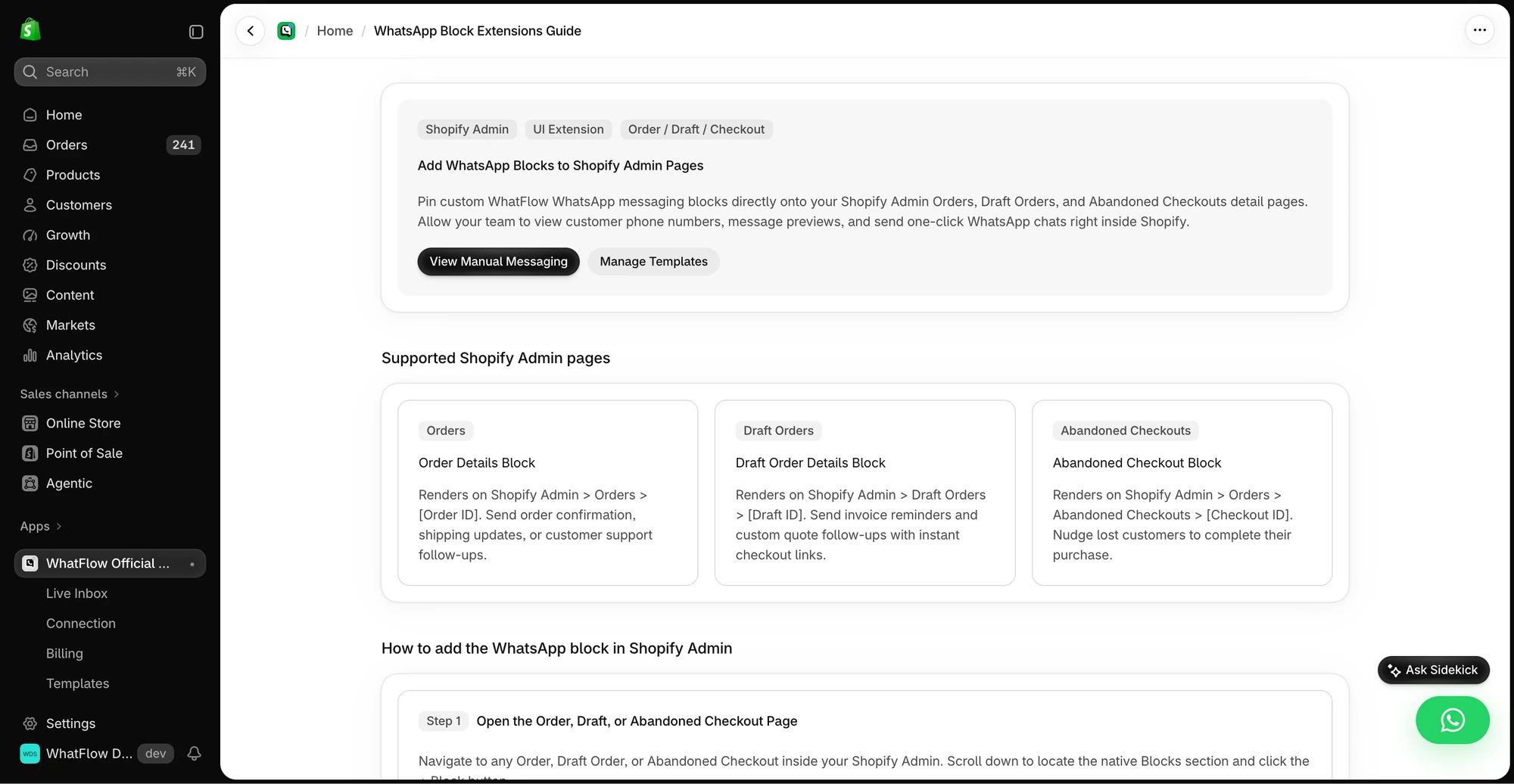
A quick correction to a common assumption: WhatFlow WhatsApp Business API is not an unofficial workaround. It runs on the official Meta Cloud API, connected through Meta Embedded Signup inside Shopify admin, and it's built to scale: inbox assignment and filters, no seat fees at any team size, Shopify Flow automation, COD confirmation, catalog sharing and admin extensions. Small stores can still start free. Our linked-device app, Chat Automation, is a separate, older entry-level product.
WhatFlow vs Wati at a glance
WhatFlow | Wati | |
|---|---|---|
Starting price | Free, paid from $4.99/month | Growth $39/month (billed annually) |
Extra team members | No seat fees | $24/user on Pro, $59/user on Business |
Shopify connection | The app is the Shopify integration | Separate $4.99/month Shopify add-on |
Feature gates | None, all features on Free | Features step up by tier |
Shopify Flow | Native triggers and actions | Its own automation builder |
Rating | 5.0/5 from 55 ratings | Check its listing |
Wati prices are from its pricing page as of November 2026. WhatFlow's rating is for the Business API app on the Shopify App Store, checked November 5, 2026.
How much does Wati cost for a Shopify team?
This is where the gap shows up. Wati's pricing page lists, as of November 2026 and billed annually:
- Growth: $39/month, 3 users, no additional users allowed.
- Pro: $79/month, 5 users, then $24 per extra user per month.
- Business: $199/month, 5 users, then $59 per extra user per month.
- Shopify Integration add-on: $4.99/month, which Wati's Shopify guide describes as the charge for automated Shopify messages.
Now take a normal growing store. Say you have eight people who touch WhatsApp: four support agents, a team lead, two warehouse staff who answer "where's my parcel?" and someone covering weekends. Growth is out, because it stops at three users.
Monthly cost before Meta fees | Wati Pro | Wati Business | WhatFlow |
|---|---|---|---|
Base plan | $79 | $199 | $9.99 (Plus, 5,000 sends) |
3 extra users | $72 | $177 | $0 |
Shopify add-on | $4.99 | $4.99 | $0 |
Total | $155.99 | $380.99 | $9.99 |
Even if that team sends 20,000 messages a month, WhatFlow's Growth plan is $29. Meta's per-message charges apply on both sides, so they don't change the comparison. Current WhatFlow amounts are on the pricing page, and our guide to WhatsApp API pricing explains how Meta bills templates.
The bigger point isn't the dollars. With per-user pricing, every new hire becomes a budget conversation, so stores end up sharing logins or leaving the warehouse out of the inbox. With WhatFlow, you just invite them. That's why we built the inbox with no seat fees.
Which one fits Shopify workflows better?
Wati does have real Shopify tools: abandoned cart, COD confirmation, shipping updates and a catalog. The difference is where the work happens.
WhatFlow puts WhatsApp inside Shopify. You get WhatFlow triggers and actions in Shopify Flow, so a WhatsApp reply can tag an order, and an order event can send a template, using the same tool you already use for inventory and fulfilment rules. Shopify Sidekick can even draft those workflows for you.
Here's a COD confirmation built that way:
Hi Aisha, thanks for your order #1042 (Rs 3,450, cash on delivery). Can you confirm we should ship it? [Confirm order] [Cancel order]
When Aisha taps Confirm, a Flow workflow tags the order cod-confirmed. If she taps Cancel, the workflow can tag it for review or cancel it. Nobody copies order numbers between tabs. Our COD reply guide walks through the setup.
On WhatFlow, that workflow, the template editor, abandoned checkout recovery, broadcasts and live catalog sharing are all on the Free plan. On Wati, store and data sync and custom automations are listed on Business, and the Shopify add-on sits on top.
What about the team inbox?
Both products give you a shared WhatsApp inbox. WhatFlow's has assignment, filters, saved replies and catalog sharing from the conversation, and it costs nothing per person.
Say a customer messages at 9pm asking if the size M linen shirt is back. Your evening agent can share the live catalog item, assign the chat to the morning lead for a restock date, and use a saved reply:
Good news, the M is back in stock tomorrow morning. Want me to hold one for you until 6pm?
The WhatFlow inbox is built for exactly this kind of handoff, and adding the morning lead never changes your bill.
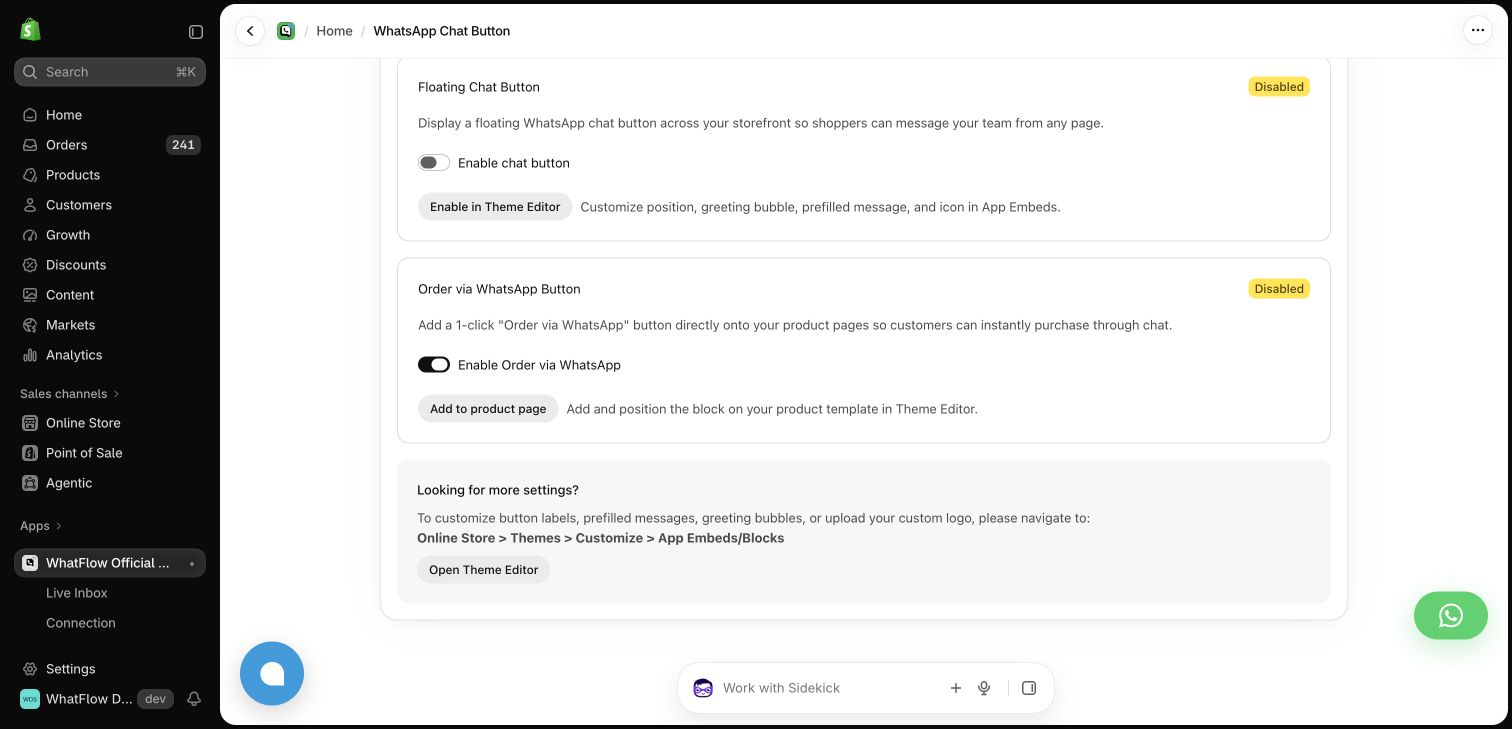
The storefront side matters too. WhatFlow's theme-matched WhatsApp button is free forever, so customers get a button that looks like part of your store instead of a generic bubble.
When Wati might still make sense
Pick Wati if you need a general WhatsApp sales platform that also serves channels or teams outside Shopify, and you're happy to pay per user above five. If you want an AI agent answering chats on its own, WhatFlow has no built-in AI bot, so that's a reason to look elsewhere. (If AI drafts with a person approving is enough, WhatFlow's MCP connector connects Claude, ChatGPT or Cursor to your Live Inbox.)
The bottom line
For a Shopify store, WhatFlow is the stronger choice and the cheaper one. You get native Shopify Flow automation, COD confirmation that updates orders, live catalog sharing and a team inbox, all on the Free plan, with no seat fees and no Shopify add-on. Start free, invite the whole team, and only pay more when you send more.
Questions worth asking
Is WhatFlow a good Wati alternative for Shopify?
Yes. WhatFlow is built specifically for Shopify, includes every feature on every plan and has no seat fees, so a growing team doesn't push you into a pricier tier. Wati is a broader WhatsApp platform; it makes sense mainly if you need its wider sales tooling beyond Shopify.
How much does Wati cost compared with WhatFlow?
As of November 2026, Wati lists Growth at $39, Pro at $79 and Business at $199 per month billed annually, plus $24 or $59 per extra user on Pro and Business and a $4.99/month Shopify add-on. WhatFlow starts free and paid plans start at $4.99/month with no seat fees. Meta's message fees apply to both.
Does WhatFlow charge per inbox seat?
No. WhatFlow's WhatsApp team inbox has no seat fees, so adding a colleague never adds a user charge. You pay only for the message plan you pick.
Are WhatFlow features restricted on the free plan?
No. The Free plan includes every WhatFlow feature, including Shopify Flow actions, COD confirmation, catalog sharing and the team inbox. Paid plans only add message allowance, and the theme-matched WhatsApp button is free forever.
Do I need a separate Shopify add-on to use WhatFlow?
No. WhatFlow is a Shopify app, so the Shopify connection is the product itself. Wati lists a separate Shopify Integration add-on at $4.99/month as of November 2026.
Sources and methodology
We checked these primary sources on November 5, 2026. Vendor pages describe advertised capabilities, rather than independent performance tests. Confirm current pricing, plan limits and availability with each provider.
- Wati pricing
Wati plan prices, included users, additional-user charges and the Shopify Integration add-on, checked November 5, 2026.
- Wati Shopify integration guide
Wati's documentation of its Shopify app, including the separate $4.99/month charge for automated messages.
- WhatFlow WhatsApp Business API on the Shopify App Store
WhatFlow plans, included sends, Shopify workflows and the 5.0/5 rating from 55 ratings (checked November 5, 2026).
- WhatsApp Business Platform pricing
Meta's per-message charges, which apply on top of either app's subscription.
- Wati pricing page
Official Wati pricing, first checked October 27, 2026 and rechecked November 5, 2026.