WhatsApp for Shopify stores in Nigeria: costs, COD and rules (2026)
What WhatsApp costs a Nigerian Shopify store, how to confirm pay-on-delivery orders, which template languages work, and what the NDPA 2023 asks of you.
Messaging customers in Nigeria on the official WhatsApp Business Platform costs $0.0067 per delivered utility template (order confirmations, delivery updates) and $0.0516 per marketing template, as of November 2026. For a Nigerian Shopify store, three things matter more than the rate card: confirming pay-on-delivery orders before the dispatch rider leaves, writing templates the way your buyers actually talk, and getting consent right under the Nigeria Data Protection Act 2023.
I'm Safwan, and I run WhatFlow. Nigerian merchants tend to ask us the same few questions: what Meta will charge in dollars, whether customers will tap a button instead of calling, and how to stop paying for failed deliveries. This guide answers all three with Meta's real figures and a setup you can copy this week.
How much does WhatsApp for Shopify cost in Nigeria?
Meta charges per delivered template message, based on the category and the recipient's country. A template is a message Meta has approved in advance. You need one for anything you send outside the 24-hour customer service window, which is the 24 hours after a customer last messaged you. Inside that window you can reply in your own words.
Here's Meta's USD rate card for Nigerian (+234) numbers, effective October 1, 2026 and current as of November 2026:
Service (free-form reply), after 1,000 free per number per month
$0.0067
Two changes from October 1, 2026 trip people up. Service replies are free only for the first 1,000 delivered per business phone number each month, and every one after that costs the utility rate. Utility templates sent inside an open customer service window are now charged as well. Both are spelled out in Meta's pricing documentation.
Authentication-international applies only to a business based outside Nigeria that sends OTP templates to +234 numbers, and only once it sends more than 750,000 messages outside service windows in a rolling 30 days (Meta's authentication-international rules). A Lagos or Abuja store verifying its own customers pays the normal $0.0067.
Worked example: 1,000 pay-on-delivery confirmations
Say you take 1,000 pay-on-delivery orders in December and send each buyer one confirmation template with Confirm and Cancel buttons.
1,000 utility templates × $0.0067 = $6.70 in Meta fees.
When buyers reply with questions ("Abeg, when e go reach Ikeja?"), your answers are service messages. The first 1,000 each month on that number cost nothing.
One parcel that doesn't go out to a buyer who already changed their mind will usually cover that whole bill. Logistics fees on a failed delivery are rarely small. Our guide to the RTO rate for Shopify COD stores shows how to work out what returns really cost you.
Worked example: a 5,000-recipient campaign
Now say you send a December sale announcement to 5,000 opted-in customers.
5,000 marketing templates × $0.0516 = $258.00 in Meta fees, if every message is delivered.
Marketing costs nearly eight times as much as utility in Nigeria, so I'd segment before sending: buyers from the last 90 days, people who clicked your last campaign, people who asked about a specific product. Our guide to segmenting WhatsApp campaigns has the filters I'd start with. Click-to-WhatsApp ads are another way to cut costs: once you reply, Meta opens a free entry point window that may stay open for up to 7 days, and it doesn't charge for your messages to that customer while it's open.
Billing currency
NGN isn't on Meta's list of WhatsApp billing currencies as of November 2026, so expect to pay Meta in USD (or another listed currency) on a card that works for dollar payments. WhatFlow passes Meta's charges through with zero markup, and your WhatFlow plan is a separate subscription. The WhatFlow pricing page has a country rate table and a cost calculator, and our WhatsApp Business API pricing explainer covers categories in more depth.
How Nigerian buyers shop, and what it changes on WhatsApp
Pay on delivery means you confirm before you dispatch
Lots of Nigerian shoppers prefer to pay when the parcel arrives, and lots of stores offer it because it wins orders. The cost shows up later: buyers who aren't home, numbers that don't connect, and people who ordered on impulse and refuse at the door.
In Shopify, cash on delivery is a manual payment method, and those orders sit as payment pending until you mark them paid. That's exactly the gap a WhatsApp confirmation fills. The buyer sees the amount and address in writing, taps a button, and the answer lands on the Shopify order. Here's one that works:
Hi Chiamaka, thanks for your order #2087 from Adire House: 2 kaftans, ₦48,500, pay on delivery to Lekki Phase 1, Lagos. Tap Confirm and we'll send it out tomorrow, or Cancel if you no longer need it.
Keep the amount and the area in the message. Someone who ordered by mistake will cancel right there, which saves you a wasted trip. For more wording, see our COD confirmation message templates.
Bank transfer and card payments
Shopify Payments isn't available in Nigeria (it's not on Shopify's supported countries list), so Nigerian stores use a third-party provider. Paystack's Shopify app, for example, lists Nigeria among its countries. Many buyers are also used to paying by bank transfer.
WhatFlow doesn't take payments inside chat, so the pattern is a link or a clear instruction. For a high-value order, or a buyer who has refused a parcel before, a follow-up can offer to switch to prepayment:
Hi Tunde, your order #2091 (₦126,000) is ready. To lock in tomorrow's delivery, you can pay now with this secure link: [link]. Prefer to pay on delivery? Just tap Keep pay on delivery.
Don't push prepayment on everyone. It's a tool for the risky orders, not the default.
English, Pidgin, Hausa, Yoruba or Igbo?
Most Nigerian buyers read English comfortably, but plenty reply in Pidgin, and many prefer Hausa, Yoruba or Igbo for a real conversation. Meta's supported template languages include English and Hausa (ha). As of November 2026 there's no code for Nigerian Pidgin, Yoruba or Igbo, and no Nigeria-specific English variant either.
Here's how I'd handle it:
Templates: write order confirmations in clear English. A short Pidgin line inside an English template reads naturally ("Abeg tap Confirm make we send am"). Add a Hausa version if a lot of your buyers are in the north.
Replies inside the 24-hour window: answer in whatever language the buyer uses. Free-form replies don't go through template review, so a teammate who speaks Yoruba or Igbo can just reply.
Avoid submitting a fully Yoruba or Igbo template under the English code. Meta reviews the text against the language you pick, and a mismatch is an easy rejection.
WhatFlow templates work in any language WhatsApp supports, and you can keep several language versions of one template. Our guide to WhatsApp template languages for order updates shows how to send each customer the right one.
What are Nigeria's data protection and marketing rules?
This isn't legal advice, but here's where things stand as of November 2026.
What that means for a Shopify store messaging customers:
You need a lawful basis for each use of a phone number.DLA Piper's Nigeria summary (updated March 2026) lists consent, contract and legitimate interests among the bases, and points out that giving a privacy notice isn't the same as getting consent. Sending an order confirmation to the number on the order fits the contract. A sale broadcast doesn't.
Direct marketing runs on consent. Commentators read GAID Article 18(1)(a) as expressly requiring consent for direct marketing, and the NDPA lets people object to direct marketing at any time, after which you must stop.
Bigger stores may have to register. The NDPC registers "data controllers of major importance" in tiers based on how many people's data you process in six months; DLA Piper lists the bands starting at 200 data subjects. Check where you fall.
Penalties scale with revenue. For a controller of major importance, fines can reach 2% of the previous year's gross revenue or ₦10 million, whichever is greater, per DLA Piper.
WhatsApp's own rules sit on top, and Meta enforces them. The WhatsApp Business Messaging Policy says you may only message people who gave you their number and agreed to hear from you, that you must honour opt-out requests made on or off WhatsApp, and that outside the 24-hour window you can only send approved templates. Ignore this and your number's quality rating drops, which limits how many people you can reach.
Keep order messages and marketing apart. A pay-on-delivery buyer expects a confirmation. They didn't sign up for your weekly promo.
Put "Reply STOP to unsubscribe" on marketing templates and actually suppress those numbers. WhatFlow has opt-outs and a blocklist for this.
Never buy number lists, and don't load your personal phone contacts into a campaign.
Setup checklist: WhatsApp for your Nigerian Shopify store with WhatFlow
WhatFlow WhatsApp Business API is built on the official Meta WhatsApp Cloud API and is rated 5.0/5 from 85 ratings on the Shopify App Store (checked November 24, 2026). It works for one-person brands and for large teams alike, because the shared inbox has no seat fees and every feature is on every plan, including Free. If you're starting from zero, read how to add WhatsApp to Shopify first, then work through this list.
Connect through Meta Embedded Signup. Install the app and connect your WhatsApp Business account from Shopify admin. You'll create or pick a Meta business portfolio along the way.
Use a Nigerian number and a recognisable display name. A +234 number your customers already know builds trust. Meta reviews the display name, so match it to your store name.
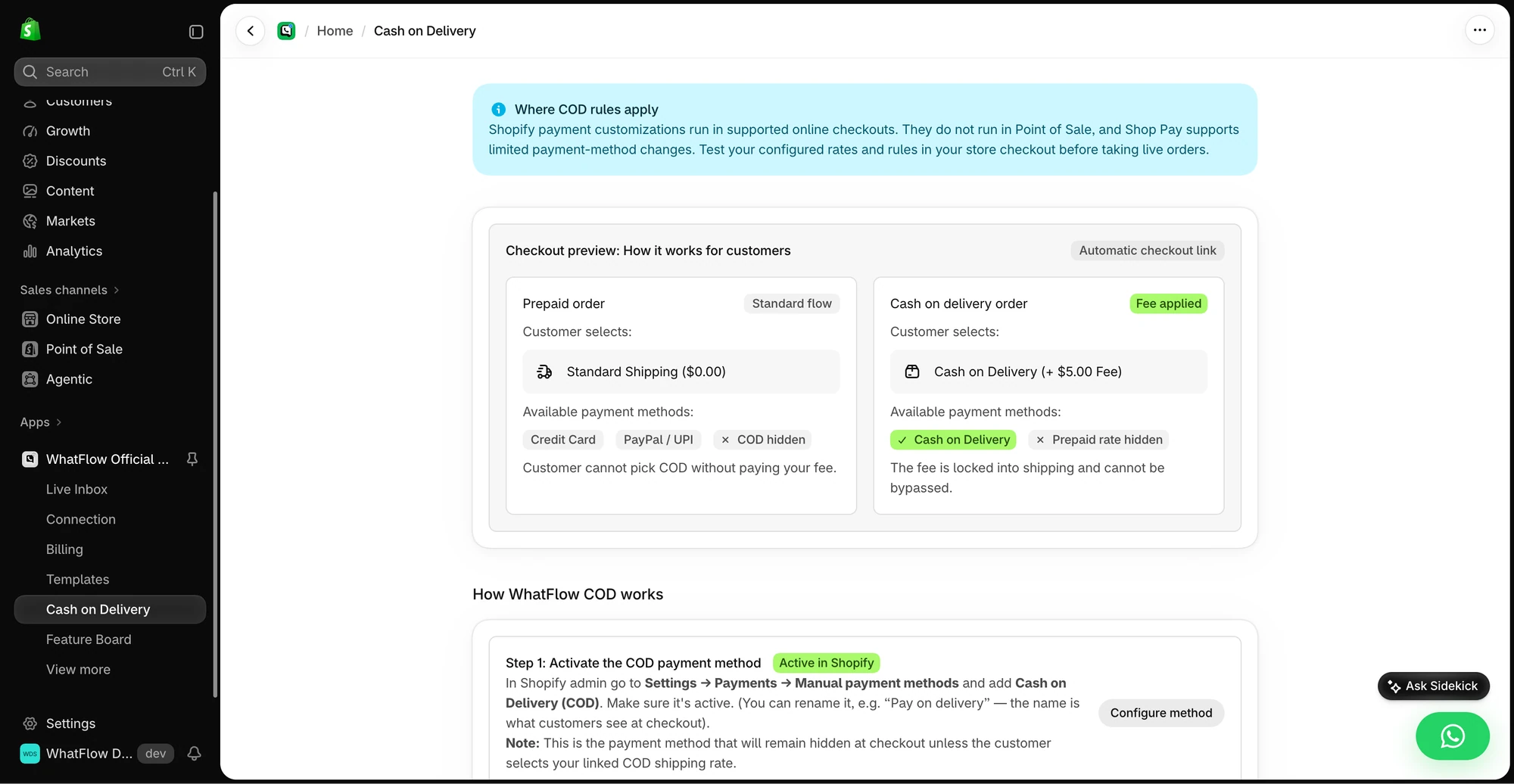
Set your COD rules. In Cash on Delivery, choose the manual payment method WhatFlow manages and, if you use a separate COD shipping rate, select it. Preview eligible and ineligible checkouts.
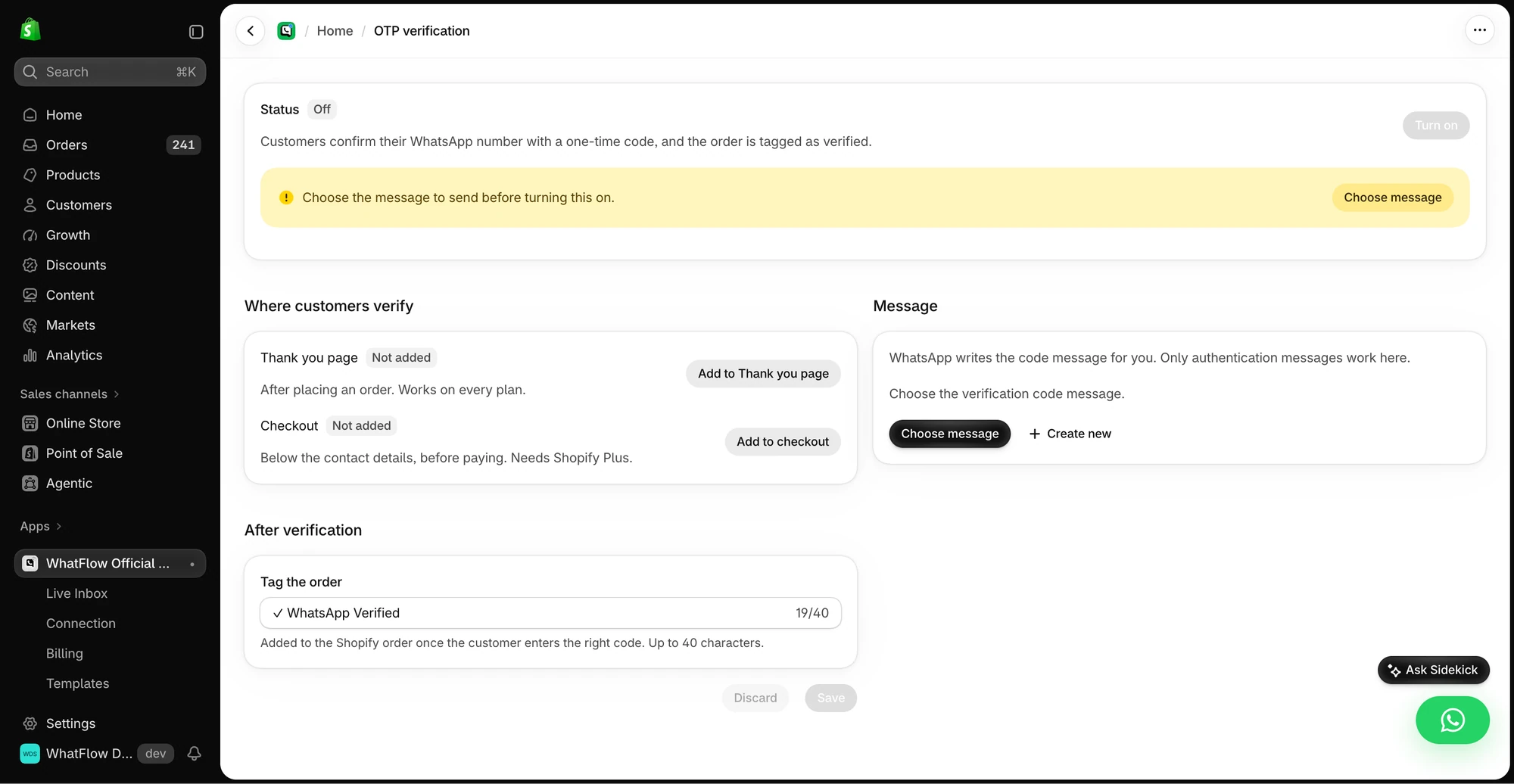
Add OTP verification where fake orders hurt. WhatFlow can verify the buyer's number with a one-time code and tag the Shopify order when it succeeds. A verified number only proves the buyer had the phone, so keep a dispatch rule.
Write templates in your buyers' language. English with a Pidgin line for confirmations, Hausa versions where they help.
Add delivery updates. WhatFlow sends shipping-journey updates (label, carrier pickup, in transit, delivered), which cuts down on "where is my order?" chats.
Consider FlowSense for a second look. FlowSense uses order and delivery outcomes to flag COD orders that may need checking before dispatch. Read its consent screen before you enable it.
WhatFlow demo store: COD rules with a sample checkout preview. Sample data, nothing sent.
The COD and OTP setup guide has the click-by-click, including the tests to run before going live: confirm, cancel, no reply, and a buyer with two open orders.
WhatFlow demo store: OTP placement options and the Shopify order tag used after verification.
For the review step, the FlowSense COD order review guide explains how to turn a flag into a fair next step. A flag is a reason to check. It isn't proof of fraud.
What to send when nobody replies
Not everyone taps a button the first time. Network drops, busy days. A second utility template a few hours later costs well under a cent:
Hi Chiamaka, your order #2087 (₦48,500) is packed and ready. Please tap Confirm so our rider can deliver tomorrow, or Cancel if you've changed your mind.
After that I'd hand the order to a person in the WhatFlow inbox rather than auto-cancel. A quick call on a big order is still worth making.
Run WhatsApp for your Shopify store with WhatFlow
Free plan available. Templates, COD confirmation, Shopify Flow automations and a shared team inbox with no seat fees. Every feature is included on every plan, including Free.
If you do one thing, replace pay-on-delivery confirmation calls with a WhatsApp template that has buttons, and tag the replies in Shopify. At about $6.70 per 1,000 orders in Meta fees, it pays for itself the first time it stops a wasted delivery. Then add your opt-in, and only after that start spending on campaigns. If you're still comparing tools, our roundup of COD confirmation apps for Shopify puts the options side by side, and the South Africa guide is useful if you also sell further south.
Frequently asked questions
How much does a WhatsApp order confirmation cost in Nigeria?
As of November 2026, Meta charges $0.0067 per delivered utility template sent to a Nigerian (+234) number, so 1,000 order confirmations cost about $6.70 in Meta fees. Your WhatsApp app's subscription is a separate charge.
Can a Nigerian business pay Meta for WhatsApp in naira?
No. NGN isn't one of the billing currencies Meta lists for the WhatsApp Business Platform as of November 2026, so Nigerian stores are billed in USD or another listed currency.
Do I need consent to send WhatsApp marketing in Nigeria?
Yes. WhatsApp's own Business Messaging Policy requires opt-in before you message anyone, and under the Nigeria Data Protection Act 2023 and the NDPC's 2025 implementation directive, direct marketing is treated as a consent-based activity that people can object to at any time.
Can I send WhatsApp templates in Pidgin, Yoruba or Igbo?
Meta's template language list includes English and Hausa but has no code for Nigerian Pidgin, Yoruba or Igbo as of November 2026. Pidgin lines inside an English template are common; full Yoruba or Igbo templates are a risk, so use those languages in free-form replies instead.
Who regulates data protection in Nigeria?
The Nigeria Data Protection Commission (NDPC), set up under the Nigeria Data Protection Act 2023. It issued the General Application and Implementation Directive (GAID) in March 2025 to explain how businesses should comply.
Per-message pricing, the October 1, 2026 service and utility changes, the up-to-7-day free entry point window and the list of billing currencies (NGN is not listed).
The official GAID PDF dated March 20, 2025; it's a scanned file our tools couldn't read, so the article relies on the secondary sources below for its wording.
Law-firm summary (updated March 17, 2026): NDPA assent date, lawful bases, the right to object to direct marketing, NDPC registration tiers and penalties.