Most Shopify stores should send WhatsApp marketing messages about two to four times a month per customer, and start at the low end. Order and delivery updates go out whenever something actually happens to the order. Reminders follow the product's real usage cycle. The right frequency for you is the highest one that doesn't push up opt-outs, blocks or unread messages, so measure it rather than copying anyone's number.
That's the answer. Below is the framework I'd use to set your own cadence, because "how often" depends far more on what you're sending than on any magic number.
Why WhatsApp frequency matters more than email frequency
Send one email too many and it goes to the promotions tab. Send one WhatsApp message too many and the customer can block you with a tap. The WhatsApp Business Messaging Policy says users can block or report businesses and that this feedback can limit how many messages you're allowed to send.
Meta also caps marketing for individual people. According to Meta's per-user marketing limits documentation, WhatsApp may limit how many marketing templates a person receives from businesses, based on their recent marketing read rate and how many messages they already have from friends, family and businesses. When you hit that cap, the send fails with error 131049. Meta says to wait at least 24 hours before retrying.
Put simply: if someone ignores your marketing, WhatsApp may stop delivering it to them. Frequency isn't only about manners. It's about whether your next message arrives at all.
How often to send each type of WhatsApp message
Split everything you send into three buckets and set the rhythm for each separately.
Shipped, out for delivery, delivered (skip the noise)
Delays and problems
Utility
As soon as you know
Every time, without exception
Abandoned checkout
Marketing
Within a few hours
One message, maybe one follow-up
Review request
Meta decides; often marketing
After the customer has used the product
Once per order
Replenishment reminder
Marketing
Just before they'd run out
Once per cycle
Back-in-stock alert
Marketing
When the item is back
Once per opt-in
Promotions, launches, sales
Marketing
Planned calendar
2 to 4 a month to start
Template categories are Meta's: utility templates are tied to a specific transaction the customer started, marketing templates are everything promotional. Meta decides the final category and can recategorise, so the template categories guide is worth a read before you assume a reminder counts as utility.
Transactional messages: as often as the order needs
Customers rarely complain about hearing too much about their own order. They complain when the update is useless ("Your order status has changed!") or when you sneak a promo into it. Keep utility messages about the order, short and specific. For COD stores, a confirmation message right after checkout is the most useful message you'll send all month; WhatFlow's COD confirmation with reply buttons can tag or cancel the order through Shopify Flow.
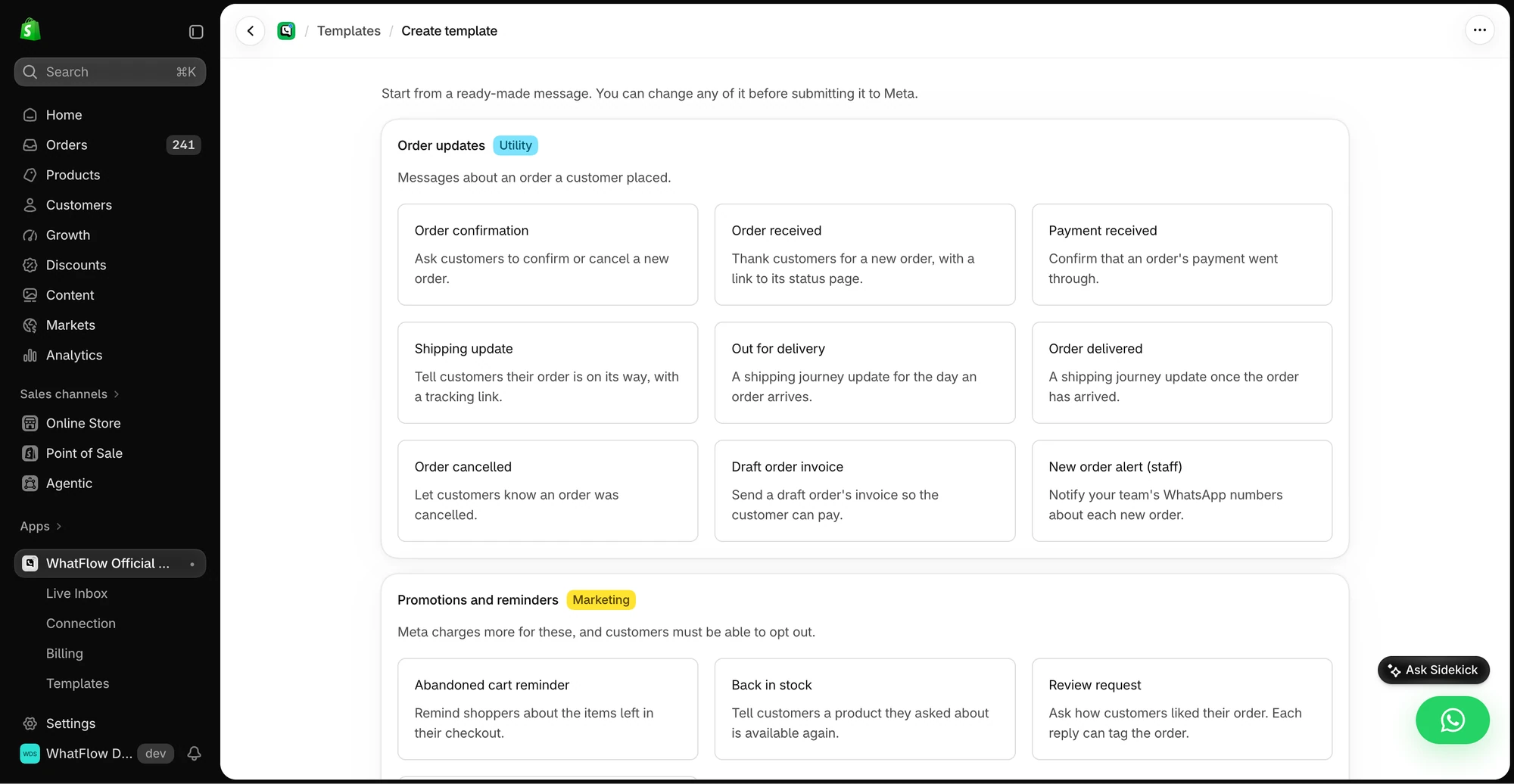
The template creation screen groups the supported message events by job.
Lifecycle messages: follow the product, not the calendar
A replenishment reminder for a 30-day supplement every 30 days makes sense. The same reminder for a 90-day face cream every 30 days is spam. Base the timing on the product's real use rate. The guide to replenishment reminders shows how to work that out.
Same idea for review requests: wait until the customer has actually used the thing. The post on when to ask for a review after delivery breaks it down by product type.
Marketing broadcasts: set a ceiling per customer, not per store
This is the trap. A store sends one broadcast a week. Sounds restrained. But that same customer also got an abandoned checkout nudge, a back-in-stock alert and a review request that week. From her side, she heard from you four times.
So set a per-customer ceiling for marketing messages (say, no more than one per week and four per month across all automations and broadcasts) and check every new campaign against it.
Frequency has a cost line too
Every template message you send is charged by Meta when it's delivered, at a rate set by category and the customer's country. As of November 2026 that includes utility templates sent inside an open customer service window, which Meta started charging for on October 1, 2026. Meta's free-form service replies are free only for the first 1,000 delivered per business phone number each month, then charged. Rates and rules change, so check Meta's pricing page rather than relying on a number from a blog post.
What this means for cadence: three shipping updates where one would do isn't only noise, it's three charges. Cut status messages that don't help the customer act or relax. "Out for delivery" is useful. "Your parcel has arrived at the sorting hub" usually isn't. The post on budgeting WhatsApp by cost per outcome shows how to put a price on each message type.
Match frequency to your buying cycle
The best predictor of how often you can message someone is how often they buy from you.
Fast consumables (coffee, tea, pet food, supplements): weekly is defensible if each message is useful. New roasts, refill timing, a recipe.
Fashion and beauty with regular drops: two to four a month, mostly around actual drops. More detail in WhatsApp for fashion stores.
Considered or big-ticket items (furniture, electronics): one or two a month, and lean on service messages when people reply.
Gifting and seasonal stores: quiet most of the year, a planned burst around the season.
A hypothetical monthly calendar
Say you run a tea shop with 3,000 WhatsApp subscribers. A month might look like this:
Week 1: New seasonal blend launch, sent to everyone who bought loose-leaf in the last six months.
Week 2: Nothing broadcast. Replenishment reminders run automatically for people due a refill.
Week 3: A brewing tip with a gentle link to the matching teapot, sent only to people who bought that blend.
Week 4: Nothing, unless a back-in-stock alert fires for someone who asked.
Any one customer gets one to three marketing messages that month. Plus order updates, which they want.
How to tell you're sending too much
Watch these after every send, compared to your usual numbers:
Opt-outs and STOP replies rise after a particular campaign.
Read rates fall for the same segment over a few sends.
Template quality in WhatsApp Manager drops from green to yellow. Meta's template quality page says ratings use customer feedback and read rates.
Error 131049 failures increase, meaning per-user caps are kicking in.
Angry replies like "who is this?" or "stop spamming". Read them. They're data.
If two of those move together, cut frequency for that segment and see if they recover. The full measurement setup is in WhatsApp marketing metrics for Shopify.
Big sale weeks are different (a bit)
During Black Friday or Eid, people expect more. You can raise frequency briefly if you say so up front:
Black Friday starts Friday at 9am. We'll send you 3 messages this week: early access Thursday night, the launch, and a last-call Sunday. Want to skip this year? Tap below.
[I'm in] [Skip Black Friday]
That message sets expectations and hands the customer control, which is the opposite of how most sale-week spam feels. The Black Friday WhatsApp playbook has the full timeline.
Free plan available
Run WhatsApp for your Shopify store with WhatFlow
Templates, COD confirmation, Shopify Flow automations and a shared team inbox with no seat fees. Every feature is included on every plan, including Free.
Start at two marketing messages a month per customer, keep transactional messages clean, and add frequency only for segments that keep reading and replying. WhatFlow puts broadcasts, automations and the inbox in one Shopify app, so you can see the replies each send generates without a separate tool.
Frequently asked questions
How often should I send WhatsApp marketing messages to customers?
For most small stores, start at two marketing messages a month per customer and adjust from there. Tie the number to how often customers buy, and slow down when opt-outs or blocks rise after a send.
Do order and shipping updates count toward my marketing frequency?
Not in the customer's head, as long as they're genuinely about their order. Keep transactional messages clean of promotions so they stay useful and don't feel like extra marketing.
Does WhatsApp limit how many marketing messages one customer can receive?
Yes. Meta may cap the marketing templates a person gets from businesses based on their recent read rate and how many messages are in their inbox. Blocked sends fail with error 131049, and Meta advises waiting at least 24 hours before retrying.
Is it OK to send several WhatsApp messages during a sale like Black Friday?
A short burst is fine if customers expect it and you tell them in advance. Two or three messages across the sale, segmented by interest, is a lot safer than daily blasts to everyone.