Messaging customers in Bangladesh on the official WhatsApp Business Platform costs $0.0037 per delivered utility template (order confirmations, delivery updates) and $0.0732 per marketing template, as of November 2026. For a Bangladeshi Shopify store, three things matter most: confirming cash-on-delivery orders before the courier picks up, writing templates in Bangla, and getting consent right under the new Personal Data Protection Act 2026.
I'm Safwan, and I run WhatFlow. Bangladeshi merchants who write to us usually ask about cost first, then about fake COD orders, then about whether Bangla templates get approved. The short answers: order messages are very cheap, marketing isn't, and yes. Here's the long version with Meta's figures and a setup you can copy.
How much does WhatsApp for Shopify cost in Bangladesh?
Meta charges per delivered template message, based on the category and the recipient's country. A template is a message Meta has approved in advance. You need one for anything you send outside the 24-hour customer service window, the 24 hours after a customer last messaged you. Inside that window you can reply in your own words.
Here's Meta's USD rate card for Bangladeshi (+880) numbers, effective October 1, 2026 and current as of November 2026:
Service (free-form reply), after 1,000 free per number per month
$0.0037
Bangladesh joined Meta's authentication-international markets on October 1, 2026. That higher rate only hits a business based outside Bangladesh sending OTP templates to +880 numbers, and only after it sends more than 750,000 messages outside service windows in a rolling 30 days. A Dhaka store verifying its own customers pays $0.0037.
Two other changes from October 1, 2026: service replies are free only for the first 1,000 delivered per business phone number each month (then they cost the utility rate), and utility templates sent inside an open customer service window are now charged. Both are in Meta's pricing documentation.
Worked example: 1,000 COD confirmations
Say you take 1,000 COD orders in a month and send each buyer one confirmation template with Confirm and Cancel buttons.
1,000 utility templates × $0.0037 = $3.70 in Meta fees.
When buyers reply ("কবে পাবো?"), your answers are service messages. The first 1,000 each month on that number cost nothing.
Under four dollars for a thousand confirmations. If even a handful of those stop a parcel going to someone who'd refuse it, you're ahead, because the courier charges for the return trip either way. Our guide to the RTO rate for Shopify COD stores shows how to measure that properly.
Worked example: a 5,000-recipient campaign
Now say you send an Eid sale announcement to 5,000 opted-in customers.
5,000 marketing templates × $0.0732 = $366.00 in Meta fees, if every message is delivered.
That's the number that surprises people. Marketing costs about 20 times as much as utility in Bangladesh, so a careless broadcast to your whole list burns money fast. Segment hard (recent buyers, past campaign clickers, people who asked about the category on sale) and read our Ramadan, Eid and Diwali campaign guide for timing. Click-to-WhatsApp ads are the other lever: once you reply, Meta opens a free entry point window that may stay open for up to 7 days, and it doesn't charge for your messages to that customer while it's open.
Billing currency
BDT isn't on Meta's list of WhatsApp billing currencies as of November 2026, so you'll pay Meta in USD or another listed currency, which means you need a card that works for international payments. WhatFlow passes Meta's charges through with zero markup, and your WhatFlow plan is billed separately. The WhatFlow pricing page has the country table and a calculator, and our WhatsApp Business API pricing explainer covers the categories.
How Bangladeshi buyers pay, and what it changes on WhatsApp
COD first, so confirmation is the job
Plenty of Bangladeshi shoppers prefer cash on delivery, especially from a store they haven't bought from before. In Shopify, COD is a manual payment method, and those orders sit as payment pending until you mark them paid. The familiar problems follow: wrong numbers, duplicate orders, and buyers who say no at the door.
A WhatsApp confirmation puts the amount and address in writing and gets a one-tap answer onto the Shopify order:
আসসালামু আলাইকুম রাফি ভাই, Nakshi Ghor থেকে আপনার অর্ডার #1187: ২টি নকশি কাঁথা, ৳৩,৯০০, ক্যাশ অন ডেলিভারি, ধানমন্ডি, ঢাকা। অর্ডার নিশ্চিত করতে Confirm চাপুন, না লাগলে Cancel চাপুন।
And the English version for buyers who prefer it:
Hi Rafi, thanks for your order #1187 from Nakshi Ghor: 2 nakshi kantha, ৳3,900, cash on delivery to Dhanmondi, Dhaka. Tap Confirm and we'll hand it to the courier today, or Cancel if you no longer need it.
Mobile financial services are everyday payment tools for many Bangladeshi buyers. Shopify Payments isn't available in Bangladesh (it's not on Shopify's supported countries list), so stores use a third-party gateway. The SSLCOMMERZ app, for example, lists cards, net banking and mobile banking (MFS) channels. Check which wallets your gateway actually supports before you mention them in a template.
Some stores ask for a small advance on high-value or out-of-Dhaka COD orders to cover delivery. WhatFlow doesn't take payments inside chat, so send a link or clear instructions, and only for the orders that need it:
Hi Rafi, your order #1192 (৳14,500) is going outside Dhaka. To confirm, please pay the delivery charge in advance using this link: [link]. The rest is cash on delivery.
Bangla, English or both?
Meta supports Bengali (bn) as a template language, alongside English. Many urban buyers are fine in English; plenty of others read Bangla far more comfortably, and a Bangla message feels like it came from a local shop. I'd write order confirmations in Bangla with an English version ready, and let your customers' replies tell you which to send. Bangla typed in Latin letters is common in chat; there's no separate code for it, so if you use it in a template, pick one code and stick with it.
WhatFlow templates work in any language WhatsApp supports, and you can keep several language versions of one template. Our guide to WhatsApp template languages for order updates shows how to route each buyer to the right one.
What are Bangladesh's data protection and marketing rules?
This isn't legal advice, but here's what I could confirm as of November 2026.
Bangladesh now has an enacted data protection law. The interim government issued the Personal Data Protection Ordinance in November 2025. When the new parliament reviewed interim-era ordinances, it passed the Personal Data Protection Bill 2026 on April 9, 2026, as The Financial Express reported, and The Daily Star says the ordinance became the Personal Data Protection Act on April 15, 2026. I couldn't open an official gazette copy of the Act, so I'm relying on those reports and the summaries below.
Consent before collection. Consent has to be specific and freely given, and when you ask for it you should say what you'll use the data for, how long you'll keep it and how to withdraw.
Purpose limitation. Use data only for the purpose you collected it for. A number collected to deliver an order isn't automatically a marketing number.
Withdrawal at any time. If someone withdraws consent, stop processing for that purpose.
No targeted advertising at minors. The ordinance explicitly bans profiling or targeted advertising aimed at children.
A phase-in. The ordinance said some sections take effect 18 months after gazette notification, while the data authority issues rules. Check the current commencement status before assuming a provision doesn't apply yet.
The authority that enforces the Act sits under the Prime Minister's Office, according to The Daily Star. I didn't find a separate Bangladeshi rule written specifically for WhatsApp or SMS marketing, so treat the consent rules above plus WhatsApp's own policy as your baseline.
WhatsApp's rules are the ones you'll hit first. The WhatsApp Business Messaging Policy says you may only message people who gave you their number and agreed to hear from you, you must honour opt-outs made on or off WhatsApp, and outside the 24-hour window you can only send approved templates. Low-quality sends drag down your number's quality rating and how many people you can reach.
Add "Reply STOP to unsubscribe" (or a Bangla equivalent) to marketing templates, and suppress those numbers with WhatFlow's opt-outs and blocklist.
Don't buy number lists or scrape Facebook group members.
Setup checklist: WhatsApp for your Bangladeshi Shopify store with WhatFlow
WhatFlow WhatsApp Business API is built on the official Meta WhatsApp Cloud API and is rated 5.0/5 from 85 ratings on the Shopify App Store (checked November 24, 2026). The shared inbox has no seat fees and every feature is on every plan, including Free, so a growing team doesn't pay more per agent. New to this? Read how to add WhatsApp to Shopify first.
Connect through Meta Embedded Signup from Shopify admin. You'll create or choose a Meta business portfolio in the flow.
Use a Bangladeshi number and a recognisable display name. A +880 number your customers already know builds trust, and Meta reviews the display name.
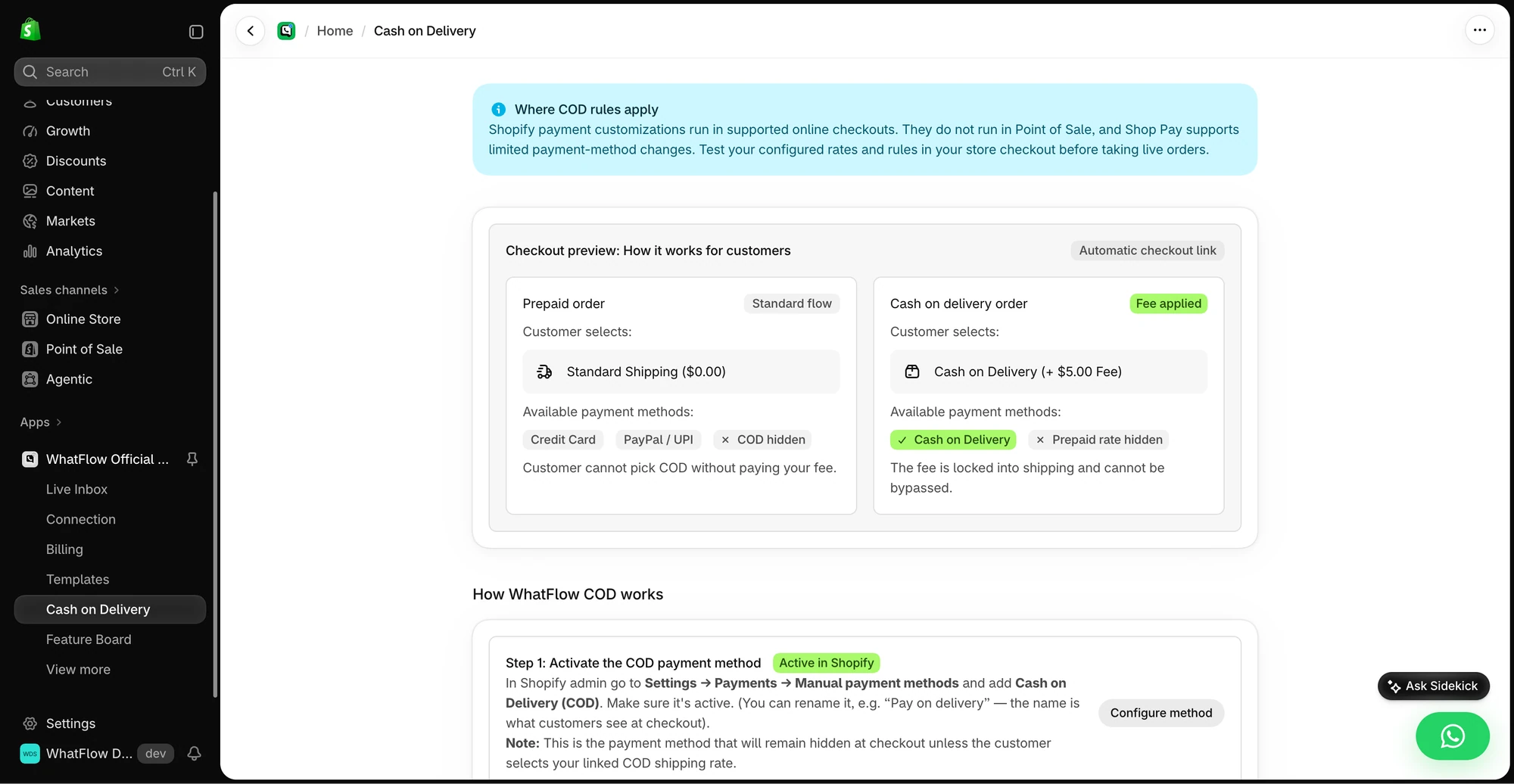
Set your COD rules. Choose the manual payment method WhatFlow manages, select any COD shipping rate, and preview eligible checkouts.
Add OTP verification where fake orders hurt. WhatFlow verifies the number with a one-time code and tags the order. That only proves access to the phone, so keep a dispatch rule.
Write templates in Bangla and English using the bn and English codes.
Add delivery updates. WhatFlow's shipping-journey messages cover label, carrier pickup, in transit and delivered.
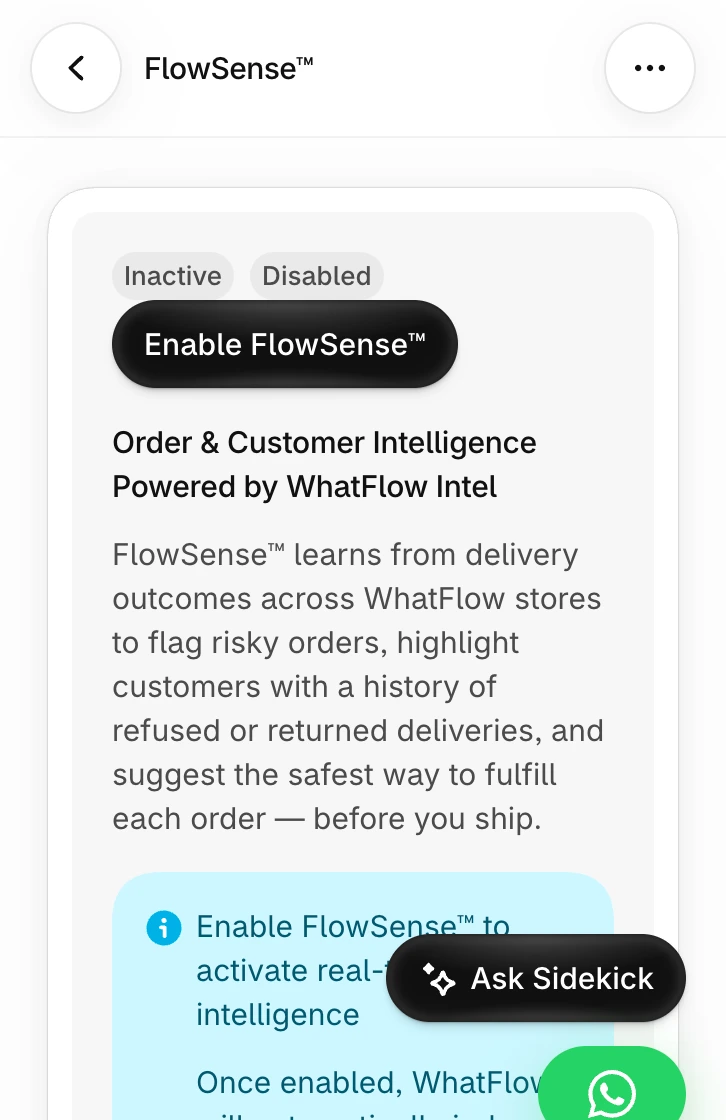
Consider FlowSense to flag COD orders that may need a closer look. Read its consent screen before enabling.
WhatFlow demo store: COD rules with a sample checkout preview. Sample data, nothing sent.
The COD and OTP setup guide has the click-by-click and the tests to run first: confirm, cancel, no reply, and a buyer with two open orders.
WhatFlow demo store: where you review FlowSense before enabling it. The feature was left inactive.
The FlowSense COD order review guide explains how to turn a flag into a fair next step. A flag is a reason to check, not proof of fraud.
When the buyer doesn't reply
Send one more utility template a few hours later. At $0.0037 it's nearly free:
রাফি ভাই, আপনার অর্ডার #1187 (৳৩,৯০০) পাঠানোর জন্য তৈরি। Confirm চাপুন, কাল ডেলিভারি হবে। না লাগলে Cancel চাপুন।
If that gets nothing, have someone in the WhatFlow inbox follow up before you cancel.
Run WhatsApp for your Shopify store with WhatFlow
Free plan available. Templates, COD confirmation, Shopify Flow automations and a shared team inbox with no seat fees. Every feature is included on every plan, including Free.
Switch COD confirmation to a Bangla WhatsApp template with buttons and tag the replies in Shopify. At $3.70 per 1,000 orders in Meta fees, it's the cheapest fix for returned parcels you'll find. Add your opt-in next, and only then plan campaigns, because at $0.0732 a message they need a real list. Our India guide and Pakistan guide cover neighbouring markets, and the COD confirmation apps roundup compares tools.
Frequently asked questions
How much does a WhatsApp order confirmation cost in Bangladesh?
As of November 2026, Meta charges $0.0037 per delivered utility template sent to a Bangladeshi (+880) number, so 1,000 COD confirmations cost about $3.70 in Meta fees.
Why is WhatsApp marketing so expensive in Bangladesh compared with order updates?
Meta prices each category separately. In Bangladesh a marketing template costs $0.0732 as of November 2026, roughly 20 times the $0.0037 utility rate, so campaigns cost far more per message than order confirmations.
Does Bangladesh have a data protection law?
Yes. The Personal Data Protection Ordinance 2025 was replaced by the Personal Data Protection Act 2026, which parliament passed in April 2026. It requires consent before personal data is collected and lets people withdraw consent at any time.
Can I send WhatsApp templates in Bangla?
Yes. Bengali (bn) is a supported WhatsApp template language, so you can write order confirmations and updates in Bangla script and keep an English version alongside.
Can a Bangladeshi store pay Meta in taka?
No. BDT isn't one of the billing currencies Meta lists for the WhatsApp Business Platform as of November 2026, so expect to pay in USD or another listed currency.
Per-message pricing, the October 1, 2026 service and utility changes, the up-to-7-day free entry point window and the billing currency list (BDT is not listed).
July 2026 analysis: the ordinance became the Personal Data Protection Act on April 15, 2026, requires consent before collection, and the authority sits under the Prime Minister's Office.
Consent, purpose limitation, withdrawal of consent, the ban on targeted advertising to minors and the 18-month phase-in for some sections, as described for the ordinance.
Secondary overview (June 2026) of the Act's consent definition, disclosures when asking for consent and administrative fines. We couldn't open an official gazette copy of the Act.