WhatsApp for food business owners is mostly about timing and trust. Customers want to know it's fresh, what's in it, and exactly when it'll arrive. Use WhatsApp to answer ingredient questions from the label, confirm orders and delivery windows before you cook or dispatch, and make reordering one tap for the things people buy every week. Payment stays on your Shopify checkout.
Food is different from most ecommerce. A late T-shirt is annoying. A late cake ruins a birthday. A missed delivery of fresh fish is money in the bin. That's why WhatsApp, where customers actually read their messages, fits food and beverage brands so well.
For a shopper asking which size or variant fits, use WhatFlow's product picker to share the relevant catalog item from the conversation. With catalog cart follow-up configured, WhatFlow can send back a Shopify checkout link. Check Shopify before treating the WhatsApp cart as a paid order. The catalog-to-checkout walkthrough shows the test sequence.
What do food and beverage customers ask on WhatsApp?
Say you run a bakery that delivers across the city, or a specialty coffee roaster shipping nationally. Your inbox will be full of:
"Is this nut-free?"
"Is it halal?" / "Is it vegan?"
"When was this baked?" / "What's the roast date?"
"How long does it stay fresh?"
"Can you deliver tomorrow before 10am?"
"Do you deliver to my area?"
"Can I change my order to two loaves instead of one?"
"Can I just get the same as last week?"
Each one is either a safety question, a timing question or a reorder. Treat them differently.
How should you answer allergen and ingredient questions?
This is the one area where speed must never beat accuracy. My rule for food brands: answer ingredient questions only from the label or your written specification. Never from memory, never "should be fine".
Put the exact ingredient and allergen information for every product into a saved reply your team can paste and adjust:
Hi Fatima, here's the full ingredient list for the Date & Walnut Loaf: [ingredients]. It contains wheat (gluten), walnuts and milk. It's made in a kitchen that also handles peanuts and sesame, so we can't guarantee it's free from traces.
And when you don't know:
I don't want to guess on this one. Let me check with the kitchen and come back to you within the hour. Please don't order until I've confirmed.
Food labelling and allergen rules vary by country, and you know your market's rules better than any blog post. Whatever they are, your WhatsApp answers should match what's on your packaging. If chat answers and labels disagree, fix the label or the saved reply the same day.
Certifications (halal, kosher, organic, vegan) work the same way. State what you're certified for and by whom, and send a photo of the certificate if customers ask. Don't stretch "made with halal ingredients" into "halal certified".
Freshness questions: give dates, not adjectives
"It's very fresh!" doesn't answer anything. Give the specific date and storage advice.
These beans were roasted on 3 November. They're at their best from about day 5 to week 5 after roasting. Keep the bag sealed, away from sunlight, and don't refrigerate.
We bake to order, so your sourdough goes in the oven the morning of delivery. It's best within 2 days, or slice and freeze it on day one.
Customers who ask about freshness are telling you it matters to them. Answer like a maker, and they'll come back.
Delivery slots: confirm before you cook
Many food brands on Shopify use local delivery. Shopify's local delivery settings let you set delivery zones by radius or postal code, a price per zone and a minimum order value. If you offer timed slots, you'll typically use a scheduling app or confirm the slot after the order. WhatsApp is the natural place to do that confirmation.
A utility template sent right after the order:
Hi Ali, thanks for order #2207 (2 x Sourdough, 1 x Almond Croissant Box). We can deliver tomorrow, Thursday. Which slot suits you?
[8 to 10am] [12 to 2pm] [5 to 7pm]
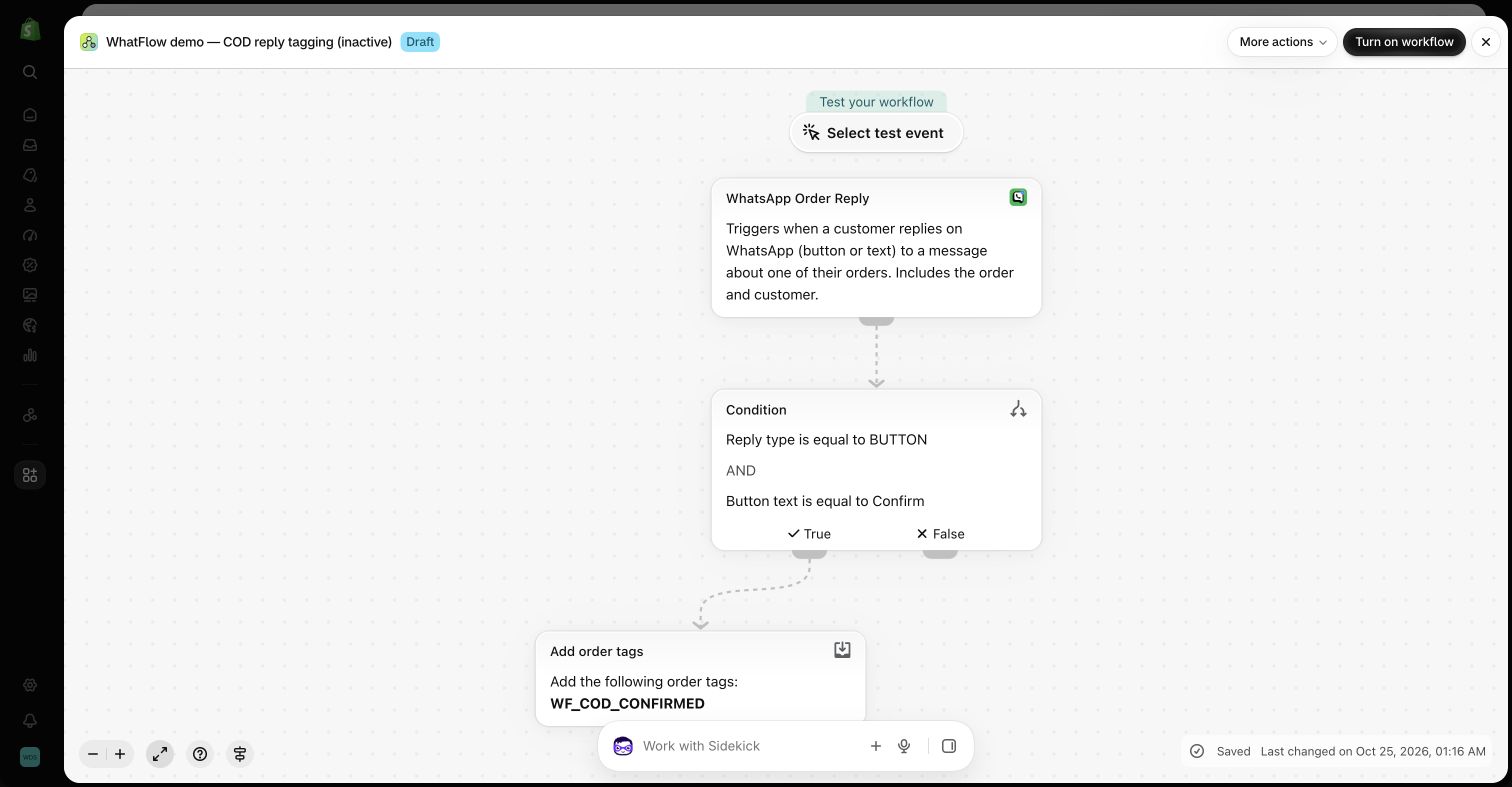
The customer taps a button, your team sees the reply in the inbox, and the kitchen knows when to bake. If you want to automate further, WhatFlow's Shopify Flow triggers can react to a customer's reply to an order message, for example by tagging the order so it appears on the right delivery run. Test it on a sample order before you rely on it.
If you accept cash on delivery, a refused fresh-food order isn't just a lost sale. It's wasted stock. A COD confirmation is a message sent right after a cash-on-delivery order asking the customer to confirm before you prepare or dispatch it.
Hi Noor, please confirm your cash-on-delivery order #3318: 1 x Family Biryani Kit, 1 x Kheer (500g), total 4,200 PKR, delivery Saturday 12 to 2pm.
[Confirm] [Change time] [Cancel]
In WhatFlow, the confirm and cancel buttons can tag or cancel the order through Shopify Flow, so your kitchen only preps confirmed orders.
A demo Shopify Flow workflow that acts on a customer's WhatsApp order reply.
Repeat purchases are the backbone of most food brands. Coffee, tea, spices, snacks, pet food, meal kits: people buy them on a rhythm. A reorder reminder timed to that rhythm is one of the most welcome marketing messages you can send.
Say a customer buys a 250g bag of coffee and drinks two cups a day. That bag lasts roughly two and a half weeks. Send the reminder around day 14:
Hi Omar, running low on Ethiopia Yirgacheffe? Your usual 250g bag (whole bean) is one tap away: {{1}}. Fresh roast goes out Monday and Thursday.
Food brands get hammered during festivals. Pre-orders for Eid sweets, Diwali mithai boxes, Christmas hampers. Publish cut-off dates early and repeat them in chat, and set an away message for when the kitchen is closed. Our guides to holiday shipping cut-off messages and WhatsApp campaigns for Ramadan, Eid and Diwali help with the planning.
Two pitfalls specific to food
"Should be fine" on allergens. I've said it already, but it's the one mistake that can actually hurt someone. Make "check the label, then answer" a hard rule for everyone on the inbox, including the weekend helper.
Alcohol in your messages. WhatsApp's Business Messaging Policy treats alcohol as a restricted category, with conditions on countries and age. If you sell wine, beer or spirits alongside food, read the policy before putting those products in templates or catalog messages.
WhatsApp for food business teams: which features matter most?
Job
WhatFlow feature
Ingredient and freshness answers
Shared team inbox, saved replies
Delivery slot confirmation
Templates with reply buttons, Flow triggers
COD confirmation
COD confirmation with Flow tag and cancel actions
Delay notices
Order and shipping update templates
Reorders
Shopify Flow plus template actions
Showing products
Live catalog sharing
Every feature is on every plan, including Free, and the inbox has no seat fees, so your kitchen lead and your driver coordinator can both be in it.
Free plan available
Run WhatsApp for your Shopify store with WhatFlow
Templates, COD confirmation, Shopify Flow automations and a shared team inbox with no seat fees. Every feature is included on every plan, including Free.
Before you set up a single automation, write a saved reply with the full ingredients and allergens for your top ten products. It's the least glamorous part of WhatsApp for a food business, and the most important. Then add COD confirmation, then reorder reminders, in that order.
Frequently asked questions
How can a food business use WhatsApp?
Food businesses use WhatsApp to answer ingredient and freshness questions, confirm orders and delivery windows before dispatch, warn customers about delays, and send reorder reminders for products people buy regularly, like coffee, bread or meal kits.
Should my team answer allergen questions on WhatsApp?
Only from the product label or your written ingredient specification, never from memory. If you can't confirm something, say so clearly. Follow the food labelling and allergen rules in the countries you sell to.
Can customers choose a delivery slot through WhatsApp?
You can confirm or offer a slot in a WhatsApp conversation or with a template that uses reply buttons. Shopify's local delivery settings handle zones and minimum order values, so if you offer timed slots you'll need a scheduling app or a confirmation step.
Can I sell alcohol through WhatsApp?
WhatsApp's Business Messaging Policy lists alcohol as a restricted category with country and age conditions. Read the current policy before you mention alcohol in any WhatsApp message.