To validate a product idea, get 15 to 25 people who match your buyer to describe how they handle the problem today, then ask them for something that costs them: a phone number on a waitlist, a deposit, or a pre-order. WhatsApp is the fastest place to do it because the conversations are short, honest and already on their phone. Compliments don't count. Commitments do.
I've watched a lot of Shopify merchants skip this step. They find a product with a nice margin, order 500 units, build a beautiful store and then discover the people who said "oh I'd totally buy that" were being polite. Validation isn't a spreadsheet exercise. It's a set of conversations that end with someone either reaching for their wallet or not.
What does it actually mean to validate a product idea?
Product validation means collecting evidence that a specific group of people will pay a specific price for a specific product, before you commit serious money to stock. The key word is evidence. Search volume tells you people are curious. Competitors tell you a market exists. Neither tells you that your version, at your price, from a store nobody has heard of yet, will sell.
You're trying to answer three questions:
Do these people have this problem often enough to care?
What do they do about it today, and what does that cost them?
Will they commit something now to get your version?
The first two you answer by talking. The third you answer by asking.
Signals that matter (and the ones that lie)
Before you talk to anyone, decide what you'll count. Otherwise you'll come out of 20 friendly chats convinced you have a hit.
Names a product they already pay for, and what they hate about it
Strong
Proves budget and a gap
Gives you their number for a launch alert
Strong
A small but real commitment
Forwards your message to a friend with the same problem
Strong
They're spending their own reputation
Pays a deposit or pre-orders
Strongest
Money is the only signal that can't be faked
Write your threshold down now. Something like: "If at least 5 of 20 people pre-order at $45, I'll place a first order of 100 units." The exact numbers are yours to choose. The point is that you set them before the results come in.
Step 1: Write down the bet
One sentence, no more. Say you're thinking about selling a refillable glass spray bottle set for natural cleaning products:
Busy parents in Dubai who already make their own cleaning sprays will pay AED 89 for a set of four refillable glass bottles with printed labels, because the plastic ones they use leak and look messy.
Who, what, price, and why. If you can't fill in all four, you're not ready for conversations yet. Spend an hour on defining your audience and brand promise first.
Step 2: Find 20 people to talk to
You don't need a big audience. You need the right 20. Good places to find them:
Your existing customers, if you already run a store in a nearby niche. They know you and they'll answer.
People who already asked a related question. Scroll your WhatsApp inbox. Every "do you have this in glass?" or "do you sell refills?" is a lead. If you track these, pre-purchase product questions become a free research database.
Communities where the problem lives: parent groups, hobby forums, Instagram comments under a competitor's post.
A small ad that opens a chat. A Click-to-WhatsApp ad with a modest budget is a quick way to get strangers who match your targeting into a conversation, and because the customer starts those chats, you can answer with normal free-form messages instead of templates.
One rule that trips people up. If a customer messages you, WhatsApp opens a 24-hour customer service window and you can reply normally. If you want to start the conversation, outside that window, WhatsApp only lets a business send a pre-approved template message, and only to people who've opted in to hear from you. A "help us with a new product" invite will almost certainly be a marketing template. The 24-hour window guide explains the mechanics, and Meta's pricing page lists current per-message rates by country.
Here's an invite template I'd use with opted-in customers:
Hi {{1}}, it's Sara from Glow & Gather. We're thinking about making something new and I'd love 5 minutes of your honest opinion, here on WhatsApp. No sales pitch. Reply YES if you're up for it, or STOP to opt out of our messages.
Step 3: Run the conversation like an interview, not a pitch
The worst validation question in the world is "Would you buy this?" Everyone says yes. Ask about the past instead. People are terrible at predicting what they'll do and quite good at remembering what they did.
I keep these as saved replies so anyone on the team can run a conversation the same way:
Thanks for helping! First question: when did you last make your own cleaning spray? What did you put it in?
What's the most annoying thing about that bottle?
Have you ever looked for a better one? What did you find, and why didn't you buy it (or did you)?
Roughly what did you spend on bottles or sprays in the last few months?
Then, and only then, show the idea:
Here's what we're thinking: a set of four 500ml glass bottles with leak-proof triggers and printed labels, AED 89. Honest reaction? It's fine to say "not for me."
A few habits that make WhatsApp interviews work better than calls or forms:
One question per message. People answer between other things. Long paragraphs get skimmed.
Accept voice notes. Plenty of customers, especially in the Gulf, South Asia and Brazil, would rather talk than type. You'll often get more detail from a 40-second voice note than a typed answer.
Ask for a photo. "Could you send a photo of the bottle you use now?" shows you the real competitor, on a real kitchen counter.
Shut up after the price. If they go quiet or ask "why so expensive?", that's data. Don't rush to discount.
Step 4: Ask for a commitment
This is the step most people skip because it feels pushy. It isn't. You're giving interested people a way to be first.
There are three levels of ask, from easiest to strongest:
Waitlist with a phone number. "Want me to message you when it's ready? Reply YES and I'll add you to the launch list." Log who said yes and when. A product launch waitlist is a whole tactic in itself.
Deposit. A small refundable amount to reserve one from the first batch. Use a Shopify product with a clear description of what the deposit is for.
Pre-order at full price. The strongest signal there is. Shopify needs a pre-order app for this, and you need to be honest about timing.
Here's how I'd word the ask:
Thanks, this was really useful. We're making a first batch of 100 sets in January. If you'd like one, I can reserve it now with a fully refundable AED 20 deposit, and you'll get it before anyone else. Want the link?
If you do take money, treat those people like gold. Tell them about delays before they have to ask. Keeping pre-order customers updated on WhatsApp is how a validation test turns into your first loyal customers instead of your first refund requests.
Step 5: Read the results honestly
Go back to the threshold you wrote down. Say you ran 20 conversations:
14 described the leaking-bottle problem without being asked.
9 named a bottle they'd bought and disliked.
7 joined the waitlist.
4 paid the deposit.
Against a goal of 5 deposits, 4 is close but not there. That's useful. Look at what the non-buyers said. If six of them flinched at AED 89 but loved the labels, maybe the test is a two-bottle starter set at a lower price. Run another ten conversations on that version.
If only 2 of 20 even recognised the problem, don't argue with it. Change the audience or drop the idea. The cheapest product you'll ever launch is the one you decided not to stock.
How I'd set this up in WhatFlow
You can run all of this from your phone with WhatsApp alone, but it gets messy fast when two people are answering and you're trying to count signals. Here's how I'd organise it in the WhatFlow WhatsApp Business API app for Shopify:
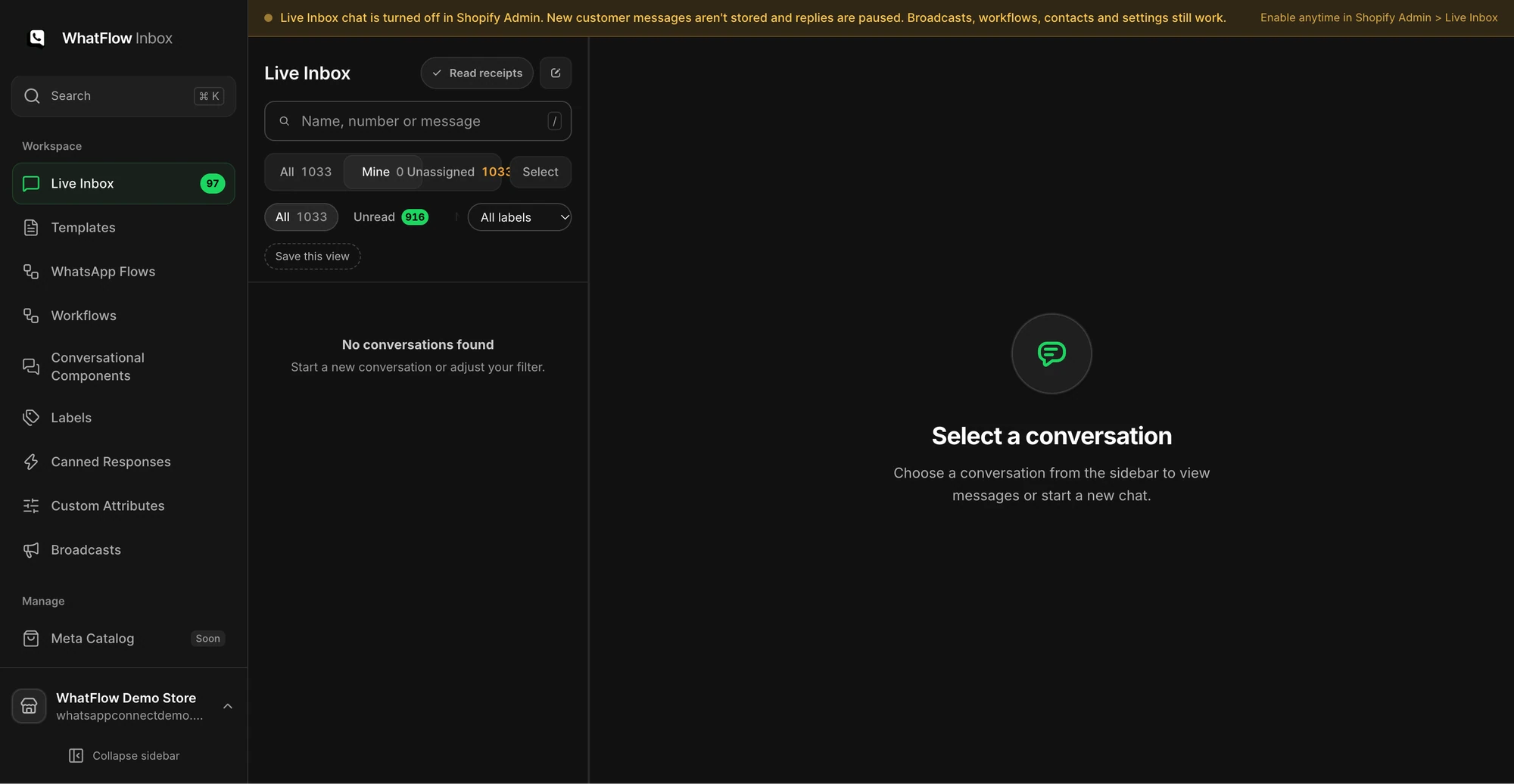
The Mine queue in the demo inbox shows how staff can narrow conversations to their assignments. No customer conversations are shown.
One shared inbox, assigned conversations. Assign every research chat to whoever runs the interviews, and filter the inbox so they're not mixed with order questions. WhatFlow's team inbox has no seat fees, so your co-founder or a part-timer can help without adding cost.
Saved replies for the question script, so every conversation asks the same things in the same order. Comparable answers are the whole point.
A template for the invite, built in WhatFlow's template editor and sent as a small broadcast to opted-in customers.
Shopify Flow for tagging. WhatFlow's incoming-message trigger in Shopify Flow can route chats that contain a keyword, say "BOTTLE", and tag the customer so you can find every participant later. The incoming-message routing guide shows how.
All of that is included on every WhatFlow plan, including the Free plan, which is plenty for a 20-person test. Meta's template charges are separate from WhatFlow's pricing.
Free plan available
Run WhatsApp for your Shopify store with WhatFlow
Templates, COD confirmation, Shopify Flow automations and a shared team inbox with no seat fees. Every feature is included on every plan, including Free.
Only talking to friends. They love you. That's the problem.
Pitching before asking. Once you've described your product, every answer bends toward it.
Counting "maybe" as yes. Maybe means no, politely.
Changing the threshold after the results. If you planned for 5 pre-orders and got 3, you got 3.
Ordering stock before anyone paid. If nobody will put down a refundable deposit for a product they say they want, the market is telling you something.
Twenty honest conversations take a week or two. A container of the wrong product takes a year to sell through. If you're still at the very start, the first 30 days of a Shopify store walks through what to do once the idea passes.
Frequently asked questions
How many customer conversations do I need to validate a product idea?
For a small Shopify store, 15 to 25 real conversations with people who match your target buyer is usually enough to spot a pattern. If you still can't see one after 25, the idea or the audience is probably too vague.
Is a compliment like 'I'd buy that' a good validation signal?
No. Compliments cost nothing. The signals that count are behaviour: someone describing what they already spend on the problem, joining a waitlist with their number, or paying a deposit or pre-order.
Can I message my existing customers on WhatsApp to ask about a new product?
Only if they've opted in to hear from you. Outside an open 24-hour customer service window, WhatsApp requires a Meta-approved template message, and a research invite is usually a marketing template.
Should I take pre-orders to validate a product on Shopify?
Pre-orders are the strongest signal you can get, because people pay. Shopify needs a pre-order app for this, and you should give an honest shipping estimate and refund anyone who asks if the product doesn't happen.