Shopify vs Wix comes down to what the website is for. If selling products is the main job, Shopify is usually the better fit, because its admin, apps and automation are built around orders, including WhatsApp order updates. If the site is mainly a website (a studio, a service business, a portfolio) with a small shop attached, Wix is a perfectly good choice and often simpler to design.
I've tried to keep this fair. Every fact about pricing and features comes from Shopify's and Wix's own pages, checked in November 2026. Where I have an opinion, I'll say so.
What's the main difference between Shopify and Wix?
Shopify is an ecommerce platform first. Everything in the admin starts from products, orders, customers and checkout. Content pages and a blog exist, but they're secondary.
Wix is a website builder first, with ecommerce as one of many things it does. Wix's drag-and-drop editor gives you a lot of design freedom, and the same site can take bookings, sell event tickets, run a restaurant menu or sell products.
That difference shows up everywhere: in how each one handles orders, which apps are available, and how much of your day-to-day work happens inside the platform.
There's a 3-day free trial, then $1 a month for the first three months on most plans. Using a payment provider other than Shopify Payments can add a Shopify transaction fee depending on your plan.
Wix
Wix's plans page lists three plans that can accept payments: Core ("Basic eCommerce"), Business ("Standard eCommerce") and Business Elite ("Advanced eCommerce"). The cheaper Light plan doesn't include ecommerce features.
A few things to know about reading Wix's prices:
Displayed prices are for yearly subscriptions, paid in full upfront, shown as a monthly figure.
Prices and currency vary by location. Wix says US-dollar prices are shown for reference only. On the page I saw, the selling plans ranged from roughly $29 a month (Core) to roughly $159 a month (Business Elite).
There's a 14-day money-back guarantee on the first upgrade to a premium plan, rather than a free trial of the paid plan.
Check both pages in your own country before deciding. Local pricing can change the comparison.
What it adds up to
At the entry level, the two are in a similar range. The real cost difference shows up later: which features you need that require a higher plan or a paid app, what your payment processing costs, and how much time you spend running things.
Ecommerce features: what does each one do?
Both platforms cover the basics well: product pages, variants, inventory, discounts, abandoned cart emails, shipping rates and taxes.
Selling on your site, in person (Wix POS) and on marketplaces and social channels including Google, eBay, Etsy, Amazon, Facebook, Instagram and TikTok.
Wix Payments plus PayPal, Stripe and dozens of other providers depending on location.
Abandoned cart emails and other triggered actions.
Discounted shipping labels from several carriers.
Automated sales tax and VAT calculation.
Physical products with up to 1,000 variants each, dropshipping, print-on-demand, digital products and subscriptions.
AI tools for product descriptions and images.
Shopify covers the same ground, and its strength is depth: a very large app store built only for commerce, Shopify Flow for automation, and a checkout used by a huge number of stores. Shopify Payments, though, is only available in supported countries, so check yours.
My take: for a store with a handful of products, either will do. As your catalogue, order volume and team grow, Shopify's ecosystem matters more.
Design and ease of use
Wix wins on design freedom. You can drag anything anywhere. If you've got a strong visual identity and want the site to look like nobody else's, Wix makes that easy without code.
Shopify themes are more structured. You work with sections and blocks inside a theme's layout. That's less freedom, but it's also harder to break, and it's built around what converts for product pages. For most stores, a clean Shopify theme is enough.
Both are easy for a beginner to get started on. Neither requires you to manage hosting or security.
Apps and automation
This is where the platforms diverge most for a growing store.
Shopify has the Shopify App Store, where apps are built specifically for commerce, and Shopify Flow, a free automation app on Basic and higher plans. Flow lets you connect events across apps: "when an order is tagged high-risk, send a WhatsApp message and hold fulfilment", for example, if your apps support those steps.
Wix has the Wix App Market and its own built-in automations. They cover many common needs, especially for service businesses, and Wix bundles a lot of functionality natively, so you may need fewer apps.
The question to ask isn't "how many apps exist?" It's "can the specific workflow I need run without me copying data by hand?" For order-heavy work like COD confirmation, shipping updates and review requests, Shopify's commerce-only app ecosystem plus Flow is usually the easier route.
WhatsApp and customer support: Shopify vs Wix
This is my area, so I'll be specific.
On Wix
Wix lets you connect a WhatsApp Business number to Wix Inbox. According to Wix's own help article:
You can't start a conversation with a contact who hasn't messaged you first.
After a customer messages, you have 24 hours to reply, and each new message resets that window.
Once connected, the number can only be used through Wix Inbox or Wix Smart Chat, not the regular WhatsApp app.
That works well for answering inbound questions. It's a limitation if you want to send order confirmations, COD confirmations or shipping updates, which are all business-initiated messages. On WhatsApp, those need pre-approved template messages under Meta's messaging policy, and the Wix article doesn't cover templates. You may find third-party apps on the Wix App Market that do more; check what each one supports.
On Shopify
Shopify itself doesn't include WhatsApp messaging, but WhatsApp apps on the Shopify App Store can send templates, run a shared inbox and hook into orders.
That's what WhatFlow does. WhatFlow's WhatsApp Business API app runs on Meta's official WhatsApp Cloud API and connects from inside Shopify admin. It handles both directions: a shared team inbox with no seat fees for inbound questions, and approved templates for order updates, COD confirmation with reply buttons, abandoned checkout messages and review requests. Because it has native Shopify Flow triggers and actions, a customer tapping "Cancel" on a COD confirmation can tag or cancel the Shopify order automatically. Every feature is on every plan, including the Free plan, and the same setup scales from a solo founder to a large support team.
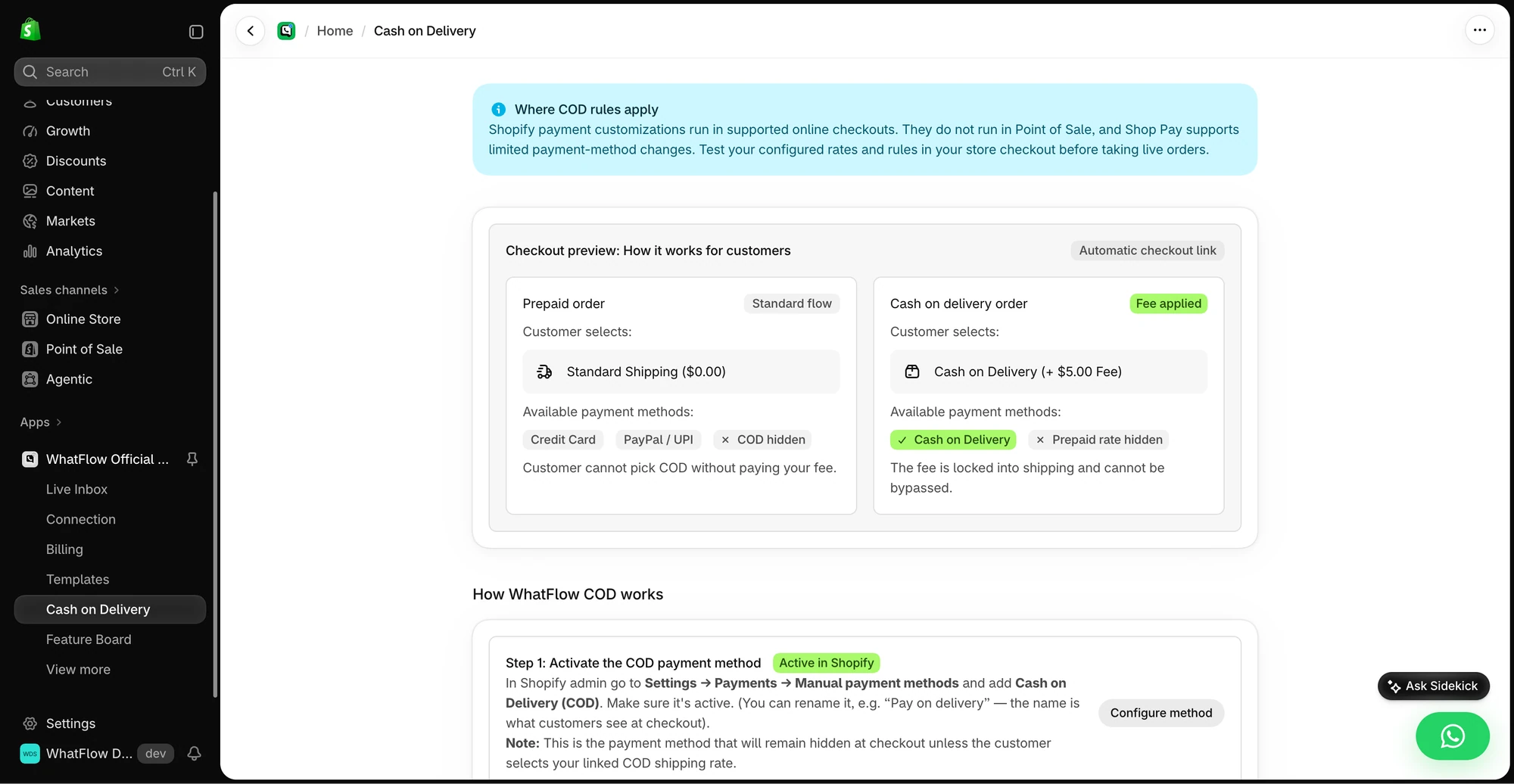
The demo COD rules screen previews how the selected shipping rate affects the COD payment option at checkout.
Service businesses, portfolios, design-led small shops
So which should you choose?
Choose Wix if:
Your business is mainly services, bookings or content, and selling products is a side line.
Design freedom matters more to you than commerce depth.
You want one tool for a website that does many different things.
Choose Shopify if:
Selling products is the main point of the site.
You expect to grow your catalogue, order volume or team.
You want to run customer conversations, COD confirmations and order updates on WhatsApp without copying data by hand.
My opinion, plainly: for a store whose business is selling products and talking to customers on WhatsApp, Shopify is the better fit. Not because Wix is bad, but because Shopify's whole ecosystem is pointed at that job.
Free plan available
Run WhatsApp for your Shopify store with WhatFlow
Templates, COD confirmation, Shopify Flow automations and a shared team inbox with no seat fees. Every feature is included on every plan, including Free.
Shopify is usually the better choice when selling products is the main point of the website, because its admin, app ecosystem and automation are built around orders. Wix is a strong choice when the site is mainly a website, such as a service business or portfolio, with a smaller shop attached.
Which Wix plan do I need to sell online?
As of November 2026, Wix's plans page lists Core, Business and Business Elite as the plans that accept payments. The Light plan doesn't include ecommerce features.
Can I use WhatsApp with a Wix store?
Yes. Wix lets you connect a WhatsApp Business number to Wix Inbox, but Wix's own help article says you can't start conversations with contacts and can reply only within 24 hours of a customer's message, and the number can then only be used through Wix Inbox or Wix Smart Chat.
Is Shopify more expensive than Wix?
Their entry prices are in a similar range. As of November 2026, Shopify Basic is $25 a month billed monthly or $19 billed yearly, and Wix's cheapest plan that accepts payments starts around $29 a month on yearly billing in US-dollar pricing, though Wix says prices vary by location. Apps and payment fees change the real total on both.
Can I move from Wix to Shopify?
Yes. Products and customers can be exported and imported, often with a migration app. Set up URL redirects from your old Wix URLs so you don't lose search traffic.