To sell high-ticket products online, replace the "add to cart and hope" funnel with a short consultation over WhatsApp. Find out what the buyer needs, show them real photos or a quick video of the exact item, answer payment and delivery questions with facts, then send a Shopify checkout link and follow up on a planned schedule. Big purchases close on trust, and trust is built in conversation.
When someone is about to spend a month's rent on your product, they want to talk to a human first. That's not a conversion problem. It's an opportunity most stores fumble because they answer like a help desk instead of a good salesperson.
Why do you need a conversation to sell high-ticket products online?
Because the risk is bigger. A customer buying a $20 T-shirt shrugs off a bad fit. A customer buying a $1,800 espresso machine or a hand-knotted rug worries about everything: is it genuine, will it suit my space, what if it breaks, what if it arrives damaged, can I pay over time?
A product page can't answer the specific version of those worries for each buyer. A WhatsApp conversation can. And because WhatsApp is where many of your customers already talk to friends and family, a reply there feels personal in a way email rarely does.
The trade-off: consultative selling takes time. One person might handle 15 to 20 serious conversations a day, not 150. That's fine. The order values pay for it.
For a shopper asking which size or variant fits, use WhatFlow's product picker to share the relevant catalog item from the conversation. With catalog cart follow-up configured, WhatFlow can send back a Shopify checkout link. Check Shopify before treating the WhatsApp cart as a paid order. The catalog-to-checkout walkthrough shows the test sequence.
The high-ticket WhatsApp playbook, step by step
Respond fast and personally. Name, role, and a real answer in the first reply.
Run a mini consultation. Three to five questions about use, space, timeline and budget.
Show, don't describe. Real photos and short videos of the actual item.
Recommend and explain. One primary option, one alternative, with reasons.
Think of it as the first ten minutes in a showroom. You're trying to learn enough to recommend confidently. Ask in batches of one or two questions so the customer isn't filling out a form.
Say you sell premium watches and a customer sends a photo of a dive watch with "price?":
Hi Omar, Sana here from Second Hand Time. That one is 285,000 PKR, fully serviced with a 12-month warranty from us. Before I send more details, is this for daily wear or more of a collection piece? It helps me suggest the right strap and tell you about water resistance.
You answered the question first (always), then asked one thing that sharpens the recommendation. Next message, you might ask about wrist size or whether they'd consider a slightly older reference at a lower price.
Questions worth asking for most big-ticket categories:
What will you use it for, and how often?
Where will it go or live? (Room size, wrist size, kitchen counter depth.)
Do you need it by a specific date?
Are you comparing it with anything else? (Tells you exactly what objection to address.)
Would you like to see it on video before deciding?
Photos and video: the trust shortcut
Studio photos are great for the product page. In chat, customers want proof of the actual thing. For a used or one-of-a-kind item, send photos of that exact piece, including the flaws. For new stock, a 20-second video in natural light shows texture and scale better than any spec sheet.
Here's a quick video of the walnut finish next to a white wall in daylight, so you can see the real tone. The grain on yours will differ slightly since it's solid wood.
WhatFlow's inbox lets you send images and video in the conversation, and the same media actions are available in Shopify Flow if you want to send, say, a care video automatically after delivery. If customers ask for a live look, a quick video call from a staff phone works, but log the outcome back in the shared inbox so the next person knows what was promised.
How should you handle financing and payment questions?
Customers buying big will ask "can I pay in installments?" and "can I pay half now?". The worst answer is a confident guess.
Be precise about what you actually offer:
Installments. Shopify offers Shop Pay Installments to eligible stores in a limited set of countries (as of November 2026, the Help Center lists the US, Canada and the UK, with Australia in early access), and only within listed order value ranges. If your store has it, say it's offered at checkout and that approval is decided by the provider. If you don't, say so.
Cash on delivery. For high-ticket items, many stores limit COD or ask for confirmation first. If you allow it, WhatFlow can send a COD confirmation template with reply buttons so the customer confirms before you dispatch an expensive parcel.
Custom quotes. For a bundle or a negotiated price, create a Shopify draft order and share its checkout link. Shopify's guide to sharing draft-order checkout links walks through it.
A saved reply for the installments question saves your team from improvising:
Good question. At checkout you'll see the payment options available for your order, including installments if your order qualifies. Approval is decided by the payment provider, not by us, so I can't promise it, but you'll see it before you pay.
Payment happens on Shopify checkout, not inside WhatsApp. Keep it that way. It's where your fraud checks and receipts live.
Trust signals that matter more than badges
High-ticket buyers check that you're a real business. Make it easy for them:
Send your physical address, return policy and warranty terms in plain words.
Point to reviews on that specific product, especially ones with photos.
Keep your WhatsApp business profile complete and consistent: logo, description, website, hours.
Big purchases take days or weeks. Your follow-up should be planned, not random. Here's a starting point:
When
What you send
Why it works
Same day, end of chat
A recap: chosen option, price, delivery estimate, link
The customer can forward it to a partner who's paying half
2 to 3 days later
One new piece of information: a video, a comparison, an answer to their worry
Gives them a reason to reopen the chat
7 to 10 days later
A short check-in, plus an honest stock or price update if there is one
Catches people who meant to come back
After that
Stop, unless they reply
Respect beats persistence
The recap message is the one most teams skip, and it's often the one that closes the sale:
Quick summary so you have it in one place: Ravello 3-seater in Oat linen, 1,290 USD including delivery to Dubai Marina, about 3 weeks lead time, 2-year frame warranty. Checkout link: [link]. Happy to answer anything your partner wants to ask.
The platform rule: your free-form replies are only allowed within 24 hours of the customer's last message. After that, follow-ups need an approved template, and promotional ones need the customer's opt-in under the WhatsApp Business Messaging Policy. Our explainer on the 24-hour customer service window shows how to plan around it. Practically, that means asking during the chat: "Would you like me to message you here if the price changes or new stock arrives?"
Who owns the deal?
High-ticket sales fall apart when three people answer the same customer differently. Assign each serious lead to one person in your inbox and keep them on it until the order ships. WhatFlow's shared team inbox has assignment and filters, and no seat fees, so you can add a specialist for one product line without your bill growing. For more on keeping ownership clear, read setting up a shared team inbox.
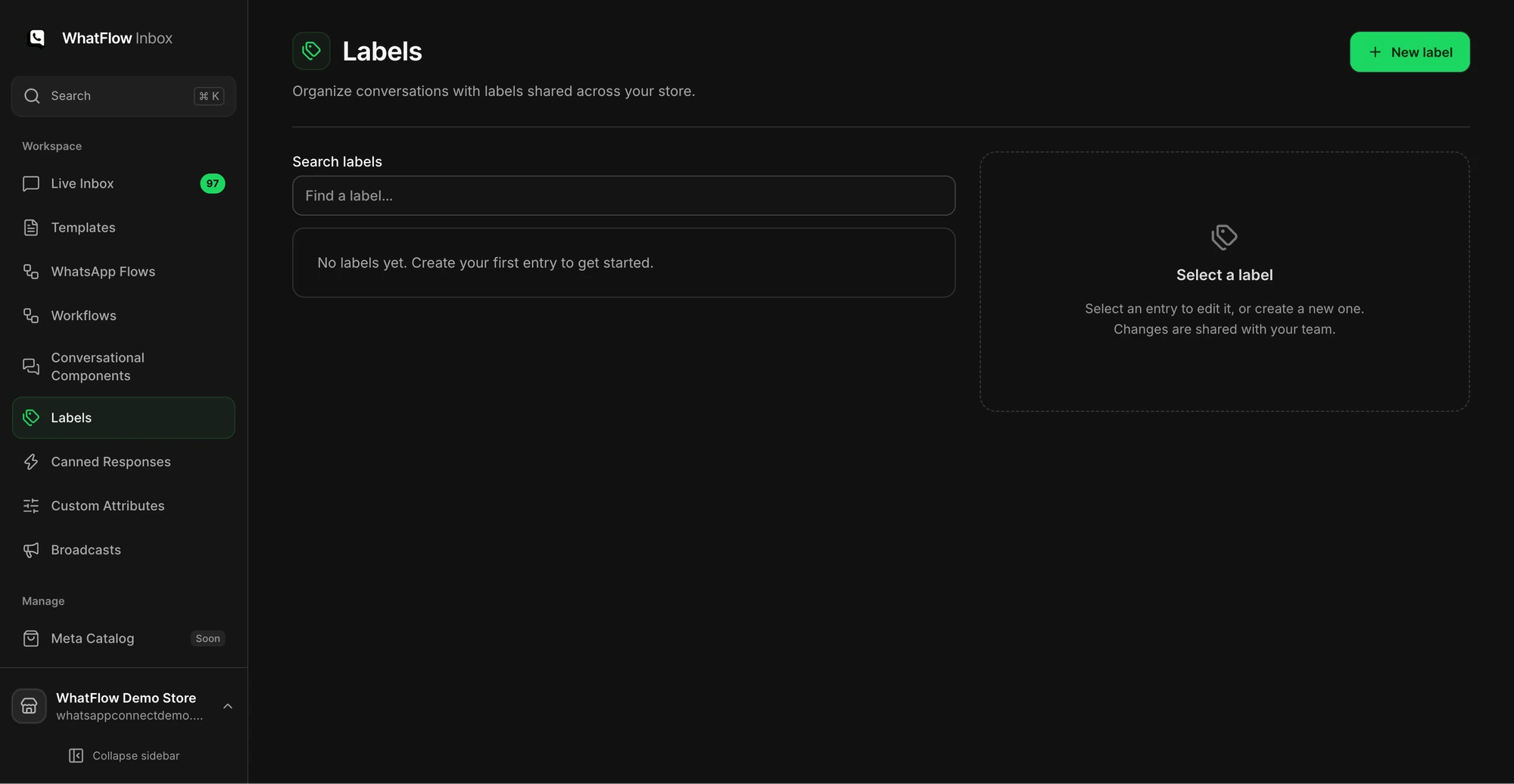
The Labels view shows where a team can organize threads with shared labels.
Pitfalls I see most often
Discounting too early. If the hesitation is about fit or trust, money off doesn't help. Answer the worry first.
Disappearing after "I'll think about it". Send the recap. Always.
Promising delivery dates you don't control. Give ranges and explain what affects them.
Too many options. Two is plenty. Five is a catalogue, and they already have your website.
Free plan available
Run WhatsApp for your Shopify store with WhatFlow
Templates, COD confirmation, Shopify Flow automations and a shared team inbox with no seat fees. Every feature is included on every plan, including Free.
Write three saved replies this week: your consultation opener, the installments answer and the recap. Then pick your top three expensive products and record a 20-second daylight video of each. That alone will change how your WhatsApp conversations feel. If you sell furniture specifically, the delivery side gets its own playbook in WhatsApp for furniture and home stores, and the general habits are in selling on WhatsApp.
Frequently asked questions
What counts as a high-ticket product for an online store?
Anything expensive enough that most customers want to ask a question before buying. For one store that's a $300 watch, for another it's a $3,000 sofa. The useful test is whether buyers hesitate and reach out, not a fixed price.
Can I offer installments for high-ticket products on Shopify?
Possibly. Shopify's Shop Pay Installments is available to eligible stores in a limited set of countries, with minimum and maximum order values listed in the Shopify Help Center. Check your own eligibility and never promise a customer approval.
How often should I follow up with a high-ticket lead on WhatsApp?
A reasonable cadence is a recap the same day, one useful follow-up a few days later, and a final check-in after a week or two. Each message should add something new, and anything outside the 24-hour window needs an approved template and the customer's opt-in.
Should I offer a discount to close an expensive sale over chat?
Not as a first move. Most hesitation on big purchases is about risk (fit, quality, delivery, trust), and a discount doesn't answer any of those. Solve the risk first.