Abandoned cart recovery rate on Shopify: how to measure and improve it
How to calculate abandoned cart recovery rate on Shopify, where the data lives, how email, SMS and WhatsApp timing differ, and how to test what's real.
Abandoned cart recovery rate is the share of abandoned checkouts that end up as completed orders. The formula is recovered checkouts ÷ abandoned checkouts × 100. On Shopify, the honest version only counts orders your reminders caused, not every shopper who would have come back anyway. That's the incremental rate, and you need a holdout to measure it.
Most merchants I talk to quote a recovery number straight from their app's dashboard. That number is almost always too flattering, and it's not their fault: Shopify and most recovery apps count a checkout as recovered once the order is completed, whoever gets the credit. This guide covers the definitions, where the data lives in Shopify, how email, SMS and WhatsApp timing differ, and a simple holdout test that tells you what your reminders are really worth.
Cart abandonment vs checkout abandonment
These get used interchangeably, but Shopify treats them as different events, and so should your maths.
Term
What it means on Shopify
Can you message them?
Abandoned product browse
Viewed a product, didn't add it to the cart
Only if you know who they are and they've opted in
Abandoned cart
Added products to the cart but didn't start checkout
Only if you know who they are and they've opted in
Yes, once they've entered an email (and opted in, for SMS or WhatsApp)
Shopify's own marketing automations split them exactly this way, with separate automations for browse, cart and checkout. In the Help Center, an abandoned checkout is one where the customer has entered their email but hasn't finished, and it's treated as abandoned after it stays incomplete for more than ten minutes.
For context on scale: the Baymard Institute's running list of studies puts the documented average online cart abandonment rate at 70.22%, across 50 studies (page updated October 28, 2026). That's an average across very different stores, so treat it as a sense of scale, not a target.
In practice, most "abandoned cart recovery" on Shopify is really checkout recovery, because that's the point where you have a phone number or email to reach. I'll use "abandoned checkout" for the measurable event from here on.
The trouble is the word "recovered". There are two very different versions.
Attributed recovery
Attributed recovery counts every abandoned checkout that later became an order, or every order that followed a click on your reminder. This is what Shopify's Recovery status shows. Shopify's Help Center is explicit that the checkout is considered recovered once the customer completes the order, regardless of whether they used your link.
It's easy to get and useful for spotting broken flows. It's useless for judging whether the reminder earns its cost, because it includes people who were coming back anyway.
Incremental recovery
Incremental recovery counts only the orders that wouldn't have happened without the reminder. You get it by comparing a group that received reminders with a group that didn't:
If 12% of messaged checkouts and 7% of unmessaged checkouts convert, your reminders are responsible for roughly 5 points, not 12. That 5 is the number that should decide your budget and your discount policy.
Where to find abandoned checkout data in Shopify
Orders > Abandoned checkouts. This is the list of every abandoned checkout, with an Email status column (whether Shopify's recovery email went out) and a Recovery status column. Count rows for the period, count the ones marked recovered, and you have attributed recovery. Two gotchas from Shopify's docs:
Abandoned checkouts older than three months are deleted automatically, so export or note your numbers monthly.
Recovery tracking applies to the Online Store and Buy Button channels, not POS or third-party channels.
Analytics > Reports > Conversion rate breakdown. Shopify's behaviour reports show a funnel: sessions, sessions with cart additions, sessions that reached checkout and sessions that completed checkout. This is where you see cart-level abandonment (added to cart but never reached checkout), which the abandoned checkouts list can't show you. Shopify notes a session measurement update rolled out in September 2026, so compare like with like if you're looking at older months.
Marketing reports. Shopify's Sales attributed to marketing report relies on UTM parameters, and the default model is last non-direct click. Recovery messages land late in the journey, so that model tends to favour them. Tag every reminder link with UTMs (for example a source of whatsapp and a campaign of checkout reminder 1) so each channel and each step shows up separately.
Your messaging app's report. WhatFlow, Shopify Messaging and email or SMS apps each report their own sends and clicks. Use them for delivery and click data, not as your recovery rate.
Worked example (hypothetical numbers)
Say you sell skincare in India and get 600 abandoned checkouts in a month, all with a WhatsApp opt-in. You hold back 20% as a control and send one WhatsApp reminder to the rest.
Now the cost side. As of November 2026, Meta's rate for a marketing template to India is $0.0118 per delivered message (see pricing for the country table). If 460 of the 480 reminders deliver, that's about $5.43 in Meta charges, or roughly $0.21 per incremental order. If the reminder included a 10% discount, the bigger cost is the discount on all 62 orders, including the 36 or so that would have bought at full price. That's the trade-off a holdout makes visible.
All of these numbers are made up to show the method. Your own will differ, which is the whole reason to measure.
Email, SMS and WhatsApp: timing and fit
There's no universal best delay. What I'd do is match the delay to how the shopper behaves and what the channel feels like to receive.
Channel
Feels like
Sensible first test
Watch out for
Email
Low pressure, read later
A first send within a few hours
Promotions tab, slow reads
SMS
Urgent, personal
One send, later than email
Cost per message, no reply culture
WhatsApp
A conversation
One send after a short delay, inviting a reply
Template approval, opt-in, per-message charges
A few rules that hold up across channels:
Don't stack them in the first hour. An email, an SMS and a WhatsApp message within 30 minutes reads like a debt collector. Coordinating email, SMS and WhatsApp covers how to sequence them.
Give the shopper a fair chance to finish on their own. Many checkouts are interrupted, not abandoned.
Stop when they order. Test that a completed checkout cancels pending reminders. Shopify's own emails don't send once the customer completes a sale.
Respect opt-in. Shopify's abandonment automations go only to customers subscribed to marketing by default (only checkout emails can be switched to all customers). On WhatsApp, Meta's policy requires opt-in before you message anyone; WhatsApp opt-in wording for Shopify checkout has copy you can use.
Why WhatsApp reminders work differently
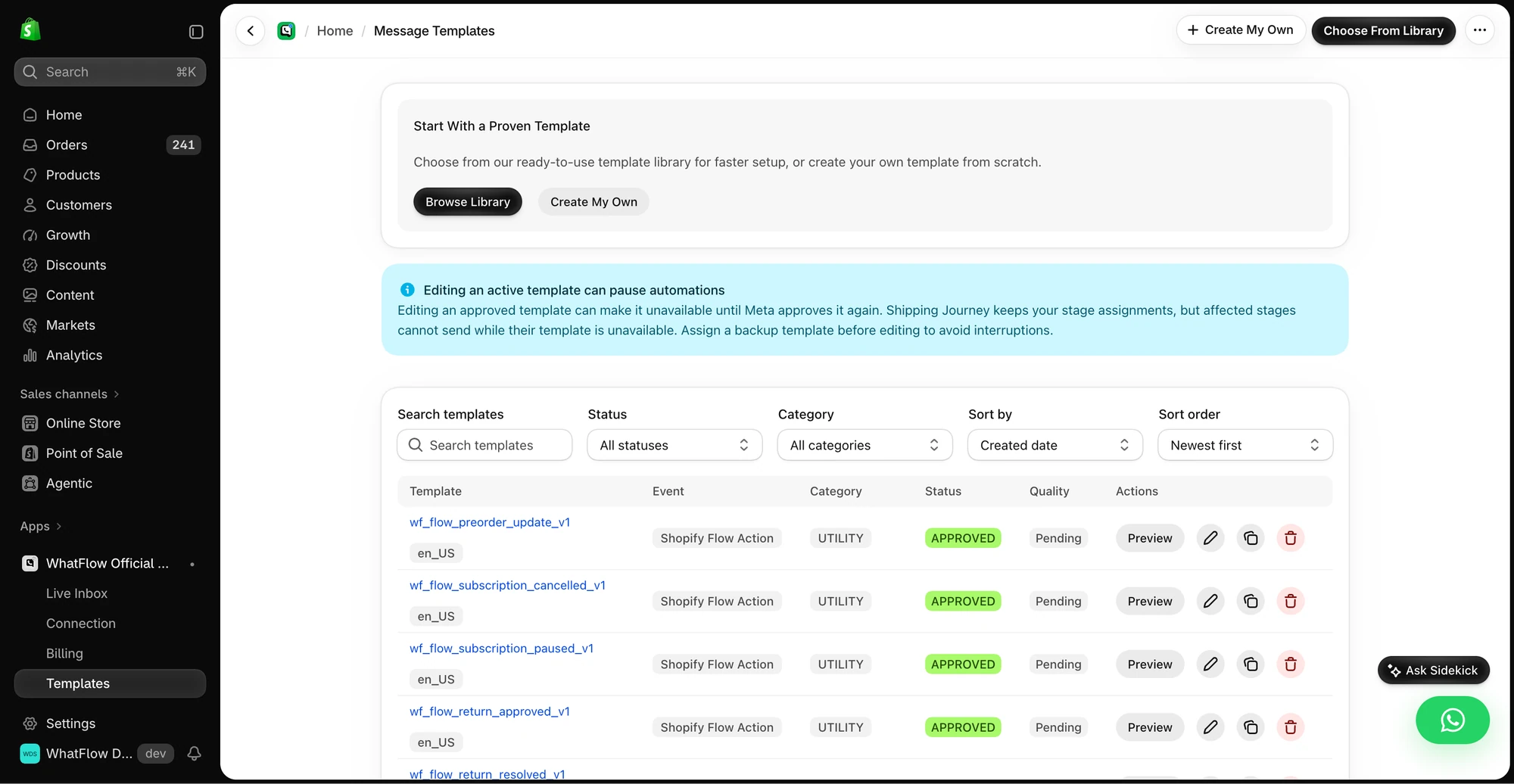
A WhatsApp reminder is a template, because the shopper hasn't messaged you, so it's outside the 24-hour customer service window. Meta charges per delivered template and categorises it, so check which category your reminder is approved under.
Demo store template manager showing category and approval status. No templates were sent.
The upside is that the shopper can reply. A reply opens the customer service window, and now you can answer the real question: shipping cost, sizing, whether COD is available.
The best-performing reminders I see ask a question instead of just pushing a link:
Hi Priya, you left the Vitamin C serum in your checkout. Want me to hold it for you? If anything stopped you (shipping, sizing, payment), just reply here and I'll help. Finish your order: [link]
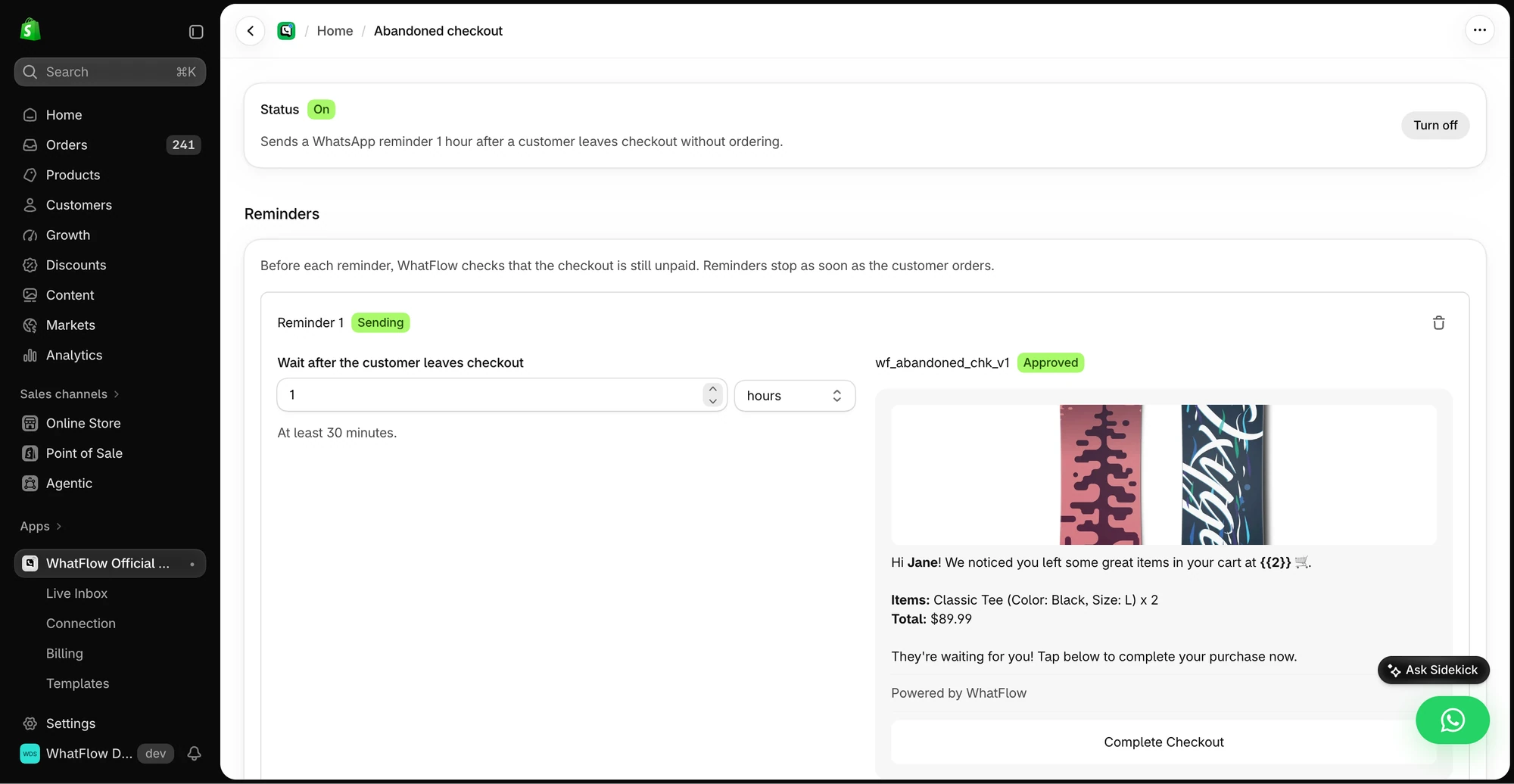
In WhatFlow, the Abandoned Checkout reminder lets you pick an approved template, set the delay and preview the message before switching it on. Draft Order Recovery does the same for orders your team prepared that the customer hasn't completed.
Demo store abandoned checkout reminder settings with a sample preview. Nothing was sent.
How to run a holdout test
A holdout is a group of abandoned checkouts that deliberately get no reminder, so you can see what happens without one.
Pick one change to test. "WhatsApp reminder vs nothing" or "WhatsApp at 1 hour vs 4 hours". Not both at once.
Choose how to split. The cleanest is a random split by checkout, if your tool supports it. If it doesn't, alternate on and off by week, and run enough weeks that one big promotion doesn't skew a single side.
Fix the window. Count an order as recovered if it completes within, say, 7 days of abandonment. Use the same window for both groups.
Wait for volume. A few hundred abandoned checkouts per group is the minimum I'd trust. Fewer than that and one wholesale order swings the result.
Compare recovery rates and revenue. Calculate the incremental rate, incremental orders and cost per incremental order, including discounts.
Keep a small permanent holdout. Even 5–10% left unmessaged keeps telling you whether reminders still earn their place as your store changes.
Two mistakes to avoid: don't compare this month's messaged checkouts with last month's unmessaged ones (seasonality will fool you), and don't drop the holdout group the moment the result looks good.
Checklist to improve your recovery rate
Separate cart, checkout and browse abandonment in your reporting
Export the abandoned checkouts list monthly before Shopify deletes older records
UTM-tag every reminder link by channel and step
Collect WhatsApp opt-in at checkout, with clear wording
Test a completed order cancels pending reminders
Use one WhatsApp reminder that invites a reply before adding more steps
Hold discounts back until a later step, and measure what they cost on orders that would have happened anyway
Run a holdout and report incremental recovery, not just attributed
Feed common reply questions back into the product page and checkout
Review the first live runs for duplicates and broken links
Run WhatsApp for your Shopify store with WhatFlow
Free plan available. Templates, COD confirmation, Shopify Flow automations and a shared team inbox with no seat fees. Every feature is included on every plan, including Free.
WhatFlow WhatsApp Business API sends abandoned checkout and draft-order reminders on the official Meta WhatsApp Cloud API, and replies land in a shared team inbox with no seat fees, so a reminder can turn into a sales conversation. All features are included on every plan, from the Free plan to paid plans from $4.99/month. The checkout and draft-order reminder guide covers setup, and if you're still choosing a tool, see the best Shopify cart recovery apps for 2026 or WhatsApp vs email cart recovery.
Shopify marks an abandoned checkout as recovered once the customer completes the order, whether or not they used the recovery link. That's why the Recovery status column overstates what your messages actually caused.
What's the difference between an abandoned cart and an abandoned checkout on Shopify?
An abandoned cart is a shopper who added products but never started checkout. An abandoned checkout is a shopper who started checkout and left without ordering; Shopify only lists it once they've entered an email address.
What is a good abandoned cart recovery rate?
I'd avoid chasing an industry figure, because stores define recovery differently and most published numbers count orders that would have happened anyway. Measure your own incremental recovery with a holdout and improve on that.
Should I send cart reminders on WhatsApp, SMS or email?
Use the channel the shopper gave you and agreed to hear from. In markets where customers live on WhatsApp, a WhatsApp reminder that invites a reply is often the most useful, but test it against a holdout rather than assuming.
How long should a cart recovery holdout test run?
Long enough to collect a few hundred abandoned checkouts in each group, and at least two full weeks so weekday and weekend behaviour are both included.
Shopify's definition of an abandoned checkout, the Recovery status column, the rule that a checkout is recovered once the order is completed, and the three-month retention.