To A/B test WhatsApp messages with a small list, test one big change at a time, split your list randomly, judge on a metric that happens often (replies or clicks, not orders), and repeat the same test over several sends before declaring a winner. With a few hundred people per variant, only large differences are real. Small gaps are noise, so call them a tie.
Most A/B testing advice is written for email lists with 100,000 people. A Shopify store with 800 WhatsApp subscribers can't run those tests and get a trustworthy answer from one send. You can still learn a lot. You just have to test differently.
Why small-list A/B tests mislead you
Say you split 600 subscribers into two groups of 300. Variant A gets 12 clicks, variant B gets 18. B "won by 50%." Feels decisive.
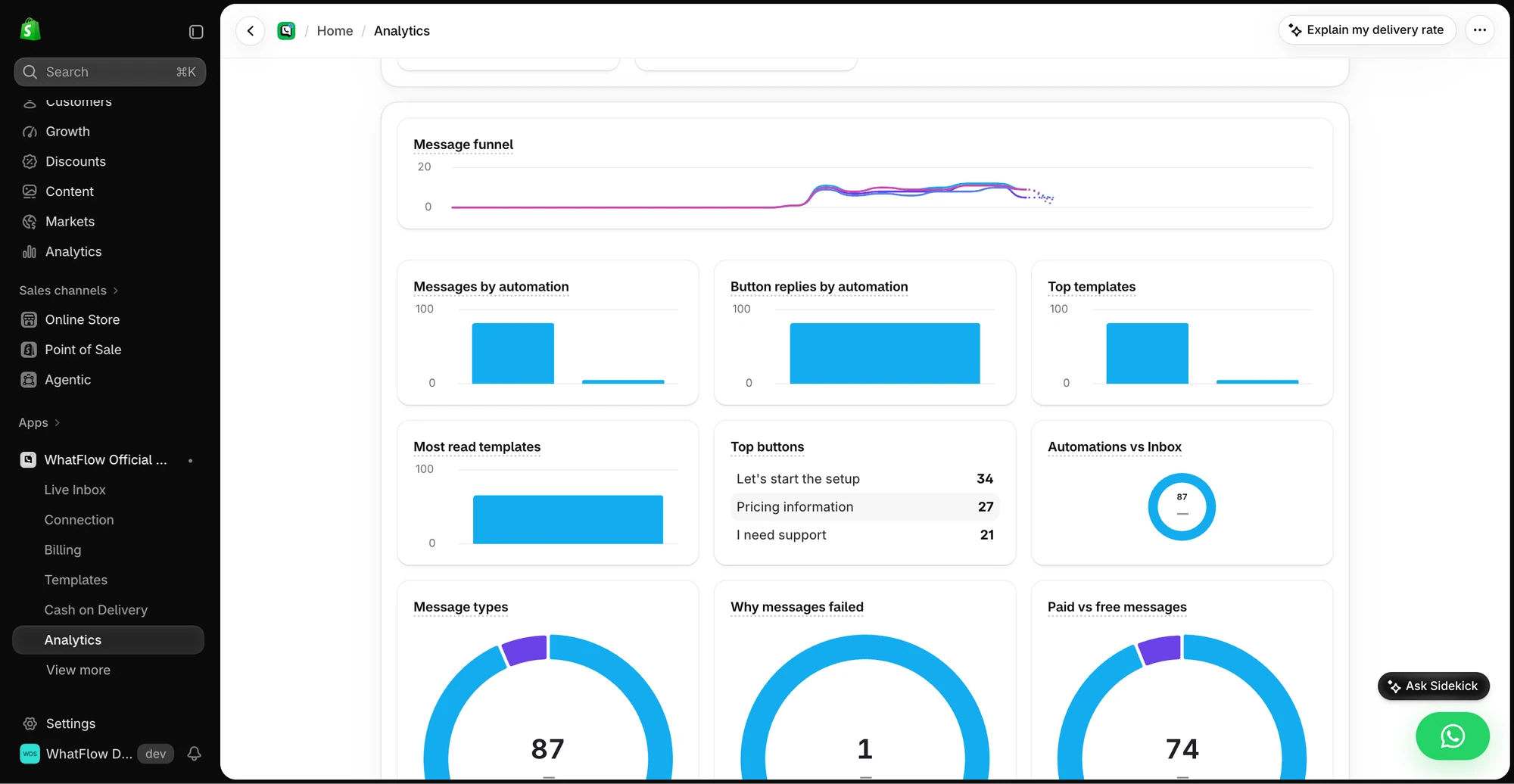
The Analytics view shows message and button reply breakdowns for the demo store. The numbers are demo activity, not a performance benchmark.
It isn't. With numbers that small, random chance easily moves a group by five or six clicks. Who happened to be on their phone, who had a payday, who was in a group chat argument. Run the identical message twice and you'd see gaps like that.
A rough rule of thumb I use: add the two counts together, take the square root, and double it. If the gap between variants is smaller than that, assume it's noise. In the example, 12 + 18 = 30, √30 is about 5.5, doubled is 11. The gap is 6. Noise. Not a basis for rewriting your whole approach. (This is a quick sanity check, not proper statistics. If you want a real significance test, any online two-proportion calculator will do it.)
If you run a manual split test, create separate opted-in audiences and keep the send time and offer consistent. WhatFlow’s recipient reports let you export delivery results for each broadcast. Use your Shopify tracking setup to compare purchases. This workflow does not require an automated A/B test feature. See the campaign walkthrough.
Step 1: Pick a metric that happens often
The rarer the event, the bigger the list you need. Orders from a broadcast might be a handful per send. Replies and clicks happen far more.
Often, but undercounted (read receipts can be off)
Okay for first-line tests
Quick reply taps / replies
Fairly often
Yes, best choice
Link clicks
Moderately
Yes
Orders
Rarely per send
Only pooled over many sends
Opt-outs
Rare
Watch it, don't optimise for it
Pick one primary metric before you send. If you choose after seeing the data, you'll always find a winner.
Step 2: Test big differences, not tiny ones
With a small list, you can only detect big effects, so only test changes that could plausibly produce one.
Worth testing:
Offer vs no offer. "Back in stock" alone vs "Back in stock, plus free delivery this week".
The first line. It shows in the notification preview. Product-first vs benefit-first.
The button. "Shop now" (link) vs "Show me the colours" (quick reply that starts a chat).
Personalised vs generic. The specific product they viewed vs the new collection.
Timing. Morning vs evening, same message.
Not worth testing on a small list: one emoji vs two, "Hi" vs "Hello", button colour equivalents. You'll never see a real difference.
Here's a hypothetical pair for a fashion store testing the button:
Variant A
Hi Maya, the Aria wrap dress is back in your size (M). Only a few left in olive.
[Shop the dress]
Variant B
Hi Maya, the Aria wrap dress is back in your size (M). Only a few left in olive.
[Hold one for me] [Ask about fit]
B opens a conversation instead of sending her to the store. That's a big enough difference to show up even on a small list, and it tells you something useful about whether your customers prefer to buy through chat.
Step 3: Split randomly, not conveniently
Don't send A to customers A to M and B to N to Z. Don't send A to your newest subscribers and B to the oldest. Shuffle the list (a random number column in a spreadsheet, sorted, works fine) and split it. Check both groups have a similar mix of countries and past buyers.
If you have a segment of very engaged customers, split that segment evenly too. One extra superfan in a 300-person group can swing the result.
Step 4: Get both templates approved first
Outside the 24-hour customer service window, every business-initiated WhatsApp message must use a Meta-approved template. If the variants differ in fixed text, that's two templates, and each needs approval before the send. Submit both together so one isn't stuck in review on send day. If one is rejected, the guide to why Meta rejects WhatsApp templates will help.
WhatFlow's template editor lets you build both variants side by side, with the same variables for customer name and product, so the only thing that differs between them is the part you're actually testing.
New templates start with an unknown quality rating until Meta has feedback and read data, according to Meta's template quality docs. That's another reason not to blast a brand-new variant at your whole list.
Step 5: Repeat and pool
This is the trick that makes small-list testing work. Instead of one test that decides everything, run the same comparison across several sends and add up the results.
Hypothetical example: a coffee shop tests "quick reply button vs link button" across four weekly broadcasts to about 500 people each.
Send
A replies/clicks
B replies/clicks
Week 1
14
22
Week 2
11
19
Week 3
16
15
Week 4
10
21
Total
51
77
Week 3 alone would have said "no difference." Pooled, B wins three of four. Run the rule of thumb from earlier: 51 + 77 = 128, √128 is about 11.3, doubled is roughly 23. The gap is 26, so B's lead is probably real. Now you can act. (Numbers invented to show the method.)
Keep the variable the same across sends and let everything else change naturally (product, offer). If B keeps winning across different products, you've learned something general about your customers.
Step 6: Use holdouts for the money question
A/B tests compare two messages. They don't tell you whether sending anything at all was worth it. For that, hold back a random slice (10 to 20%) that gets nothing, and compare orders per customer. The guide to WhatsApp marketing metrics explains why this matters more than attributed revenue.
Watch the side effects
Every test has a cost line. Track opt-outs for each variant. A pushy variant can win on clicks and lose on blocks, and blocks hurt everything you send later. WhatsApp also caps marketing messages for people who rarely read them; Meta's per-user limits page says the cap is based partly on recent read rate. If one variant consistently gets fewer reads, it isn't only losing the test, it may be shrinking your reachable audience.
Also be careful with how often you test. Two variants doesn't mean two sends to the same person. Each customer gets one message, same as any well-run broadcast. Keep within your usual message frequency.
Where WhatFlow fits
WhatFlow's Business API app gives you the template editor, broadcasts and a shared inbox to handle replies when a quick-reply variant starts conversations. Every feature is included on every plan, including Free, so you don't need an upgrade to run tests. If a test points you toward conversational broadcasts, the next step is making those replies easy to answer; saved replies that don't sound robotic help there.
Free plan available
Run WhatsApp for your Shopify store with WhatFlow
Templates, COD confirmation, Shopify Flow automations and a shared team inbox with no seat fees. Every feature is included on every plan, including Free.
One primary metric, chosen before sending (replies or clicks).
Random split, similar groups.
Both templates approved in advance.
Repeat across sends and pool the results.
Track opt-outs per variant.
Small gaps are ties. Move on and test something bigger.
Frequently asked questions
Can you A/B test WhatsApp messages with a small list?
Yes, but only for big differences and with a metric that happens often, like replies or clicks rather than orders. Repeat the same test across several sends and pool the results before you decide.
How many people do I need for a WhatsApp A/B test?
There's no fixed minimum, but with a few hundred people per variant you can only reliably spot large differences. If the gap between variants is a handful of clicks, treat it as a tie.
What should I A/B test first on WhatsApp?
Test the first line, the call to action button, or whether to include an offer at all. Those tend to make bigger differences than emoji or small wording changes.
Do I need a new template for each WhatsApp test variant?
Usually yes. Business-initiated messages outside the 24-hour window must use an approved template, so each variant that changes fixed text needs its own approved template.