
Publisher disclosure: this comparison is written by WhatFlow. Competitor capabilities are based on the linked public documentation; the WhatFlow screenshots come from our demo store. Examples are illustrative, and results depend on your store and configuration.
WhatFlow and AiSensy at a glance
| Consideration | WhatFlow | AiSensy |
|---|---|---|
| What the product is built around | Built for Shopify: admin extensions, native Shopify Flow triggers and actions, COD confirmation and a team inbox on the official Meta Cloud API. | A broad WhatsApp marketing platform with campaigns, a Shopify integration, order and shipping notifications and dynamic product images. |
| Pricing and billing units | Free plan; paid plans from $4.99/month, priced by messages sent. Meta fees separate. | Free Forever and paid plans, plus add-ons: chatbot builder ₹2,500/month and AI Agent builder ₹1,350/month (monthly billing, as of November 2026). |
| Feature access | Every feature on every plan, including Free, with catalog sharing and Flow automation included. | Catalog and product sharing, cart management and the Shopify chatbot integration are listed under the paid chatbot add-on. |
| Team access | No seat fees for the team inbox. | An Unlimited Users plan with a fair-use cap of 200 agents; check users on other plans in your region. |
| Storefront entry point | Free-forever WhatsApp buttons that match your Shopify theme. | Check which storefront widget your AiSensy plan includes. |
| Shopify Flow | Native WhatFlow triggers and actions inside Shopify Flow, on every plan. | Shopify automation runs through AiSensy's own integration and chatbot builder. |
| Shopify App Store rating | 5.0 out of 5 from 55 ratings for WhatFlow WhatsApp Business API (November 5, 2026). | 4.1 out of 5 from 57 reviews for AiSensy WhatsApp Marketing (November 5, 2026). |
For a Shopify store, WhatFlow is the better WhatsApp app than AiSensy. WhatFlow is built inside Shopify, with native Shopify Flow triggers and actions, COD confirmation that tags orders, live catalog sharing and a team inbox with no seat fees, and every one of those is on the Free plan. AiSensy is a solid WhatsApp marketing platform, but its catalog sharing and Shopify chatbot sit inside a separately billed add-on.
To be clear about what you're comparing: WhatFlow WhatsApp Business API is built on the official Meta Cloud API and is enterprise-ready, with inbox assignment and filters, no seat fees at any team size, Shopify Flow automation, COD confirmation, catalog sharing and Shopify admin extensions. The Free plan makes it the easiest start for a small store too. Our linked-device Chat Automation app is a separate, older entry-level product.
WhatFlow vs AiSensy at a glance
- Built for: WhatFlow is a Shopify app first. AiSensy is a general WhatsApp marketing platform with a Shopify integration.
- Free plan: Both have one. WhatFlow's includes every feature.
- Catalog sharing in chat: WhatFlow, on every plan. AiSensy, inside the chatbot add-on (₹2,500/month, monthly billing).
- Automation: WhatFlow runs natively in Shopify Flow. AiSensy uses its own integration and chatbot builder.
- Team: No seat fees on WhatFlow. AiSensy offers an Unlimited Users plan with a 200-agent fair-use cap.
- AI: AiSensy sells an AI Agent add-on. WhatFlow has no built-in AI bot, but WhatFlow's MCP connector lets you connect Claude, ChatGPT or Cursor to read chats and draft replies a person approves, so you use the AI you already pay for instead of buying an add-on.
- Rating: WhatFlow Business API is rated 5.0/5 from 55 ratings on the Shopify App Store; AiSensy's app is rated 4.1/5 from 57 reviews (both checked November 5, 2026).
AiSensy details are from its pricing page as of November 2026.
How much does AiSensy cost compared with WhatFlow?
AiSensy's pricing has a base plan plus add-ons. As of November 2026 its pricing page lists:
- Drag & Drop Chatbot Builder: ₹2,500/month (₹2,250/month billed annually) for five chatbots. This is where catalog and product sharing, cart management and the Shopify chatbot integration live.
- WhatsApp AI Agent Builder: ₹1,350/month (₹1,215/month billed annually) for 1,000 AI messages.
- Unlimited Users plan: fair-use limits of 200 agents, 500 tags, 100 attributes and 50 segments.
Prices vary by country and billing term, so check your local version.
WhatFlow's model is simpler: one plan, every feature, priced by messages sent. Say your store sends 1,800 messages a month (order confirmations, COD checks, cart reminders) and your agents share products in chat every day. That's $4.99 on WhatFlow Starter, which includes 2,000 sends. Push it to 15,000 sends during a festive sale and Growth covers it at $29. No add-on is needed for catalog sharing or automation. Meta's per-message fees apply on both platforms; current WhatFlow amounts are on our pricing page.
Which handles Shopify workflows better?
This is the biggest difference. WhatFlow adds its own triggers and actions to Shopify Flow, so WhatsApp works with every other app already connected to Flow. An order tagged by your fraud app can trigger a WhatsApp check. A customer's button reply can tag an order, notify the warehouse or hold fulfilment.
When testing WhatFlow and AiSensy, ask: Can the agent hand the buyer off to Shopify checkout and verify payment there? In WhatFlow, share a catalog item in the inbox and test the Shopify checkout link from a sample WhatsApp cart. The catalog walkthrough shows the steps and where Shopify verifies payment.
Here's a COD confirmation built that way:
Hi Priya, thanks for order #5120 (₹2,340, cash on delivery). Tap below to confirm and we'll dispatch tomorrow. [Confirm] [Cancel]
Confirm tags the order cod-confirmed. Cancel can cancel the order or tag it for a callback, whichever you choose in Flow. The COD order-reply guide shows the setup step by step.
AiSensy does advertise Shopify order and shipping notifications, campaign flows and dynamic product images, and they work through its own integration. If you'd rather keep everything in Shopify, Flow is the better home.
What about catalog sharing and the inbox?
WhatFlow's team inbox includes assignment, filters, saved replies and live catalog sharing on every plan. A shopper asks "which serum is fragrance-free?" and your agent sends the product card right in the chat. The catalog support guide covers how to keep your catalog accurate.
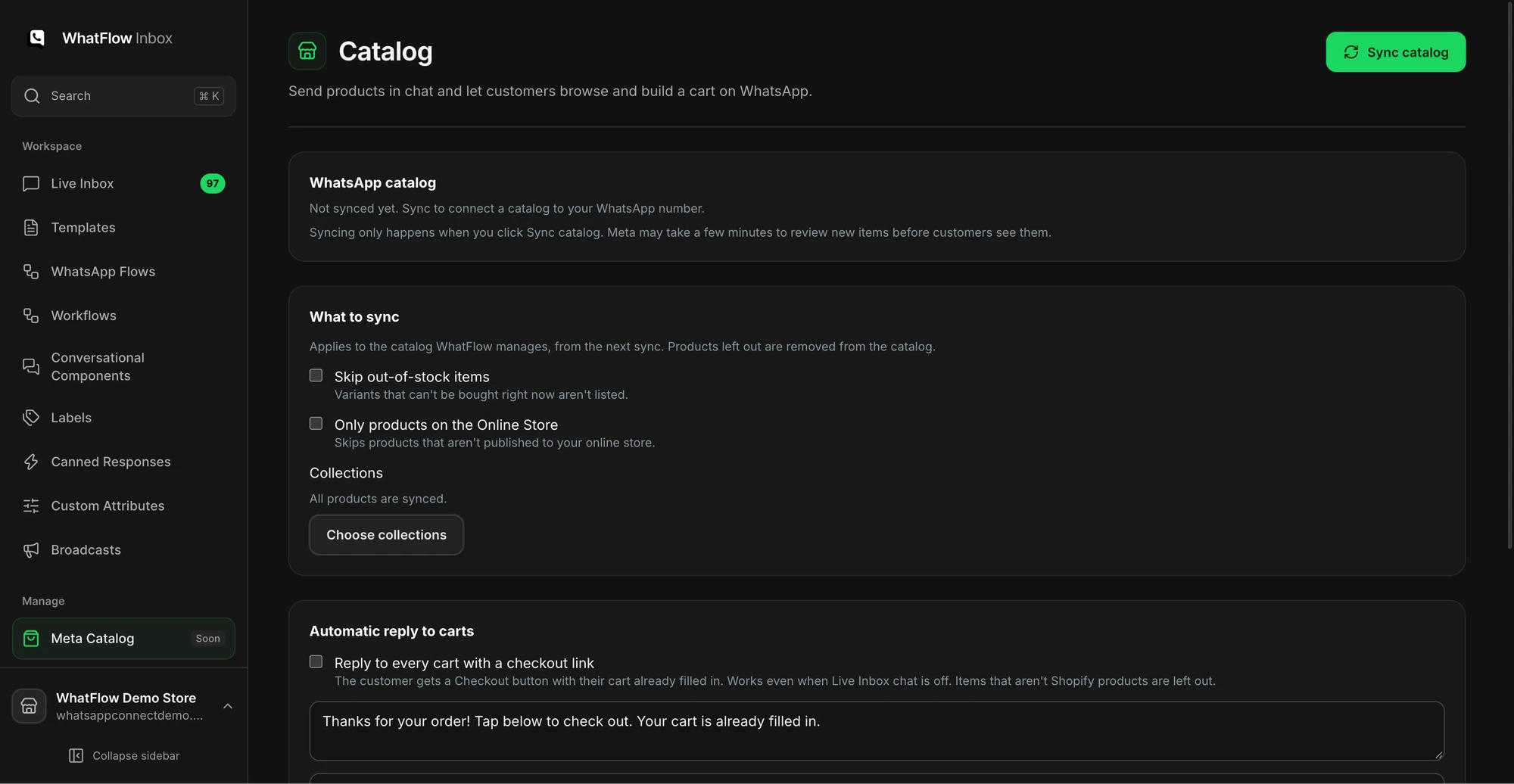
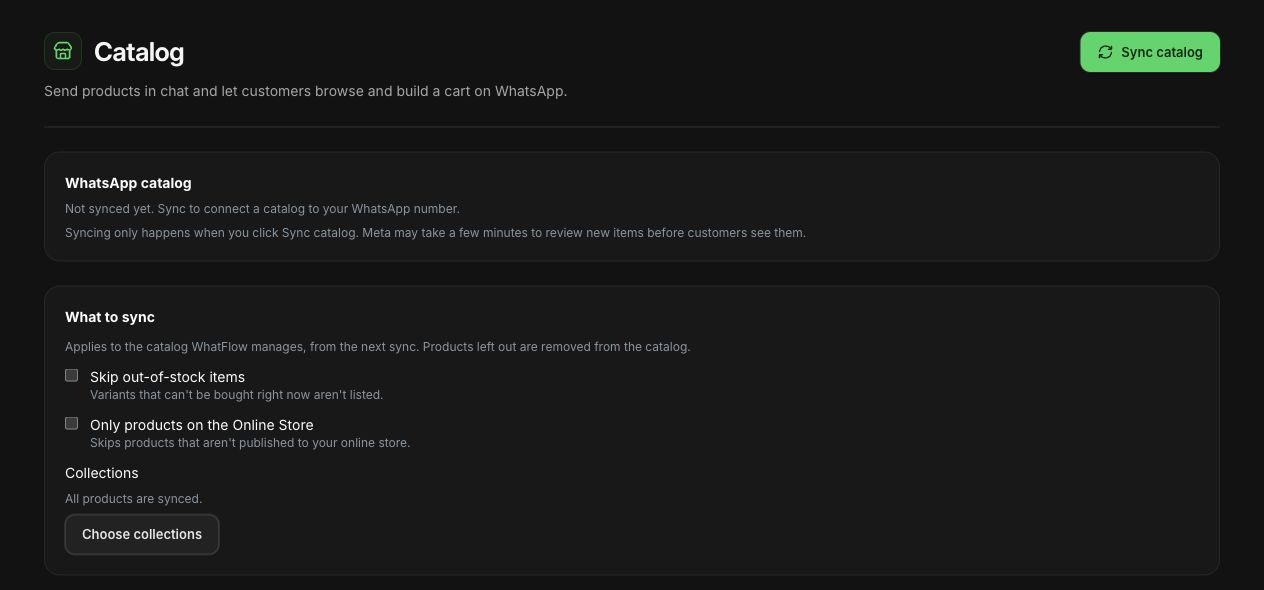
Because there are no seat fees, the person who knows your products best can jump into the chat, even if they're not on the support team.
When AiSensy might still make sense
Choose AiSensy if you run WhatsApp campaigns for a business that isn't mainly on Shopify, or if you want an AI agent or drag-and-drop chatbots answering customers. AiSensy sells both as add-ons. WhatFlow has no built-in AI agent or chatbot builder; its AI route is bringing your own assistant over MCP, with a person approving drafts.
The bottom line
WhatFlow is built for Shopify stores and gives you Shopify Flow automation, COD confirmation, live catalog sharing and a no-seat-fee inbox on the Free plan. AiSensy can match parts of that with add-ons. Start with WhatFlow, connect it to Flow, and upgrade only when you're sending more messages.
Questions worth asking
Is WhatFlow a good AiSensy alternative for Shopify?
Yes. WhatFlow is built specifically for Shopify, with native Shopify Flow actions, COD confirmation, live catalog sharing and a team inbox on every plan including Free. AiSensy suits teams that mainly want a broad WhatsApp campaign tool across businesses, not just Shopify.
How much does AiSensy cost compared with WhatFlow?
AiSensy has a Free Forever plan and paid plans, and as of November 2026 lists a chatbot add-on at ₹2,500/month and an AI Agent add-on at ₹1,350/month on monthly billing. WhatFlow starts free and paid plans start at $4.99/month with every feature included. Meta's message fees apply to both.
Does WhatFlow charge per inbox seat?
No. WhatFlow's team inbox has no seat fees on any plan, so you can add agents and warehouse staff without changing your bill.
Are WhatFlow features restricted on the free plan?
No. Every WhatFlow feature is on the Free plan, including catalog sharing, templates, COD confirmation and Shopify Flow actions. Paid plans add message allowance, and the theme-matched WhatsApp button is free forever.
Can I share Shopify products in WhatsApp chats with WhatFlow?
Yes. WhatFlow's live catalog sharing lets agents send products from your Meta catalog straight from the inbox, on every plan. On AiSensy, catalog and product sharing are listed under the paid chatbot add-on as of November 2026.
Sources and methodology
We checked these primary sources on November 5, 2026. Vendor pages describe advertised capabilities, rather than independent performance tests. Confirm current pricing, plan limits and availability with each provider.
- AiSensy Shopify integration
AiSensy's description of its Shopify notifications, campaign flows and dynamic product images.
- WhatFlow WhatsApp Business API on the Shopify App Store
WhatFlow plans, included sends, Shopify workflows and the 5.0/5 rating from 55 ratings (checked November 5, 2026).
- WhatsApp Business Platform pricing
Meta's per-message charges, which apply on top of either app's subscription.
- AiSensy pricing
AiSensy plans, fair-use limits and add-on prices, checked October 27 and November 5, 2026.
- AiSensy WhatsApp Marketing on the Shopify App Store
AiSensy WhatsApp Marketing listing rating, checked November 5, 2026.