Messaging customers in Germany on the official WhatsApp Business Platform costs $0.1365 per delivered marketing template and $0.055 per utility or authentication template, at Meta's USD list rates as of November 2026. Only the Netherlands has a higher marketing rate on Meta's card, and no market has a higher utility rate. What matters most locally: German law wants prior express consent for advertising by electronic message, double opt-in is how you prove it, and you'll get the most value from replies and a few well-chosen order updates.
I run WhatFlow, a WhatsApp app for Shopify, and Germany is the market where I give the most "send less, answer more" advice. Here are the real numbers, the rules, and the setup I'd use.
How much does WhatsApp cost for a Shopify store in Germany?
Meta charges per delivered template message. The price depends on the template category and on the recipient's country code, so every +49 number is billed at German rates wherever your store is based. Undelivered messages aren't charged. These are Meta's USD list rates for Germany from Meta's WhatsApp pricing page, effective October 1, 2026:
First 1,000 per number per month free, then $0.055
Two definitions. A utility template is a pre-approved message about something the customer already started, such as an order. A service message is a free-form reply you send inside the customer service window, the 24 hours after the customer's last message.
Since October 1, 2026, utility templates are charged even when the customer service window is open, and service replies are charged after 1,000 a month per business number. In Germany, at $0.055 each, that adds up.
Worked example: 1,000 order confirmations
Say you ship 1,000 orders a month from your Shopify store in Cologne.
1,000 utility templates × $0.055 = $55 a month.
Add a dispatch update for each order and you're at $110.
That's real money for messages a customer might skim. My advice in Germany: let Shopify's email receipt do the paperwork and use WhatsApp for one moment that matters, usually dispatch with tracking. A customer who replies "Can you leave it at the Packstation?" opens the service window, and your answer counts toward the free 1,000.
Worked example: a 5,000-recipient campaign
Say you send a winter collection template to 5,000 opted-in German customers.
All 5,000 delivered: 5,000 × $0.1365 = $682.50.
4,800 delivered: 4,800 × $0.1365 = $655.20.
For comparison, the same campaign to 5,000 UK numbers costs $317.50 at Meta's UK rate. Germany is the market where I'd most want a campaign to go only to people who bought in the last few months, not the whole list. The campaign budgeting guide helps you work out what each order has to bring in.
How to keep German WhatsApp costs down
Let customers start the chat. A chat button on product pages and a QR code on the packing slip bring people to you. Their message opens the 24-hour window and your free-form replies are service messages. See how to add WhatsApp to Shopify for the button.
Pick one utility template per order. Dispatch with tracking beats confirmation plus dispatch plus delivered.
Use click-to-WhatsApp ads for acquisition. Once you reply in time, Meta's free entry point window can stay open for up to 7 days, with no Meta charge for messages to that customer. The free entry window guide explains when it applies.
Watch volume tiers. Utility and authentication get cheaper at higher monthly volume per market; our volume tier guide shows how to read the invoice.
Send marketing to small segments. Fewer, better campaigns.
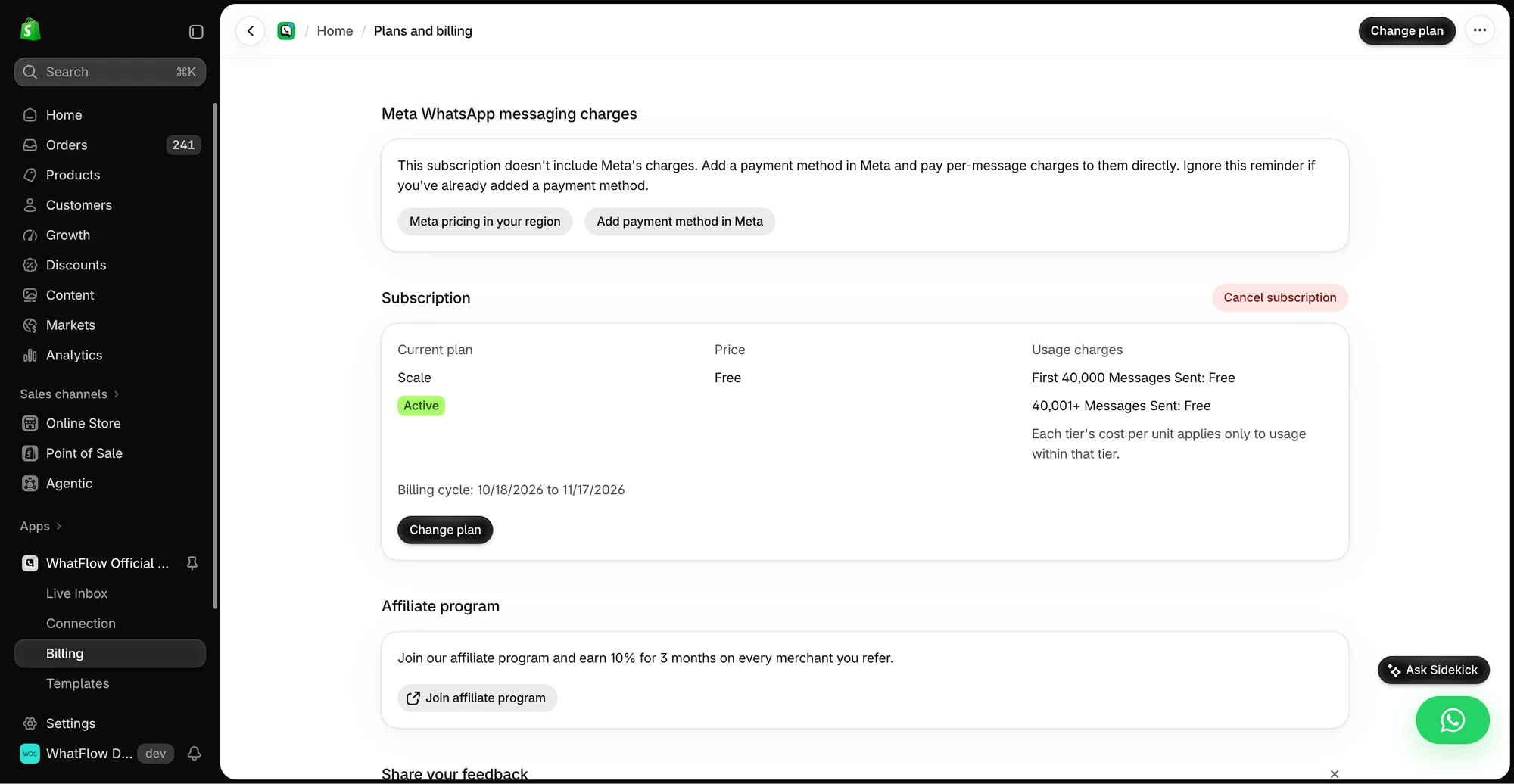
WhatFlow passes Meta's charges through with no markup, and Meta bills them separately from your app plan. Those 6,000 messages fit the Essential plan ($19 a month for 10,000), and every feature is on every plan, including Free. The WhatFlow pricing page has the country table and a calculator.
Paying Meta in euros
EUR is on Meta's list of billing currencies for the WhatsApp Business Platform. You pick the currency when the Messaging account is created, and Meta publishes a separate rate card per currency, so don't expect the USD figures above to convert exactly.
WhatFlow Billing in a demo store: Meta's messaging charges shown apart from the app subscription.
Local habits that change your WhatsApp setup
German templates, and maybe Austria and Switzerland
Write your templates in German using the de language code. Meta also lists de_AT and de_CH in its supported template languages if you sell into Austria or Switzerland and want regional versions. Pick du or Sie once and stick with it across email, site and WhatsApp. Du suits a casual fashion brand; a furniture or B2B shop probably wants Sie.
Shopify Payments supports Klarna for customers in Germany, including pay in 30 days and pay in 3 interest-free instalments, according to Shopify's Klarna page. If you offer pay-later, expect "When do I have to pay?" questions in chat. Save a reply that points to Klarna's own app rather than guessing their terms.
Returns: the 14-day right of withdrawal
EU consumers can cancel an online purchase within 14 days of delivery without giving a reason, as Your Europe explains. German shoppers know this. Have a saved reply that sends the returns steps and asks for the order number and a photo if something arrived damaged. The returns and exchanges guide has more examples.
Kein Problem, du kannst innerhalb von 14 Tagen nach Erhalt zurücksenden. Schick mir bitte deine Bestellnummer, dann bekommst du die Rücksendeschritte direkt hier.
What do GDPR and UWG §7 mean for WhatsApp marketing in Germany?
Two sets of rules apply: GDPR for the personal data, and the Act against Unfair Competition (UWG) for the advertising itself. This isn't legal advice, but here's how they fit a Shopify store's WhatsApp program.
UWG §7: prior express consent
§7(2) no. 2 UWG says advertising by automated calling machine, fax or electronic mail is always an unreasonable nuisance unless the recipient gave prior express consent. Is WhatsApp "electronic mail"? The law doesn't name it, but the IHK Region Stuttgart guidance counts SMS, MMS and messenger messages including WhatsApp, and says the advertiser carries the burden of proving consent. I'd plan on that basis.
§7(3) has an existing-customer exception (the Bestandskundenprivileg): you may advertise your own similar products to a customer whose address you got during a sale, if they haven't objected and you told them at collection and in every message that they can object at any time. The IHK guidance describes this exception for email only. I wouldn't build a WhatsApp program on it.
Double opt-in: prove consent on the channel itself
German practice is double opt-in: the person signs up, then confirms. The IHK Rhein-Neckar notes that courts have accepted double opt-in as proof of email consent, and that a double opt-in email doesn't prove consent for a different channel. So for WhatsApp, confirm on WhatsApp.
The cheapest way I know: after the checkout tick box, show a "Bestätige per WhatsApp" link that opens a chat with a pre-filled message. The customer sends it from their own phone. That proves they control the number, costs you nothing (it's an incoming message), and gives you a timestamped record.
JA, ich möchte Angebote von Nordlicht Studio per WhatsApp erhalten.
Then reply inside the window, as a free-form service message:
Danke, du bist dabei! Du bekommst etwa zweimal im Monat Angebote und Neuheiten von Nordlicht Studio. Mit STOP kannst du dich jederzeit abmelden.
GDPR: record it, and make leaving as easy as joining
Article 7 GDPR says you must be able to demonstrate consent and that withdrawing must be as easy as giving it. Keep the date, the source, the wording version and the confirming message. Private companies in Germany are mostly supervised by the data protection authority of their federal state, as the BfDI contact finder notes. Our GDPR and WhatsApp marketing consent checklist covers lawful bases, processors and privacy-notice wording; I won't repeat it here. Order updates sit on the contract basis, not consent.
WhatsApp's own opt-in rule
The WhatsApp Business Messaging Policy requires opt-in before you contact someone and says you must honour opt-outs made on or off WhatsApp. Meta's opt-in guidance adds that the opt-in must name your business and comply with local law. Put a way out in every marketing template:
Neu: unsere Wintermäntel, nur bis Sonntag mit kostenlosem Versand: [Link]. Keine Angebote mehr per WhatsApp? Antworte STOP.
What about the Impressum?
You'll read that a German WhatsApp profile "needs an Impressum". §5 DDG puts the Impressum duty on commercial digital services, which covers your shop. I didn't find a rule that adds anything WhatsApp-specific, so I won't invent one. The practical step: put your shop URL in the WhatsApp business profile so the Impressum is a tap away.
Setup checklist: WhatsApp for a German Shopify store with WhatFlow
WhatFlow WhatsApp Business API runs on the official Meta WhatsApp Cloud API and suits a two-person shop as well as a 50-person support team: a shared inbox with no seat fees, native Shopify Flow triggers and actions, and a 5.0/5 rating from 85 ratings on the Shopify App Store (checked November 24, 2026).
Connect with Embedded Signup. Install WhatFlow and run Meta's Embedded Signup from Shopify admin. The connection and billing doc walks through it.
Use a German number and your shop name as the display name, so customers recognise you. Check the sender in Connections.
Choose EUR billing at account creation if your books are in euros.
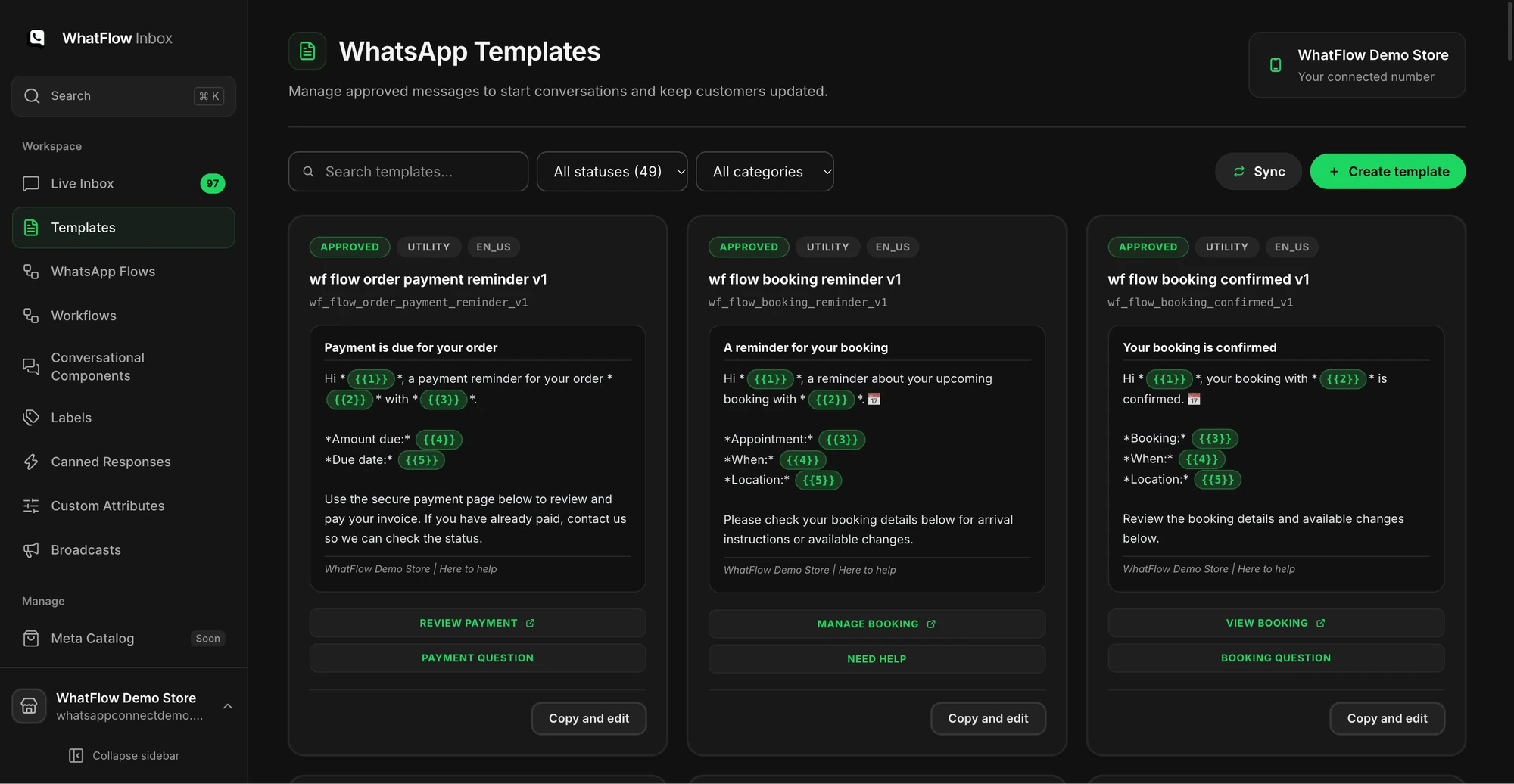
Write templates in German. Start in Template Library, edit in Message Editor, then check category and approval in Templates. Keep de_AT or de_CH versions only if you need them.
Pick one order update. Dispatch with tracking in Shipping Journey is where I'd start at German utility prices.
Build the double opt-in. A checkout tick box plus a pre-filled WhatsApp confirmation link, with a Shopify Flow workflow that tags the customer when the "JA" message arrives.
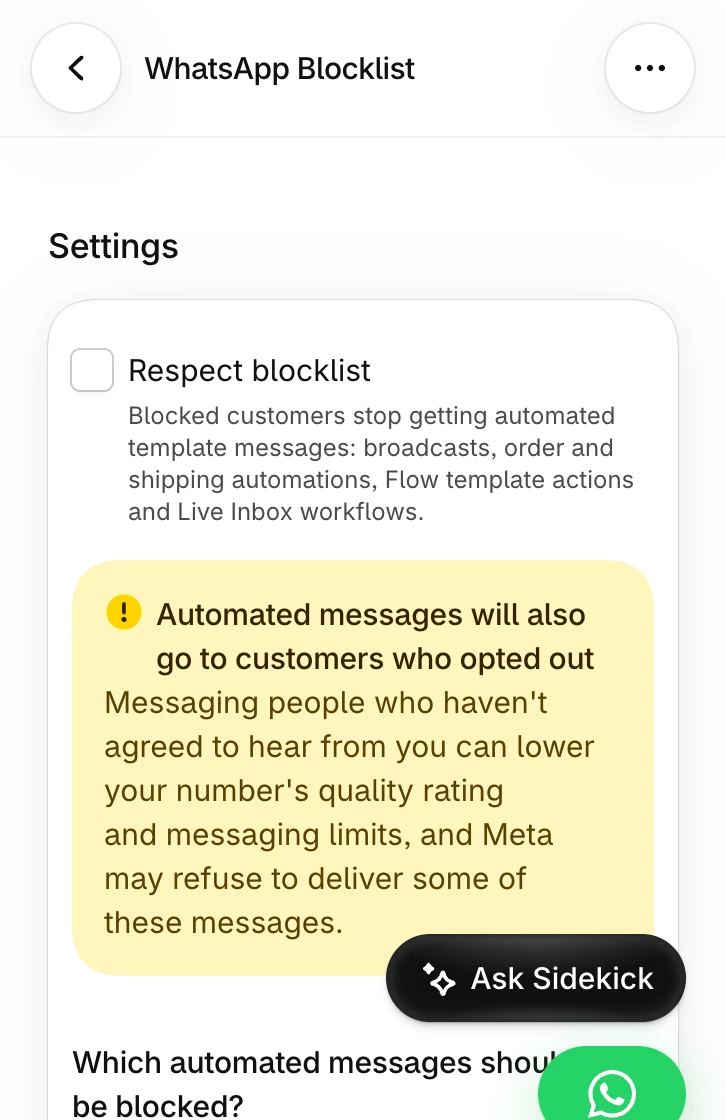
Turn on opt-out handling and the blocklist before your first campaign. The message controls doc shows where.
Keep consent records: tag, date, wording version and the confirming message.
Blocklist settings in a WhatFlow demo store, with the warning shown when suppression is off.
Template list in a WhatFlow demo store, filtered by language and approval status.
As volume grows, the WhatFlow team inbox handles assignment and filters, and Shopify Flow can route incoming messages and tag opt-ins automatically.
Run WhatsApp for your Shopify store with WhatFlow
Free plan available. Templates, COD confirmation, Shopify Flow automations and a shared team inbox with no seat fees. Every feature is included on every plan, including Free.
Build the double opt-in before anything else, because German marketing rules make everything else depend on it. Then add a chat button so customers come to you, and approve one German dispatch template. Leave campaigns until you have a confirmed list. Selling into Spain too? Read WhatsApp for Shopify in Spain, and for the UK rules see WhatsApp for Shopify in the UK.
Frequently asked questions
How much does a WhatsApp marketing message cost in Germany?
As of November 2026, Meta's USD list rate for a delivered marketing template to a German (+49) number is $0.1365. Utility and authentication templates cost $0.055, and service replies cost $0.055 after the first 1,000 free per business number each month.
Do I need consent to send WhatsApp marketing to German customers?
Yes. Under §7(2) no. 2 UWG, advertising by electronic mail without the recipient's prior express consent is always an unreasonable nuisance, and German chamber of commerce guidance treats messenger messages such as WhatsApp the same way. WhatsApp's own policy also requires an opt-in.
Can I use the existing-customer exception (Bestandskundenprivileg) for WhatsApp?
§7(3) UWG lets you email existing customers about similar products under strict conditions, but the IHK guidance I read describes that exception for email only. I wouldn't rely on it for WhatsApp; ask for explicit consent instead.
Does my WhatsApp Business profile need an Impressum?
§5 DDG sets the Impressum duty for commercial digital services, which covers your Shopify shop. I found nothing that adds a separate WhatsApp rule, so the practical step is putting your shop URL in the WhatsApp profile so the Impressum is one tap away.
Can I pay Meta for WhatsApp in euros?
Yes. EUR is one of the billing currencies Meta lists for the WhatsApp Business Platform as of November 2026. You choose it when the Messaging account is created.
Secondary source: treats SMS, MMS and messages such as WhatsApp as electronic mail, recommends double opt-in to prove electronic consent and puts the burden of proof on the advertiser.
Secondary source: courts have accepted double opt-in as proof of email consent, and a double opt-in email doesn't prove consent for a different channel such as the phone.