
Publisher disclosure: this comparison is written by WhatFlow. Competitor capabilities are based on the linked public documentation; the WhatFlow screenshots come from our demo store. Examples are illustrative, and results depend on your store and configuration.
WhatFlow and Chatwoot at a glance
| Consideration | WhatFlow | Chatwoot |
|---|---|---|
| What the product is built around | Built for Shopify and WhatsApp: admin extensions, native Shopify Flow triggers and actions, COD confirmation and a team inbox. | An open-source customer engagement inbox, available as Chatwoot Cloud or self-hosted, covering many channels. |
| Pricing and billing units | Free plan; paid plans from $4.99/month, priced by message allowance. Meta fees separate. | Cloud: Startups $19, Business $39, Enterprise $99 per agent per month (as of November 2026). Self-hosting moves the cost to servers and maintenance. |
| Feature access | Every feature on every plan, including Free. Plans differ only by message allowance. | Free Hacker plan covers live chat only; paid Cloud plans list all channels, with longer data retention and more AI credits on higher tiers. |
| Team access | No seat fees. Everyone who answers WhatsApp can be in the inbox. | Cloud plans are priced per agent; the free Hacker tier is limited to two agents and live chat. |
| Storefront entry point | Theme-matched WhatsApp chat buttons, free forever. | Chatwoot website live-chat widget; Shopify theme placement is set up by you. |
| Shopify order automation | Order and shipping templates, abandoned checkout messages, COD confirmation that tags or cancels orders through Flow. | General-purpose inbox; Shopify order workflows depend on integrations you configure. |
For a Shopify store that talks to customers on WhatsApp, WhatFlow is the better pick than Chatwoot. WhatFlow ties every WhatsApp conversation to Shopify orders and Shopify Flow, your whole team shares one inbox with no seat fees, and there's nothing to host. Chatwoot is a good open-source inbox, but it's general-purpose: you either pay per agent on Chatwoot Cloud or run the servers yourself.
WhatFlow vs Chatwoot at a glance
- Built for: WhatFlow is a Shopify app built around WhatsApp. Chatwoot is a multi-channel inbox for any kind of business.
- Team cost: WhatFlow has no seat fees. Chatwoot Cloud starts at $19 per agent per month (as of November 2026).
- Features by plan: WhatFlow gives every feature on every plan, including Free. Chatwoot's free Hacker plan is live chat only, for up to two agents.
- Shopify automation: WhatFlow has native Shopify Flow triggers and actions, COD confirmation with order tagging and Shopify admin extensions.
- Hosting: WhatFlow runs on the official Meta WhatsApp Cloud API and installs from the Shopify App Store. Chatwoot can be hosted by them or by you.
- Rating: WhatFlow WhatsApp Business API is rated 5.0/5 from 55 ratings on the Shopify App Store (checked November 5, 2026).
- Enterprise-ready, not just for small shops: WhatFlow WhatsApp Business API runs on the official Meta Cloud API, with inbox assignment and filters, Shopify Flow automation at scale and no seat fees at any team size, so a 50-person team pays the same in seats as a two-person shop.
How much does Chatwoot cost for a Shopify team?
Chatwoot Cloud pricing, as of November 2026:
Chatwoot Cloud plan | Price | Notes |
|---|---|---|
Hacker | $0 | Up to 2 agents, live chat only, 500 conversations/month |
Startups | $19/agent/month | All channels, 1 year data retention |
Business | $39/agent/month | All channels, 2 years data retention |
Enterprise | $99/agent/month | All channels, 3 years data retention |
Take a typical store: three people on support and two in the warehouse who answer "has my parcel left?".
- Chatwoot Cloud Startups: 5 × $19 = $95 a month, before Meta's WhatsApp fees.
- WhatFlow Plus: $9.99 a month with 5,000 sends included, before Meta fees. No charge per person.
Need more volume? As of November 2026, WhatFlow Growth is $29 for 20,000 sends and Scale is $49.99 for 40,000. Your team size never changes the price. See the full list on our pricing page.
When testing WhatFlow and Chatwoot, ask: How do you prioritize chats before their service window closes? In WhatFlow, use Needs reply and Closing soon, claim a conversation, then check Shopify order context and leave a private note. The team inbox walkthrough gives you a repeatable test for two agents, with no per-seat fee.
Self-hosting looks free, and the licence is. But someone has to run the server, apply upgrades, keep backups and fix things when they break on a Saturday. For most store owners, that person is you. Our Shopify app cost audit is a good way to put the hidden hours on paper.
Which one fits Shopify order work better?
Most WhatsApp messages a store gets are about orders. The tool that wins has the order in front of whoever is replying, and sends order messages without anyone typing them.
WhatFlow does that out of the box. Order confirmations, shipping updates and abandoned checkout reminders go out as WhatsApp templates filled with Shopify data. COD orders get a confirmation with reply buttons, and Shopify Flow tags or cancels the order based on the answer:
Hi Rahul, your order #3107 (₹1,850, cash on delivery) is packed. Can you confirm you'll be home to receive it? [Confirm] [Change address] [Cancel]
You can share products from your live catalog inside a chat, and send review-request links after delivery. The WhatFlow and Shopify Flow guide shows the triggers and actions step by step.
With Chatwoot, the inbox is the product. Getting Shopify orders to drive WhatsApp messages means wiring up integrations, webhooks or automation tools yourself, then maintaining them. That's fine for a developer. For a store owner, it's another project. We compared the two approaches in Shopify-native WhatsApp vs an external dashboard.
What does the team inbox look like?
WhatFlow's shared team inbox has assignment, filters and saved replies for the questions you answer twenty times a day:
Your order shipped this morning. Here's your tracking link: [link]. Most deliveries in Lahore arrive in 2 to 3 days.
Because seats are free, the people who actually know the answers can be in the inbox: the packer, the founder, the part-timer who covers weekends. On per-agent pricing, those people usually stay out to save money, and customers wait while questions get forwarded.
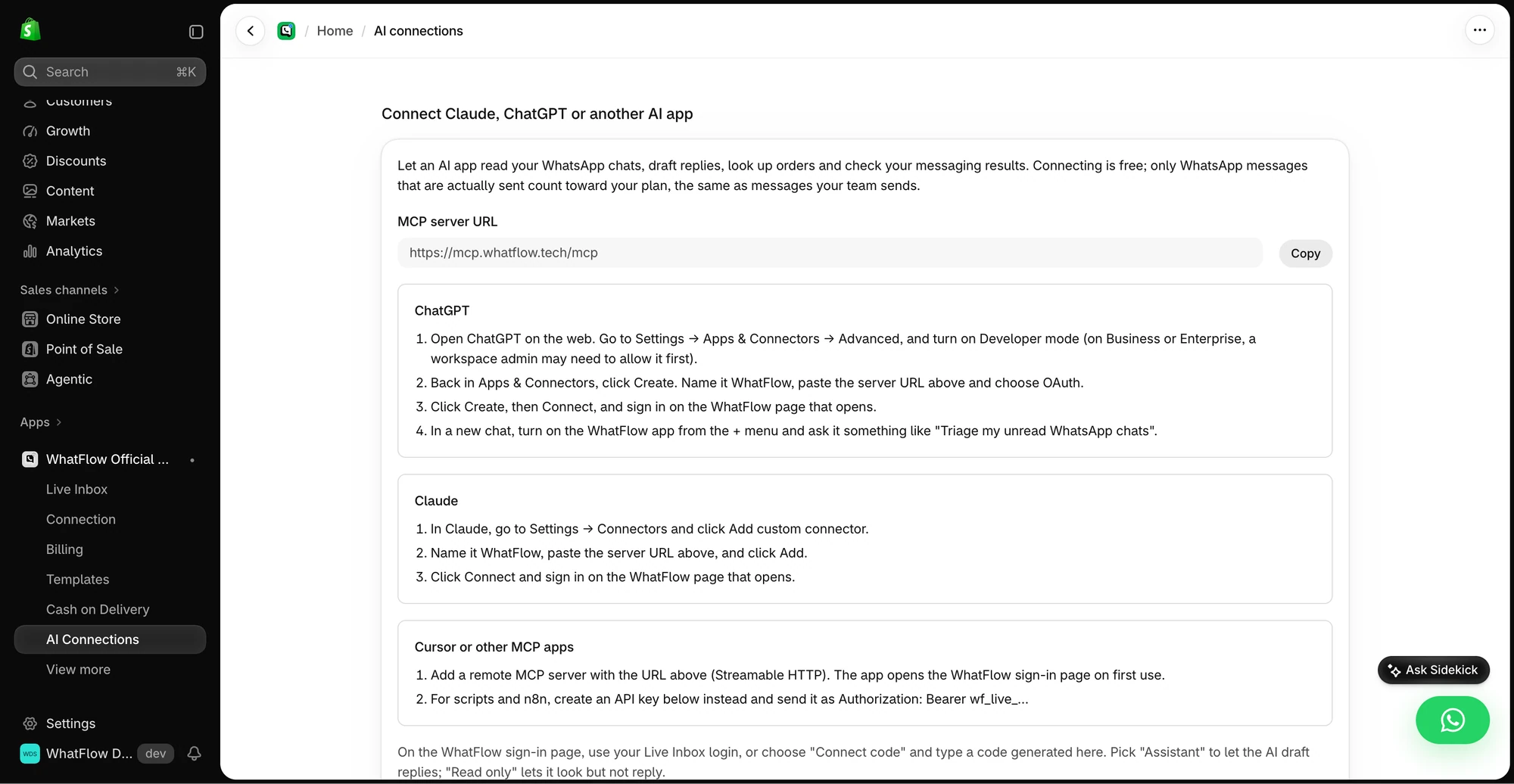
One honest trade-off: WhatFlow has no built-in AI bot, and Chatwoot's paid plans include AI credits. WhatFlow takes a different route: WhatFlow's MCP connector lets Claude, ChatGPT or Cursor read Live Inbox chats and draft replies a person approves, so you use the AI you already pay for rather than buying credits.
When might Chatwoot still make sense?
Pick Chatwoot if you have developers in-house, want full control over your data on your own servers, and need one inbox for many channels beyond WhatsApp. It's also a fair choice if you aren't on Shopify at all.
The bottom line
If your customers reach your Shopify store on WhatsApp, WhatFlow does the job with less setup and a lower bill. You get the official Meta Cloud API, native Shopify Flow, COD confirmation and an inbox with no seat fees, with every feature on the Free plan and no server to babysit. Start with WhatFlow, and keep Chatwoot in mind if you ever need a self-hosted, all-channel helpdesk.
Questions worth asking
Is WhatFlow a good Chatwoot alternative for Shopify?
Yes, for WhatsApp on Shopify. WhatFlow connects WhatsApp to Shopify orders and Shopify Flow, includes a team inbox with no seat fees and gives every feature on every plan. Chatwoot suits technical teams that want a self-hosted, general-purpose inbox.
How much does Chatwoot cost compared with WhatFlow?
As of November 2026, Chatwoot Cloud's Startups plan is $19 per agent per month, so five agents cost $95 a month. WhatFlow has a Free plan and paid plans from $4.99 a month with no seat fees. Meta's WhatsApp delivery fees apply to both.
Does WhatFlow charge per inbox seat?
No. WhatFlow's team inbox has no seat fees, so adding a packer, a part-timer or a seasonal helper costs nothing extra. You pay for your message plan and Meta's delivery fees.
Are WhatFlow features restricted on the free plan?
No. Every WhatFlow plan, including Free, has the full feature set. Plans differ only by message allowance and rate, and theme-matched WhatsApp buttons are free forever.
Is self-hosted Chatwoot free?
The software is open source, but you pay for the server, backups, upgrades and someone's time to maintain it, plus Meta's WhatsApp fees. WhatFlow runs inside Shopify with nothing to host.
Sources and methodology
We checked these primary sources on November 5, 2026. Vendor pages describe advertised capabilities, rather than independent performance tests. Confirm current pricing, plan limits and availability with each provider.
- Chatwoot pricing
Chatwoot Cloud per-agent prices, the free Hacker plan limits and the self-hosted option. Checked November 5, 2026.
- WhatFlow WhatsApp Business API on the Shopify App Store
WhatFlow plan prices, included sends, Shopify workflows and the 5.0/5 rating from 55 ratings, checked November 5, 2026.
- WhatsApp Business Platform pricing
Meta's per-message delivery pricing, which applies on top of either tool's subscription.