WhatsApp for Shopify stores in Morocco: costs, COD and rules (2026)
Meta's WhatsApp rates for Morocco, a worked COD month, Darija and French templates, and what Loi 09-08 and the CNDP require before you send promotions.
WhatsApp for Shopify in Morocco costs $0.023 per delivered utility template (order and COD confirmations, shipping updates) and $0.0414 per marketing template to a +212 number, as of November 2026, on Meta's official WhatsApp Business Platform. For a Moroccan store, the job is confirming paiement à la livraison orders before dispatch, writing in Darija and French, and following Loi 09-08: prior consent for promotions and a declaration to the CNDP.
I'm Safwan, co-founder of WhatFlow. The Moroccan merchants I talk to who run cash on delivery worry about one thing above all: parcels coming back. This guide puts numbers on the messaging side and covers the legal side with the actual text of the law.
How much does WhatsApp for Shopify cost in Morocco?
Meta charges per delivered template, priced by category and by the recipient's country code. A template is a message Meta approved in advance; you need one to start a conversation and for anything sent outside the 24-hour customer service window (the 24 hours after a customer last messaged you). Inside that window you can reply freely with service messages.
Meta's USD rates for Morocco, effective October 1, 2026 and current as of November 2026:
OTPs from very large senders based outside Morocco
$0.0811
Service message
Free-form reply in the window, after 1,000 free per number per month
$0.023
Since October 1, 2026, service replies are free only for the first 1,000 per business phone number each month, and utility templates sent inside an open service window are charged too. Details are in Meta's pricing doc.
Ignore the authentication-international row unless you're huge. Meta applies it only when your business is based in a different country from the customer and you send more than 750,000 qualifying messages to these markets in a rolling 30 days. A Casablanca store sending OTPs to Moroccan buyers pays $0.023.
Worked example: a COD month for a caftan store
Say you sell caftans and djellabas from Casablanca, ship 800 orders a month, and most are paid on delivery.
One Eid campaign to 2,000 opted-in customers: 2,000 × $0.0414 = $82.80
2,200 service replies about sizes and delivery: 1,000 free, then 1,200 × $0.023 = $27.60
Meta total: $165.60, or about $0.069 in utility messages per COD order
Look at the ratio. In Morocco a utility template costs more than half a marketing template, which is unusual; in Colombia it's closer to a fifteenth. So be picky. The COD confirmation earns its $0.023 every time, because a refused parcel costs you two courier trips. A "your order is being prepared" message usually doesn't. I'd run confirmation, out-for-delivery and delivered, and drop the rest.
Click-to-WhatsApp ads help here. When a chat starts from one of those ads and you reply inside the service window, Meta opens a free entry point window that may stay open for up to 7 days, with no Meta charges for your messages to that buyer. If your sales start from Instagram or Facebook ads, that's real money; free entry window vs the 24-hour window explains how it works.
Meta doesn't list MAD as a billing currency, so expect to pay Meta in USD or another supported currency. WhatFlow passes Meta's charges through with zero markup, and your app plan is separate: the 4,400 templates above fit the Plus plan ($9.99 a month for 5,000). The WhatFlow pricing page has the country table and a calculator.
Why COD confirmation matters so much in Morocco
I can't give you a reliable COD percentage for Morocco; published estimates disagree wildly. The US International Trade Administration's Morocco ecommerce guide says cash on delivery "remains a significant portion of online e-commerce transactions" while cards are increasingly used.
In Shopify, COD is a manual payment method, and those orders sit as payment pending until you mark them paid. A COD confirmation is a utility template sent right after the order asking the buyer to confirm or cancel before dispatch. Imagine a buyer who orders three caftans at midnight to choose one at the door. Without a confirmation you ship all three and two come back. With one, your team spots it and calls before the courier does.
Meta's template language list includes Arabic (MAR), code ar_MA, and French (MAR), code fr_MA. I'd keep two versions of every order template, one in each, and send whichever matches the language the customer used at checkout or in their first message. WhatFlow templates are language-agnostic, so both versions live under the same template.
Darija is a spoken language people also text in, so many shoppers will reply in Darija written in Arabic script or in Latin letters ("salam, wach kayn L?"). Templates written in a friendly Darija tone tend to read more naturally than formal Modern Standard Arabic. The samples below are simple on purpose; have a native speaker check them before you submit them to Meta.
COD confirmation, Darija (Arabic script):
السلام نادية، شكرا على الطلبية ديالك رقم #3051: 2 قفاطن، 640 درهم، الخلاص عند التوصيل فالدار البيضاء. واش نصيفطوها ليك؟ ضغطي على "تأكيد" ولا "إلغاء".
Buttons: تأكيد / إلغاء.
The same message in French:
Bonjour Nadia, merci pour votre commande n°3051 : 2 caftans, 640 DH, paiement à la livraison à Casablanca. On vous l'envoie ? Touchez « Confirmer » ou « Annuler ».
Buttons: Confirmer / Annuler.
Out for delivery, in French:
Nadia, votre commande n°3051 est en route. Le livreur vous appellera aujourd'hui. Merci de préparer 640 DH.
A saved reply for the "wach kayn?" question in Darija:
مرحبا! هاد الموديل كاين فالمقاسات M و L. بغيتي نصيفط ليك الصور؟
Right-to-left tips: put order numbers and links on their own line at the end, keep button labels to one word, and never mix an Arabic and a French sentence in one template. Preview on a real phone. Multilingual customer messaging on Shopify covers routing chats by language in a small team.
What does Morocco's data protection law say about WhatsApp marketing?
This isn't legal advice. Here's what Loi n° 09-08 (promulgated by Dahir 1-09-15 of February 18, 2009) says, from the Justice Ministry's consolidated text, as of November 2026. The regulator is the CNDP, the Commission nationale de contrôle de la protection des données à caractère personnel.
Consent, with sensible exceptions (Art. 4). Processing needs the person's unambiguous consent, unless it's needed to perform a contract with them, among other exceptions. Sending a COD confirmation for an order the customer placed fits the contract exception; a promotion doesn't.
Tell people at collection (Art. 5). Your identity, the purposes, who receives the data, their rights of access and correction, and the reference of your CNDP declaration receipt.
Free opt-out from marketing (Art. 9). Anyone can object, free of charge, to their data being used for prospecting.
Direct marketing needs prior consent (Art. 10). Direct marketing by automated calling, fax, email "or a means using a technology of the same nature" to someone who hasn't consented in advance is banned. There's one exception: you collected the contact directly during a sale, you're promoting similar products, and you offer a simple, free opt-out at collection and in every message. You must also identify yourself and give a valid way to stop the messages.
Declare before you process (Art. 12). Processing personal data needs a prior declaration to the CNDP, and sensitive data needs prior authorization.
Transfers abroad (Arts. 43 and 44). Data can go only to countries with sufficient protection, unless an exception applies, such as the person's express consent or performance of a contract with them. Shopify and Meta store data outside Morocco, so this applies to you.
The law doesn't name WhatsApp. The CNDP's guidance on direct marketing talks about "different forms of electronic messaging (sms, email,…)", and I'd treat WhatsApp the same way. That guidance says you need the recipient's prior consent and a CNDP declaration made before the processing starts. It also quotes Article 59: processing someone's data for marketing despite their objection can bring three months to a year in prison and a fine of 20,000 to 200,000 DH.
J'accepte de recevoir les offres de [Boutique] sur WhatsApp. Je peux me désabonner à tout moment en répondant STOP.
Setting up WhatFlow for a Moroccan Shopify store
WhatFlow WhatsApp Business API runs on the official Meta WhatsApp Cloud API and is rated 5.0/5 from 85 ratings on the Shopify App Store (checked November 24, 2026). Every feature is on every plan, including Free, and the team inbox has no seat fees, which matters when you've got four people confirming orders by hand during Eid.
Connect through Meta Embedded Signup from Shopify admin, using a +212 number and your store name.
Create ar_MA and fr_MA utility templates for COD confirmation, out for delivery and delivered.
Set COD rules. Pick the manual payment method WhatFlow manages, choose COD shipping rates if you use them, and preview eligible checkouts.
Turn on COD confirmation. Confirm and Cancel replies can tag or cancel the Shopify order through Shopify Flow, so the warehouse sees only confirmed orders.
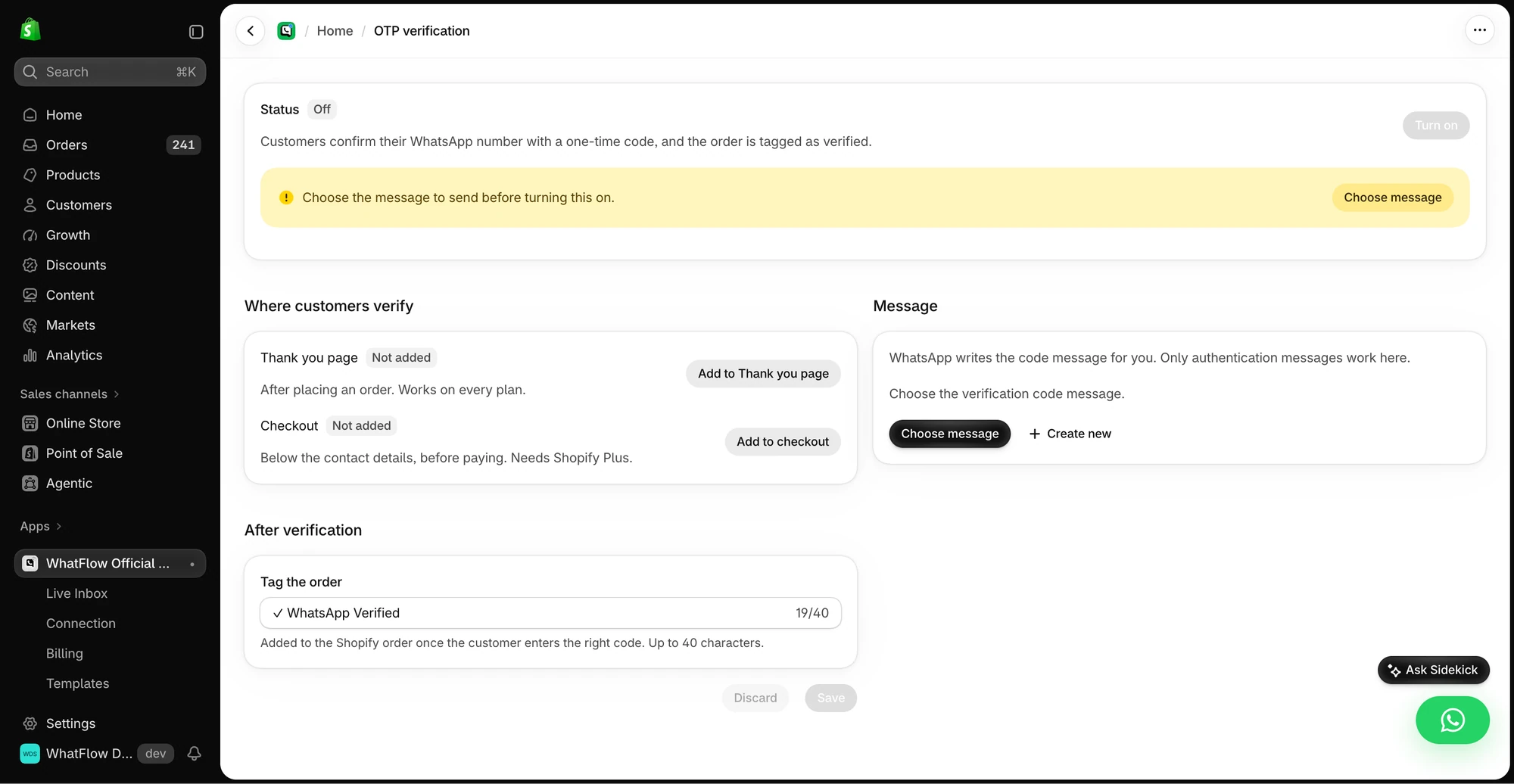
Add OTP verification if you get fake orders. WhatFlow tags the order after a correct code; a verified phone shows access to the number, so still keep a dispatch rule.
Use FlowSense for a second look at COD orders that may need checking. A flag means "check this", not "fraud".
Route chats by language in the shared inbox with assignment and labels, and use opt-outs and the blocklist for STOP replies.
WhatFlow demo store: OTP placement options and the Shopify order tag. Sample data, nothing sent.
Free plan available. Templates, COD confirmation, Shopify Flow automations and a shared team inbox with no seat fees. Every feature is included on every plan, including Free.
Get the COD confirmation live in Darija and French first; at $0.023 it pays for itself the first time it stops a parcel that would have come back. File your CNDP declaration and fix your opt-in before the next Eid campaign. If you also sell to France, the France guide covers rates and consent rules there.
Frequently asked questions
How much does a WhatsApp message cost in Morocco?
As of November 2026, Meta charges $0.0414 per delivered marketing template to a Moroccan (+212) number and $0.023 per utility or authentication template. Service replies cost $0.023 after the first 1,000 free per business number each month.
Do I need consent to send WhatsApp promotions in Morocco?
Yes. Article 10 of Loi 09-08 bans direct marketing by email and similar technologies to people who haven't given prior consent, with a narrow exception for existing customers buying similar products who are offered an easy opt-out.
Do I have to declare my customer database to the CNDP?
Yes, as a rule. Article 12 of Loi 09-08 requires a prior declaration to the CNDP for processing personal data, and prior authorization for sensitive data. The CNDP's own guidance says marketing processing must be declared before it starts.
Which language should WhatsApp templates use in Morocco?
Many stores keep two versions: Arabic, often in Darija, and French. Meta lists Arabic (MAR), code ar_MA, and French (MAR), code fr_MA, as template languages.
Is cash on delivery common for online shopping in Morocco?
The US International Trade Administration's Morocco guide says cash on delivery remains a significant portion of online transactions, while card use is growing. It gives no percentage, and published estimates vary widely.
Morocco is scheduled for authentication-international rates from October 1, 2026; the rate applies only to very high-volume senders based in another country.
Official consolidated text (Dahir 1-09-15 of February 18, 2009): consent (Art. 4), information (Art. 5), opposition (Art. 9), direct marketing (Art. 10), declaration to the CNDP (Art. 12) and transfers abroad (Arts. 43 and 44).
CNDP guidance: prior consent plus a prior CNDP declaration for marketing, the existing-customer exception, the right to object free of charge, and Article 59 penalties.