Good WhatsApp business etiquette comes down to four habits: write like a helpful person rather than a ticket system, keep messages short enough to read on a phone, use emoji and voice notes only when the customer has set that tone, and respect the clock when you start a conversation. Get those right and customers forgive a lot.
I'll go through each, with before-and-after examples, then give you a one-page team cheat sheet at the end.
What does good WhatsApp business etiquette look like?
Think of how a good shop assistant talks to a regular. Friendly, specific, quick to the point, never sloppy with the facts. WhatsApp sits in the same app as people's friends and family, so a corporate tone stands out, and not in a good way. But it's still your business talking, so overly casual ("heyyy 😂 lemme check") makes people wonder whether their order is in safe hands.
The sweet spot is warm and precise.
Before:
Dear Customer, we acknowledge receipt of your query regarding order 5521. Kindly be informed that the same shall be processed in due course.
After:
Hi Ahmed, thanks for messaging. I've found order #5521. It's packed and will go out with the courier tomorrow morning, and you'll get the tracking link here on WhatsApp.
Same information. One sounds like a person.
Tone: match the customer, one step calmer
Mirror the customer's formality, then sit slightly calmer than them. If they write "Good afternoon, I'd like to enquire…", don't reply "hey!". If they write "hiii is this in stock 😍", you can loosen up.
A few rules I'd put in any store's guide:
Use their name once, near the start. Not in every message.
Use your first name. "It's Sara from the team" at the start of a conversation makes a shared inbox feel human, and it makes handovers obvious.
Say "I" when you're doing something ("I've checked", "I'll send"). "We" is for policies.
Drop the filler. "Kindly", "please be informed", "do the needful", "as per". They add length and distance.
Don't over-apologise. One sincere sorry beats three reflexive ones.
Message length: one screen, one job
Most people read WhatsApp on a phone, often between other things. A good reply fits on one screen and does one job: answer, ask, or confirm.
If you've got three pieces of information, send one message with three short lines, not three separate messages that buzz their phone three times. And not one dense paragraph either.
Here's where it stands:
Order #2210 left the warehouse today.
Courier: Aramex, tracking AR7781203.
Expected delivery: Thursday or Friday.
Line breaks are your friend. Bullets work in WhatsApp too, and so does bold (asterisks) for one key detail like a date.
Emoji: when they help and when they hurt
Emoji do a real job on WhatsApp. They soften a short message that would otherwise read as curt. "Done 👍" reads friendlier than "Done."
But they backfire in the wrong place. My rule of thumb:
Situation
Emoji?
Customer used emoji, friendly product question
Yes, one
Order confirmation or "it's shipped"
Fine, one
Complaint, delay, damaged item
No
Refunds, payments, COD disputes
No
Health, skincare reactions, allergies
No
First message to a brand-new customer
Usually no
Stick to the obvious ones (🙂 👍 🙏 🎉). Skip anything that might read differently across cultures or age groups. And never use emoji as the whole reply to a question.
Voice notes: handle with care
In plenty of markets (the Gulf, India, Brazil, Indonesia) customers send voice notes all the time. It's normal, and you shouldn't make them feel odd about it. Reply in text by default anyway, for three reasons: the customer can skim text, your team can search it later, and a written answer is a record.
When a voice note from you does make sense:
the customer sent one and clearly prefers talking
you're explaining something physical ("how to fit the strap", "how to layer the serum")
the customer is upset and a warm voice would help more than text
Keep it under a minute, and follow up in text with the key facts:
Just to put it in writing: return the jacket in the original bag, use the label inside the box, and your exchange ships as soon as the courier scans it.
Don't ever send a voice note with an order number, a price or a date that isn't also in text.
Timing: when to reply and when to start a conversation
There are two very different things here.
Replying to a message the customer just sent is fine any time you're working. If they messaged at 11pm and you happen to be up, a reply is welcome. If you're closed, an away message that sets expectations is better than silence. We've written up WhatsApp away message examples for business hours if you need wording.
Starting a conversation is different. A promotional broadcast at 11pm is intrusive. Schedule business-initiated messages for daytime in the customer's own time zone, avoid prayer times and major religious holidays in markets where that matters, and don't stack reminders. Our guide on how often to message customers goes deeper.
There's also a platform rule behind this. On the WhatsApp Business API, once 24 hours pass after the customer's last message, the business can only start a conversation with a Meta-approved template message. The 24-hour customer service window explainer covers it in plain English, and Meta's pricing page has the current charges as of November 2026.
In WhatFlow Team Inbox, Needs reply shows open conversations where the customer wrote last. Closing soon helps staff prioritize the service window. Claim a thread before replying, check the Shopify order if the phone number matches, and leave an internal note when the next shift needs to pick it up. The agent walkthrough shows how that handoff works.
Read receipts and the "seen but no reply" problem
Customers can see blue ticks. If you open a message you can't answer yet, send a holding reply straight away:
Got it, checking with the warehouse now. Back to you within the hour.
It's two seconds of typing and it removes the worst feeling in customer service: being ignored by someone who's obviously there.
Asking for personal details
Ask only for what you need, and say why. "Can you confirm the postcode on the order so I know I've got the right one?" is fine. Never ask for card numbers, CVVs or one-time passwords in chat. The WhatsApp Business Messaging Policy says businesses shouldn't ask people to share full payment card numbers, and keeping your chats clean of those requests makes scams that impersonate your store easier for customers to spot.
Ending a conversation
Don't leave it hanging, and don't drag it out. Close with what happens next and an open door:
All sorted. Your exchange ships tomorrow and you'll get tracking here. Anything else, just message this number.
Skip the "Is there anything else I can help you with today?" script if the customer has clearly finished. Asking for a review right after a support issue is usually a mistake, too. Wait until the product has been used.
A team cheat sheet
If more than one person answers your WhatsApp, write the etiquette down. Here's a version to paste into your customer service playbook:
Introduce yourself by first name in the first reply.
Reply to every read message, even if only with a holding reply.
One screen per message. Use line breaks.
Emoji: max one, never in complaints, money or health.
Text by default. Voice notes only if the customer started it, plus a text summary.
No business-initiated messages before 9am or after 8pm customer time.
Never ask for card details or OTPs.
Close with the next step.
In WhatFlow, the best way to keep this consistent is through saved replies. Write your approved openings, holding replies and closings once, and anyone in the shared inbox can drop them in and adjust them. Because WhatFlow's team inbox has no seat fees, there's no reason the part-timer who covers weekends shouldn't have the same replies as everyone else.
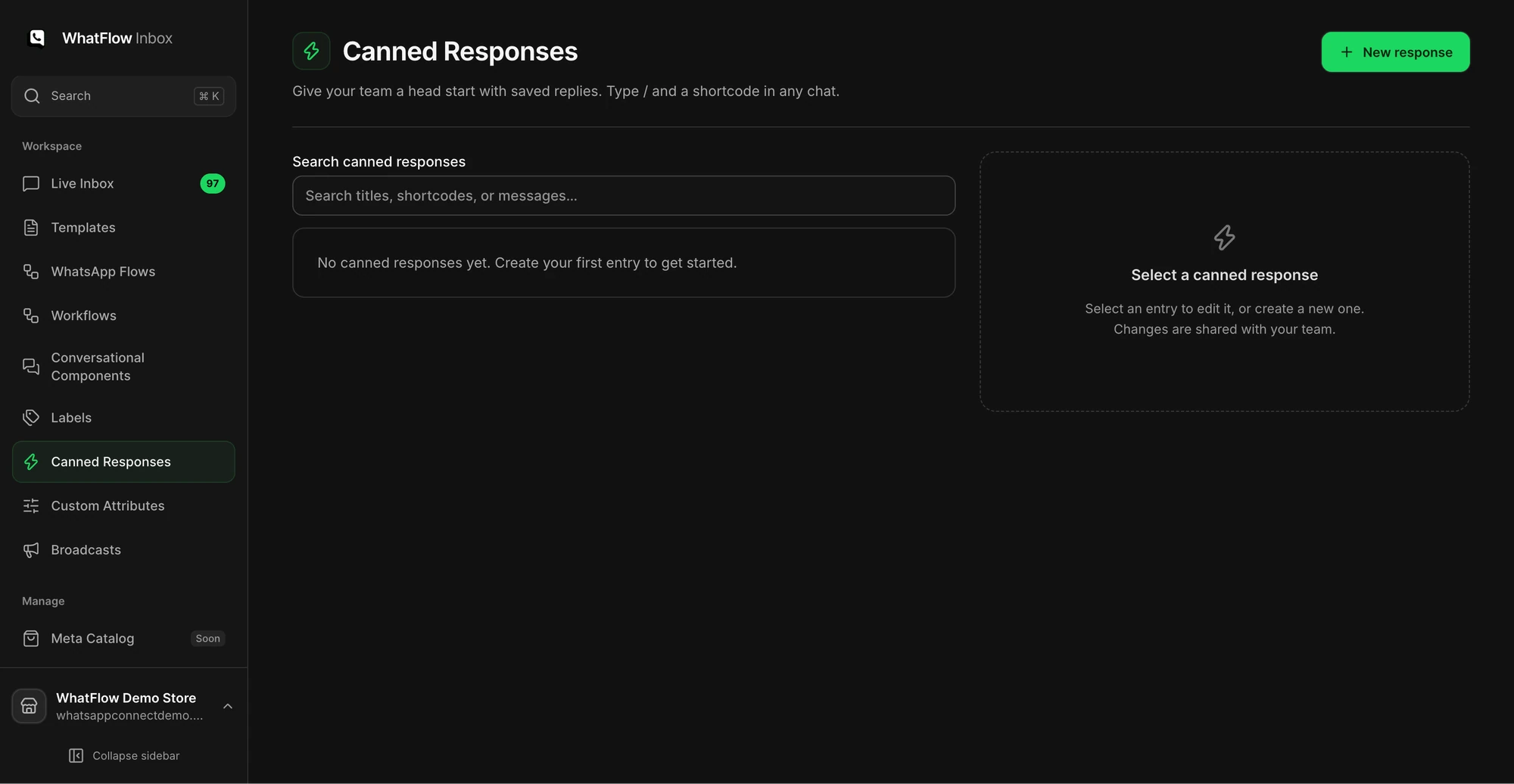
The Canned Responses screen is where a support team manages reusable replies.
Free plan available
Run WhatsApp for your Shopify store with WhatFlow
Templates, COD confirmation, Shopify Flow automations and a shared team inbox with no seat fees. Every feature is included on every plan, including Free.
Customers don't remember a perfectly phrased message. They remember that your store always answered, always used their name, and never made them chase. Pick your rules, write them down, and stick to them across everyone who touches the chat.
Frequently asked questions
Is it professional to use emoji in WhatsApp customer service?
Yes, in moderation. One emoji that matches the customer's tone is fine in a friendly chat; skip them entirely in complaints, refunds and anything involving money or health.
Should a business send voice notes on WhatsApp?
Only when the customer sent one first or asked for one, and keep it under a minute. Follow up with a short text summary so the key details are searchable.
Is it rude to message customers late at night on WhatsApp?
Replying to a message the customer just sent is fine at any hour. Starting a conversation late at night, like a promotion or a reminder, usually isn't, so schedule business-initiated messages for daytime in the customer's time zone.
Should support agents sign their name on WhatsApp?
Yes. A first name at the start of a conversation tells the customer a real person is helping, and it makes handovers inside a team clearer.