Yes, you can offer incentivized reviews in the US, as long as the reward doesn't depend on what the review says. The FTC's review rule bans incentives conditioned, openly or by hint, on sentiment, and the FTC expects the incentive to be disclosed. Google is stricter: incentivized reviews aren't allowed on Google Maps at all. In the EU, you must explain how you verify reviews.
That's the short version. The long version matters because the difference between a legal incentive and an illegal one is often a single word in your review request. "Leave an honest review and get 10% off" can be fine. "Tell us why you love it and get 10% off" isn't. Let's go through what each set of rules says, then I'll show you wording I'd actually send on WhatsApp.
This isn't legal advice. If you're running anything unusual, like paying for video testimonials or using reviews in paid ads, talk to a lawyer where you sell.
What is an incentivized review?
An incentivized review is a review written after the business offered the customer something of value for writing it: a discount code, loyalty points, a free sample, entry into a prize draw, or cash. The incentive is the issue, not the review. A genuine customer can write a genuinely honest review and it's still "incentivized" if you paid them something for it.
What does the FTC's 2024 review rule say?
The FTC announced its final rule on fake reviews and testimonials on August 14, 2024, and it came into force in October 2024. It applies to businesses, not to the customers who write reviews. In plain terms, it prohibits:
Fake reviews and testimonials, including AI-generated ones, and buying or spreading reviews you knew or should have known were fake.
Incentives conditioned on sentiment. You can't offer compensation that depends on the review being positive, or negative about a competitor.
Undisclosed insider reviews. Reviews by staff, managers or their relatives need a clear disclosure of the connection.
Company-controlled "independent" review sites that claim to be neutral while reviewing your own products.
Review suppression through baseless legal threats, intimidation or false accusations, or claiming your displayed reviews are all of them when you've filtered out the negative ones.
Fake social media indicators, like bought followers or views used to misrepresent influence.
The FTC's questions and answers page is where the useful detail lives. Three points every store owner should know:
Incentives aren't banned by the rule. What's banned is an "express or implied requirement" that the review express a particular sentiment. The FTC's own example of an implied condition is a coupon offered to customers who tell you how much they loved their visit.
A disclosure doesn't rescue a sentiment-based incentive. Paying for 5-star reviews is a violation even if the reviewer discloses the payment.
Undisclosed incentives can still be a problem under the FTC Act and the Endorsement Guides, even when they're not conditioned on sentiment.
This isn't theoretical. In December 2025 the FTC sent warning letters to 10 companies about possible violations, and the same release puts civil penalties at up to $53,088 per violation.
Is review gating allowed?
Review gating means asking customers how their experience was first, and only sending the review link to the happy ones. It's common, and lots of tools make it easy.
The FTC's rule doesn't contain a specific ban on it. But the FTC's Q&A says the practice could still violate the FTC Act, and its guide for marketers says plainly not to ask for reviews only from customers you think will leave positive ones. Google goes further and prohibits selectively soliciting positive reviews.
My view: don't gate. Ask everyone the same way. You can (and should) still follow up with unhappy customers to fix their problem, and the FTC says contacting customers to resolve issues isn't prohibited. Just don't make the review link conditional on the answer. A clear review moderation policy helps you apply the same rules to good and bad reviews once they're in.
What do Google and other platforms allow?
Platforms set their own rules, and they're often stricter than the law.
Google. Google's Maps content policy says reviews posted because a business offered an incentive aren't allowed and will be removed. That covers payments, discounts and free goods or services. Businesses also can't discourage negative reviews or selectively ask for positive ones. Asking for genuine reviews is fine as long as there's no incentive and no attempt to influence the rating.
So the same 10%-off offer might be acceptable for a review on your own Shopify product page (with a disclosure) and banned for a Google review of your store. Never send one incentive message with both links in it.
Marketplaces. If you also sell on Amazon, Etsy or similar, read their review policies before you offer anything. Many marketplaces restrict incentives far more than the FTC does.
What about EU rules on reviews?
EU consumer law, updated by Directive (EU) 2019/2161 (often called the Omnibus Directive), requires traders who publish consumer reviews to tell people whether and how they make sure those reviews come from real customers. The EU's Your Europe summary puts it simply: traders publishing reviews must disclose how they ensure reviews were submitted by real consumers who bought the product, and they can't pay for fake reviews or alter customer reviews.
Regulators check this. A Commission-coordinated sweep of 223 websites found that in 144 cases, authorities couldn't confirm the traders were doing enough to make sure reviews were authentic.
For a Shopify store selling into the EU, that means a short, honest note near your reviews (or on a linked page): reviews are collected from verified buyers via your review app, whether you publish negative ones, and whether any were written in exchange for an incentive.
Safe vs risky incentive wording
Wording
Verdict
Why
"Leave an honest review, good or bad, and get 10% off your next order."
OK on your own site, with disclosure
Not conditioned on sentiment
"Every review enters our monthly draw for a $50 gift card."
OK on your own site, with disclosure
Same reward whatever the rating
"Tell us what you love about it and get 10% off."
Not OK
Implies the review must be positive
"Leave a 5-star review and we'll send a free gift."
Not OK
Explicitly conditioned on rating
"Review us on Google and get free shipping."
Not OK on Google
Google bans incentivized reviews
"Happy with your order? Leave a review! Not happy? Reply here."
Risky
Routes only satisfied customers to the review link
And the disclosure itself can be a single line shown with the review, which most review apps can display: "This reviewer received a 10% discount code for leaving an honest review."
WhatsApp review-request messages that stay compliant
Here's what I'd send through a review-request workflow. These go out as templates because they're sent days after delivery, outside the 24-hour customer service window, and only to customers who've opted in.
No incentive (my default):
Hi {{1}}, your Linen Throw arrived a week ago. Would you share an honest review? Good or bad, it helps other shoppers and it helps us improve. It takes about a minute: {{2}}
With an incentive, unconditional and disclosed:
Hi {{1}}, how's the Linen Throw? If you leave an honest review, whatever your rating, we'll send you a 10% code for your next order as a thank-you. Reviews that received this code are marked on our site. Leave yours here: {{2}}
Following up on a problem (separate from the review request):
Hi {{1}}, sorry to hear the throw arrived with a pulled thread. Could you send a photo? We'll send a replacement or refund, your choice.
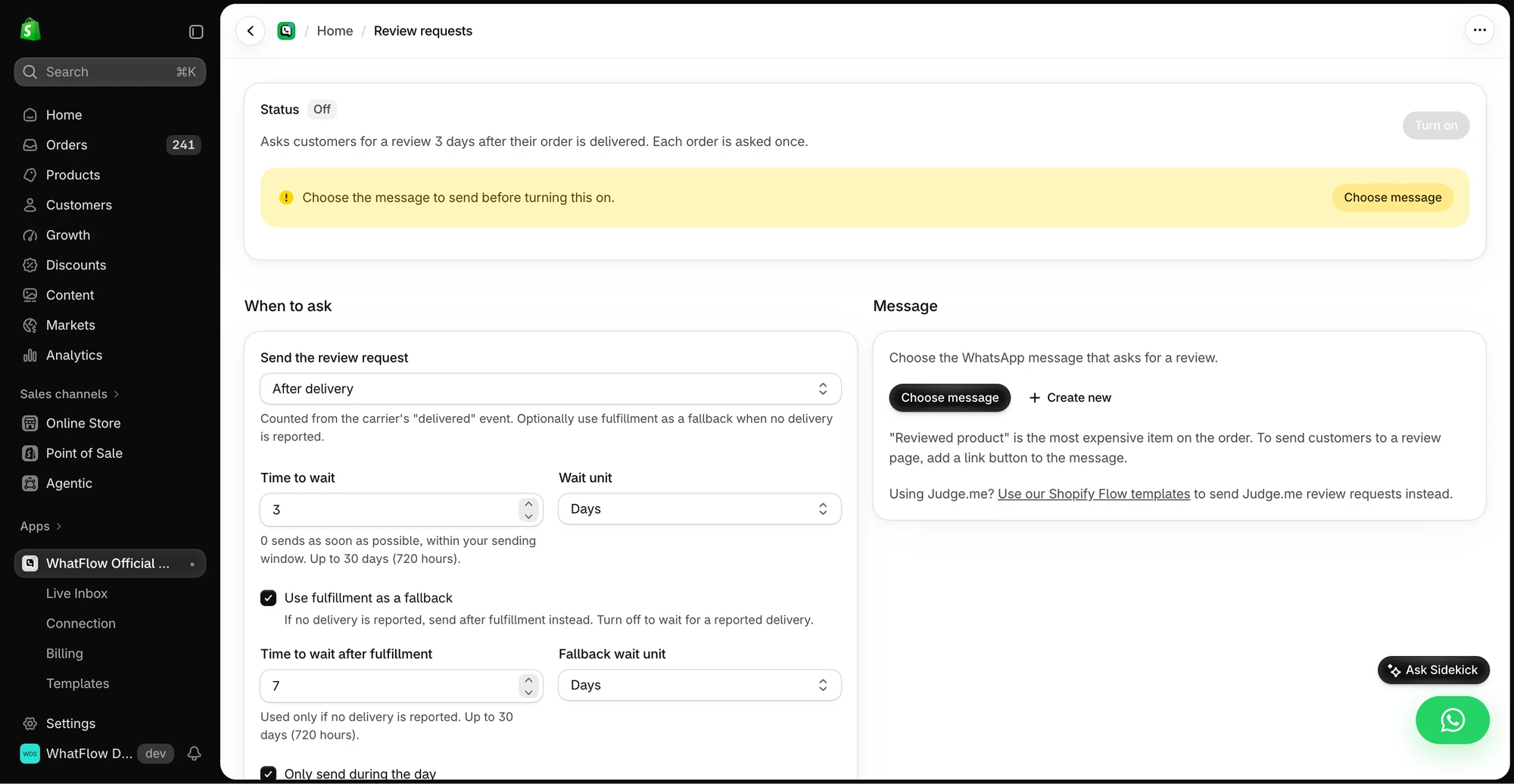
WhatFlow's review-request workflow sends a WhatsApp message with a link to your review app's form. It doesn't decide who's happy, and I'd keep it that way: trigger it from Shopify Flow for every fulfilled order after a set delay, with the same message for every customer. If a customer replies with a complaint instead, it lands in the shared team inbox where someone can fix it.
The review request setup shows delivery timing and the option to use fulfillment as a fallback.
You can build the template in WhatFlow's template editor, and the whole thing is available on every plan, including Free. Meta's per-message template charges are separate.
Free plan available
Run WhatsApp for your Shopify store with WhatFlow
Templates, COD confirmation, Shopify Flow automations and a shared team inbox with no seat fees. Every feature is included on every plan, including Free.
If the reward would change depending on what the customer writes, don't offer it. If it wouldn't, disclose it, keep it off Google, and ask everyone the same way.
Frequently asked questions
Are incentivized reviews legal in the US?
Offering an incentive for a review isn't banned outright by the FTC's Consumer Reviews and Testimonials Rule. What's banned is conditioning the incentive, expressly or by implication, on the review being positive or negative, and the FTC says incentivized reviews should disclose the incentive.
Can I offer a discount for a 5-star review?
No. Tying a reward to a particular rating or sentiment is exactly what the FTC rule prohibits, and adding a disclosure doesn't fix it.
Can I give a discount for leaving a Google review?
No. Google's Maps user-generated content policy says reviews posted because a business offered an incentive aren't allowed and will be removed, whatever the rating.
Is it OK to only ask happy customers for reviews?
It's risky. The FTC rule has no specific ban on it, but the FTC says the practice can still be deceptive under the FTC Act, its marketer guide says not to do it, and Google prohibits selectively soliciting positive reviews.
Do EU rules cover incentivized reviews?
EU consumer law requires traders who publish reviews to tell consumers how they make sure reviews come from real customers, and bans fake reviews. If your reviews include incentivized ones, say so in that explanation.